
Two weekends ago, after a 3-person, 4-phone, 2-state, text-message, voicemail, super game of Telephone with Ms. Darling and her family, to ensure that she would return in time to the green mountains from her Beantown night with Madonna, Ms. Darling and I found ourselves at the Vergennes Opera House for a Friday night performance of The Foreigner, by Larry Shue, starring my friend Jay Peak, and with a brief cameo by his girlfriend Gee Wiz.
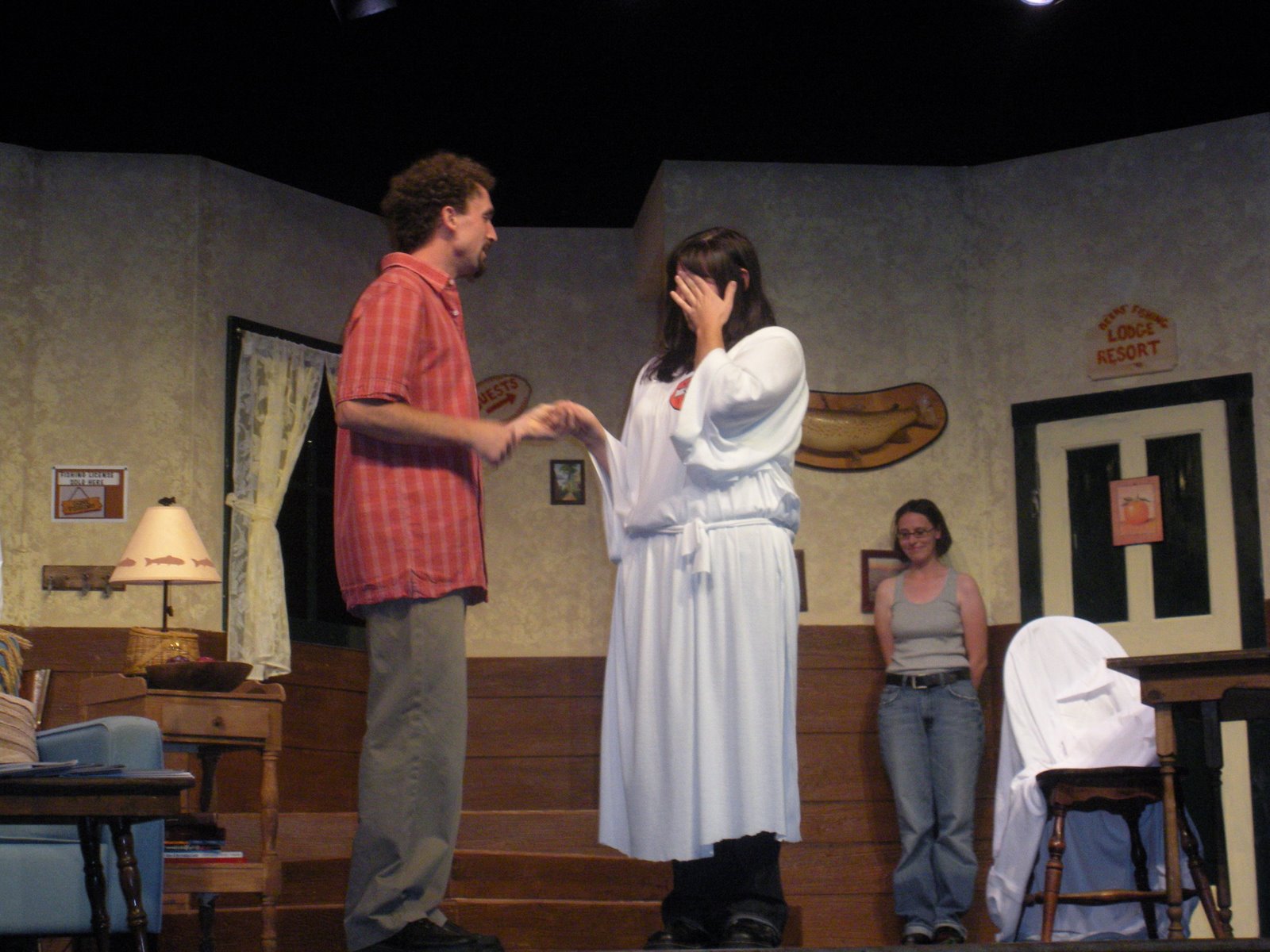
The Foreigner is a 2-act play that takes place at a fishing lodge in Georgia and centers around a pathologically shy and insecure British man named Charlie (played by Jay Peak who, jokingly [I hope] said he found some inspiration in the personality traits of yours truly) who, in an attempt to avoid any awkward social interaction with the other guests, pretends to be a non-English-speaking, non-speaking foreigner. When certain events force Charlie to communicate with the other guests in his pretend non-English language, hilarity ensues. And though the ultimate message of this play might be that even the unspoken word can communicate a human’s inherent goodness, one lesson I drew from the play was the power of language.
As the banner on my blog confidently tells my reader(s), and as most of my English-major friends will attest to, the pen is often mightier than the sword. Words matter and are often more powerful than ever intended by the person communicating them. Exhibit A for this argument can be found no further than the fact that I still remember the five most negatively influential comments made in my direction, even though all occurred at least 12 years ago, and some, a quarter of a century ago:
“You’re the worst sorry-assed student I’ve ever seen,” said Gary Perry, 11th-grade chemistry teacher after discovering me looking at a college basketball tournament bracket in class; “God is ashamed of you!” shouted Chris Ortloff, a church member after I dumped a bucket of water on his son at a church youth group meeting (I asked Papa Benchly if God was ashamed of me. His paraphrased response was, “you shouldn’t have done what you did, and that’s not something God would condone. With that said, he probably had it coming.”); “You’re Benchly. You’re asexual to us,” said Ms. Scharf, describing why I was “just friends” with 8 women in college; “Ew, Benchly touched my arm! Now I have cooties!” screamed nameless female elementary school classmate when a bump in the road knocked me into her seat on the bus; and “That’s not a real Dukes of Hazzard matchbox car, Benchly. You can’t play with us,” said nameless 1st grade classmate when I attempted to pretend that my orange matchbox sports car was The General Lee.
Though ranging from comical to typical to stereotypical to tragic, all affected me, and The Trash Heap would opine that all continue to affect me to this day. Words are powerful and have a shelf life that rivals that of even the most nonperishable foods. Whoever first claimed that names couldn’t hurt you like a stick or stone was lying or kidding him/herself, just like anyone who claims to be rubber, not glue. For instance, the names with which you’ll inevitably tease me after I quote You’ve Got Mail in the next two paragraphs will most likely sting for a long time.
This past year, I’ve been proud of the blog entries I’ve been able to craft with the words that I’ve sewn together. After two depressingly barren years of blogging, I’ve doubled the number of entries from those two years and still have two months left in the year with which to write the stories of my life. In perfect contrast, however, I feel as though I’ve slowly lost the ability to verbally communicate effectively. Anyone who has suffered through my bumbling retellings of a story or a joke lately will surely agree. Like Kathleen in You’ve Got Mail, I always “get tongue tied and my mind goes blank. Then I spend the rest of the night tossing and turning over what I should have said.” I may have a way with the written word, but the spoken one feels increasingly foreign to me.
When I do “have the pleasure of saying the thing [I] want to say at the moment [I’m] wanting to say it,” as Joe Fox warns in You’ve Got Mail, “remorse eventually follows.” For proof of that, I need to look no further than the difficulty I’ve had as of late in my attempts to communicate my feelings to Ms. Darling or my frustrations with certain family members. In each instance, no matter how carefully-crafted each thought was, I exited the conversation either feeling as if I had failed to accurately express what I was thinking, or that I had said too much. Considering how important words are, I’ve started contemplating communicating only in writing. And if this wasn’t the first step to a J.D. Salinger-like reclusive lifestyle, I’d probably go for it.
After all I’ve said, if you’re still left doubting the power of words, consider how they affected the life of Gee Wiz two weekends ago. After The Foreigner‘s curtain fell and the performers took their well-earned bows, Jay Peak stood in his rightful place at center stage, took Gee Wiz by the hand, and spoke the first nonfictional, but nevertheless well-rehearsed and deeply personal words of the night: a proposal. And in response, in between nervous snorts and tears of happiness, Gee Wiz uttered perhaps the most meaningful word of her life: “yes.” And in response, we say, “Mazel tov!”


 Benchly'sword
benchly, you have a way with words, written and spoken. i even like your non verbal communication skills…
You might want to keep in mind that your written words can hurt just like your verbal ones. And sometimes they can hurt more because the recipient knows more thought and time has been spent crafting those written words.Another thought to ponder – good communication skills include listening. Perhaps opening your ears and mind to what others are trying to say or what others are feeling could help where you feel your overall communication skills are lacking.Communicating only in writing allows you to say what you think and feel without having to listen to what others have to say. Thus, the “listening portion” of communicating is gone and you are left being only half-good at communicating.Unless of course:1] You are afraid of hearing what others have to say, because it just might be different than your view, or it might be something you know deep down but don’t really want to hear or face. OR2] You don’t care what others have to say, which could be the case if being self-centered were your true nature. Hopefully that is not the case.As a writer, it is easy to hide behind that veil of words. It might be out of your comfort zone, but you really should think about stepping out from behind that curtain and seeing what happens. You might not want to hear what is being said all the time, but if you don’t listen you will also miss the good things being said.
Thanks, anonymous. It’s always great to hear from a fan.
I hope you understand I was offering a response to some of your musings. I figured with your current theme and the fact that your blog is listed on your local newspaper’s blog directory for the general public to access, you would be open to responses from the general public.
Of course.
Well, Anonymous….what got stuck in your bonnet? There’s nothing wrong with speaking your mind but why are you so ashamed of signing your name. If you have so much to say about what’s wrong with Benchly’s musings or his life, then be up front and sign your name. If you can’t, then maybe you have no right to comment on his writings or his life. Think about that for a while. Oh, my name is MaryBeth…..what’s yours???
Really? Your mother? Defending your blog?
I know. It’s sweet. And kind of unexpected. I almost forgot that Benchlys liked to support each other.