The (Life) Choices We Make

I slept in this morning, which is a luxury my new “home” now allows me to afford. My walk to work, though shorter, is still long enough to justify listening to my iPod and, with my carefully selected songs in hand and ear, I can feel, at least for five minutes of the day, like I’m caught in a movie’s musical interlude that suggests both whimsy and the promise of things to come. I’m getting ahead of myself here.

This morning’s walk to work was serenaded by Dar Williams’ “As Cool As I Am,” a song, which, embarrassingly, I still don’t think I quite understand (maybe Ms. Parker could help me out here?), and yet which feels relevant nonetheless. But as I turned each corner on my way to my office home, my thoughts were not of her lyrics or the joys one feels when a short walking commute to work means saving gas money, but rather of how and why I came to be spending my work day mornings alone.

As all four of you know, it’s been over three years since I was first introduced to Freckles and subsequently introduced her to you. I did so in a carefully crafted entry on carpooling, which I’m not entirely sure even the most faithful readers of mine would recall if I didn’t link to it here.

I think it’s safe to say that my readers quickly caught on to my love for Freckles. Maybe it was the sudden lack of blogging on my part (as Sarah the L knows, writer’s block is the consequence of happiness and falling in love), or maybe it was the fact that I beat my readers over the head with our whirlwind romance. Whatever the case, I was happy and everyone knew it.

But as is sadly the case in life, people change, things change, relationships change, love changes, and Freckles and I found ourselves on opposite ends of our relationship’s spectrum. One of us believed in us, and the other didn’t anymore. One of us felt heartache for hurting a loved one, the other for being hurt. Both of us were terrified of losing a loved one. And so it was last week that I found myself with packed boxes, bags, and Othello in hand, failing miserably at settling into my parents’ guest bedroom.

The day that I officially moved out of the apartment that Freckles and I had turned into a home, the rains poured harder than they had all summer. With no end in sight, I was forced to load the final items into my car while unable to dodge the raindrops. Three years ago, I described such a rainstorm as something “placed perfectly between miserable and pretty.” This past week, it felt more like melancholy drowning in heartache.

A day later, as the rains stopped, the sun came out, and the inevitable rainbow appeared in the sky. We’re shedding tears of sorrow, but at least the world is still hopeful. And I think of all the great times Freckles and I had together, and the love that we had, and the sadness we felt the last time we saw each other. But that I’ll save just for me.
The Road Not Taken

I shall be telling this with a sigh
Somewhere ages and ages hence:

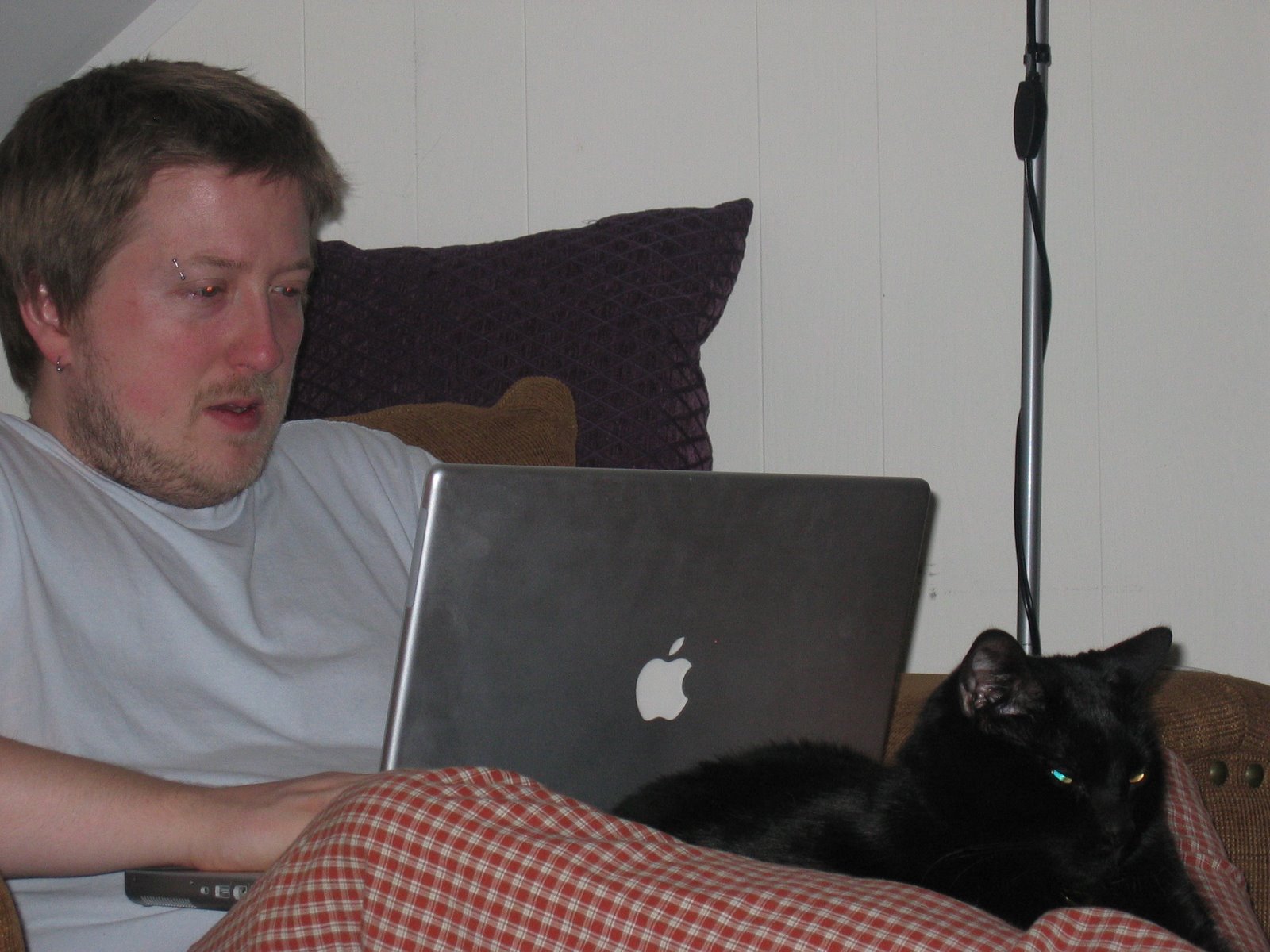
With only a handful of minutes left before yet another July day abruptly leaves me behind, I’ve settled in The Blogging Chair and Othello has taken up residence on top of the purple coffee table-turned-footstool, his tail tapping against my outstretched legs as if to keep tabs on me.

Earlier this evening, Freckles and I returned from an all-too-short, 4-day family vacation in Bethany Beach, Delaware. And although he got quite a bit of love from Sarah the L in our absence, Othello is most definitely playing the part of Emotionally-Hurt Kitty. This is not to be confused with Heartbreakingly-Sad Kitty and Pathetically-Miserable Kitty. (Montana Girl wasn’t kidding when I adopted him a few years ago: Othello requires more emotional attention than the next cat! Considering how emotionally sensitive I am, she also got it right when she called him my kitty soul mate.)

Freckles and I left Delaware a little after 10 a.m. and I expected us to arrive in Burlington shortly after 9 p.m. I expected an 11-hour trip because that’s how long it took us to do the reverse trip 5 days earlier. However, despite a 20-minute detour in Millsboro, DE to find Grandma and Grandpa Benchly in the local cemetery, as well as 1-hour detour in Dover, DE (home of Dover Man, the invincible capital of Delaware!) to pick up an E-Z Pass for me, water for Freckles, and “cheap” gas (read: $3.89/gallon) for the car, we ended up arriving in Burlington 1 hour earlier than expected. If you ask me, the difference was the timing of the trip; in other words, we hit the streets of NYC before rush hour did. If you ask Freckles, the difference was the route.

Any Vermonter will tell you that there’s no easy way to get there from here. We have two interstate highways: one travels from the northwest to central eastern Vermont, the other travels north to south but on the eastern border. And thus, anyone wishing to travel down the west coast of Vermont from Burlington has two options: 1) brave the local (read: the pharmacy-destined elderly) traffic on Route 7 and ultimately cross over to New York’s “Northway,” which I think is so named because Canada is north of the self-centered New York City, not the other way around; or 2) go 40 miles out of the way on our two interstates while hoping that the traffic-less route will save in time what it costs in gas. On the way home, we went the “Northway” route because Freckles didn’t want to repeat our spontaneous adventures on our southbound trip. And although I was happy to oblige because I wanted to be home as quickly as possible, it wasn’t because I regretted our ultimate southbound route; in fact, I’d probably do it again:

And both that morning equally lay
In leaves no step had trodden black.
Oh, I kept the first for another day!
Yet knowing how way leads on to way,
I doubted if I should ever come back.

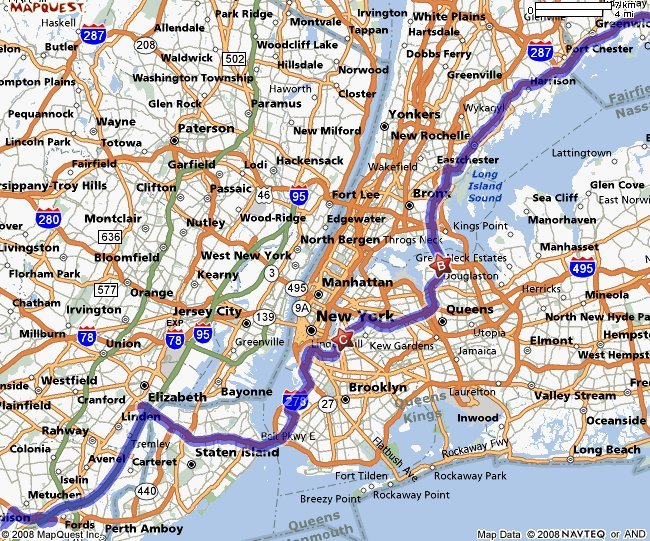
It was 2 p.m. on Saturday, and we had been in the car since a little after 8 that morning. We were stuck in traffic on I95 South, about 5 or 6 miles east of the George Washington Bridge (aka, the gateway to hell [aka, New Jersey]), and had been at a practical standstill for 10 minutes. Our planned route looked like this:

But traffic was going nowhere and it was going nowhere fast. While I cursed myself for daring to test the George Washington Bridge waters when we could have easily skirted around the city the “Northway,” I silently prepared an imaginary alternate route in my head. With our road map placed conveniently in the trunk, I convinced Freckles to let me try a detour on a bridge that sounded vaguely familiar (the Whitestone) and which, the signs said, would take us south. 5 minutes later, while pulling an oh-my-god-we’re-lost-in-Queens-again U-turn, I cursed myself for taking said Whitestone Bridge while silently preparing an imaginary way out of Queens. 45 minutes later when, without map, we arrived in New Jersey via the Bronx, Queens, Brooklyn, and Staten Island (while also enjoying a gorgeous view of the Manhattan skyline), I applauded my navigational skills while Freckles silently prepared to throw herself out the window. She claims we lost time, while I strongly believe my “Staten Island Detour Express” route saved us time:

Two roads diverged in a wood, and I—
I took the one less traveled by,
And that has made all the difference.

Now, I learned my lesson and will most likely never be able to go the out of the way route with Freckles again, and maybe going on the Whitestone Bridge wasn’t the smartest idea (when told about our I-95 South to “Staten Island Detour Express” route upon our arrival in Delaware, Papa Benchly’s response was “why did you go that way?!?”), but I’m still a firm believer in the underlying philosophy expressed in this quote (one of my favorites):

Although a beach-bound Freckles will most likely disagree (as would a Yankee Stadium-bound Benchly), I think the trip should be just as important as the destination.

The Huddled Masses Yearning to Suffocate

Hidden among the classic rock albums delivered to my 18-year-old-high-school-self’s doorstep by BMG and Columbia House, the hordes of folk music that serve as a reminder of my post-college sensitivity, and the indie albums that symbolize my juvenile attempt to fit in by not fitting in, is a brown CD case that protects a 12-song album straight out of southern blues rock heaven. In another room, a Blockbuster-like collection of Academy Award winning films, Sundance Festival selections, and indie pictures surround a 2-disc edition of a classic movie starring two of my generation’s greatest actors. The album is one of the top 20 selling albums of all time; the movie is in the top 10. Both were released in the 1990s, both received rave reviews, and yet, 10-15 years later, you’d be hard pressed to find one person who would admit to liking either of them. I’m talking, of course, about Hootie and the Blowfish’s debut album Cracked Rear View, and James Cameron’s epic film Titanic.

In the past few weeks, as I struggled through the BBGE’s most recent selection, the painfully-easy-to-read Nineteen Minutes by Jodi Picoult (a successful book because of its author’s fame, not talent), I found a blog-worthy similarity between the fleeting fame of a band or movie, and the book’s ongoing discussion of the fragility of a high school kid’s popularity. Stated in such a simplistic way that would make Picoult proud (and concerned that you were trying to usurp her commercial success throne), the popularity of a high school kid, or of a movie, or of a band, is entirely at the mercy of those who deem it worthy of popularity. But as soon as enough of society has conformed and fallen in line with the beliefs of the masses, the popularity will spawn resentment and the masses will stop being fans.

I don’t know what a sociologist would say about this phenomenon mostly because Sociology 101 was my first college class and, let’s be honest here, who does well in their first college class? Even so, I do feel as though I have an idea of the mindset of the masses. For as long as I can remember, walking the line of popularity has always been a delicate balance between conformity and individuality. The two operated in an almost symbiotic way: you were popular because you didn’t conform, but you stayed popular by not sticking out. In other words, you had to be different to get noticed, but like everyone else to be popular. Those who were just plain different were outcasts, and those who were simply carbon copies were followers. You had to find the balance, all the while facing the fact that the line between the two was constantly changing.

Most high school kids lack confidence, and so what usually happens in their quest for popularity is that they establish a unique identity, and when their fear of the potential wrath of the masses gets to them, they fall back in line. Although conformity brings with it less popularity, it’s the safer side of that line. The kids who are ahead of their time and who make the “mistake” of not falling back in line quickly discover the hell that waits for them on the other side.

All of these thoughts were on my mind last week when Freckles and I went to see M. Night Shyamalan’s The Happening in a local movie theatre filled to the brim with teenagers who all believed it was their responsibility to give a running commentary of the film (in between their cell phone calls, of course). Their immaturity and disrespect brought me back to high school, which, in a way, helped me understand why so many movie critics were quick to bash Shyamalan’s latest.

The Happening is a story of a mysterious plague that begins to almost immediately kill off the northeastern part of the US. It’s told through the eyes of a Philadelphia married couple (played by Mark Wahlberg and Zooey Deschanel), their friend (John Leguizamo) and his daughter (Ashlyn Sanchez). Without giving too much away, I’ll say that the story is more about the couple than the plague (think Signs), that the couple’s survival of the plague is subtly dependent on who they are and what brought them to that particular point in life (again, like Signs), but that, unlike Signs (a great movie in and of itself), Shyamalan doesn’t spell out the ending with a climactic “Swing away, Merrill” line or a Sixth Sense-like twist. Instead, he hopes the viewers are smart enough to pick up on the subtle clues brilliantly acted out by Wahlberg and Deschanel. And because I wasn’t as subtle as Shyamalan, you know how this story ends: the critics (read: masses) hated it.

The Los Angeles Times said, “Shyamalan favors the whimper over the bang,” that Shyamalan failed to answer the question of what happened?, that “Wahlberg’s displays of emotion never mesh[ed] with what’s going on,” and that Wahlberg’s character should have thrown himself into a much more situation-appropriate sweaty mass panic.” Even my beloved The Onion said, “Wahlberg’s soothing, almost hypnotic vocal patterns seem modeled on the paternal purr of Mr. Rogers.” What most every critic (save Roger Ebert) failed to understand is that Shyamalan took a thriller story and Hitchcocked the hell out of it. I’d even go so far as to say he one-upped Hitchcock because as great as Alfred was in building tension, his movies always had an expected bang. Shyamalan recognized that the more powerful way of telling this story would be to have the audience figure the bang out for themselves (whether in the theatre or on the drive home) and the fact that the ending wasn’t as clear cut as The Sixth Sense would leave an unsettled uneasiness in every viewer, which is, incidentally, the kind of reaction you’re looking for in a thriller.

But alas, in this popular eat popular world that hates Hootie because they love him, that sees Titanic five times before bashing it, Shyamalan never had a chance. He made a name for himself when he got Bruce Willis to act, but then he kept refusing to conform to the cookie-cutter standards of our society. He stuck his neck out, and with Jerry Bruckheimer special effects, we cut it off.

Good Night and Good Luck, Indeed

A few years ago in my I-Don’t-Care-About-Anything-Other-Than-The-Fact-That-I-Don’t-Have-A-Girlfriend phase in which I blind dated the entire city of Burlington, Vermont, I met a girl once for coffee and Scrabble (I’m not really a coffee drinker, but I would have met up for crystal meth and water-boarding if it meant the chance to meet a girl). In honor of her heritage, we’ll call her French Girl. French Girl and I spent close to 10 hours together that day experiencing the realized wet-dream of a bohemian like myself: smuggling wine into a French movie, gourmet hot chocolate, Scrabble, chess, and participating in a college psych experiment. In retrospect, the date would have been perfect if not for the fact that she chose the end of the date as the proper time to confess how unattractive she found me. But as we said good night and good luck in the dating world, I thought to myself how fortunate I was to have met her, for she was the one who first introduced me to Tim Russert (who, incidentally, she found attractive).

In the last few years, I have spent countless weekend mornings watching Meet the Press as well as numerous primary and/or debate evenings glued to NBC and MSNBC, forever on the edge of my seat, anticipating Russert’s next insightful word. With a media so unabashedly biased that it makes The Onion look sincere, Russert’s point of view was always refreshingly honest. His youthful exuberance captured my attention, his unmistakable intelligence made it easy for me to listen, and his controlled passion showed me that his was the voice of reason.

As a reporter, Russert informed the uninformed viewer by following the most important lesson of storytelling: show, don’t tell. Rather than shout out opinion after opinion in an effort to win the Most Popular YouTube Soundbite of the Day award (an award co-owned by Keith Olberman and Bill O’Reilly), he stated all points of view equally and left it to the now-informed viewer to form an opinion. He believed that well-informed viewers were in a better position to make a difference in this world than viewers who had spent the last hour being brainwashed by media propaganda.

As an interviewer, there was no one better. Russert simply did not care whether the interviewee was Democrat, Republican, conservative, liberal, agnostic, religious, pro-life, pro-choice, etc. What mattered was his belief that everyone be held accountable for all opinions and actions, right or wrong. When one side did its best to spin an answer, as happens everyday in politics, Russert would counter with a hard-hitting, yet completely respectful and truthful follow-up question. What resulted, as evidenced by the most recent primary season, was a country full of conservatives applauding Russert’s Obama and Clinton interviews, and liberals doing the same for the McCain ones.

And so it was that my heart broke at the news that Tim Russert died of a heart attack today at the age of 58. He was the kind of fair and balanced that Fox News unfairly claims to be, and he was the living embodiment of one of Edward R. Murrow’s greatest quotes: “To be persuasive, we must be believable; to be believable, we must be credible; to be credible, we must be truthful.” His passing leaves a void the likes of which the field of journalism hardly ever sees. He won’t be forgotten and he most certainly won’t be replaced.

The BBGE, and Bob’s your uncle

As some of you may know, I’m a member of Burlington’s best book group ever, appropriately titled the Best Book Group Ever. Started many years ago through random connections on Friendster (the Myspace of 2004), the BBGE now consists of nine members: The Dean, The Professor, The Canadian, The Heinous Shrew, CAT, Mr. Benchly, The Russian, The Mother, and The Newbie. With this steady Who’s Who of Burlington cast of characters in place, invitations to join are rare and not taken lightly. Mine came via CAT two years ago, and thankfully, I have yet to be kicked out. Since then, only The Newbie has accepted an invitation.

After our most recent gathering, I took it upon myself to write a recap for the BBGE’s private website. Because I had fun with it, and because I’ve been slacking with the Blogger posts lately, I thought I’d share it with you, my faithful reader. And so, without further ado, I give to you a rare glimpse into the Best Book Group Ever…

May 20, 2008 – The Newbie’s house (The Attack by Yasmina Khadra)

For this recapper, book group began in the Old North End when four ONErs (The Professor, The Dean, CAT, and Mr. Benchly) gathered at CAT’s house so that we could carpool to The Newbie’s house. (The Professor came bearing a fishbowl surprise veggie dish from The Heinous Shrew who could not attend.) Mr. Benchly was impressed with how environmentally conscious all of his carpooling book groupers were since The Newbie’s house was only two or three miles away near Oakledge Park. At this point, it was revealed to him that The Newbie’s house was actually in Essex, 20 minutes away, and Bob’s your uncle.

At sometime near 7 p.m., the ONEr carpool express arrived at The Newbie’s newbie house, which is in an area of Essex nearly as wooded as Oakledge Park, but populated by not nearly as many drunk college kids. The ONEr carpool express arrived a few minutes after The Mother, and a few minutes before The Canadian. The other book group member, The Russian, could not attend, and Bob’s your uncle.

Our appetizer hour was spent circling The Newbie and her husband’s new cardboard kitchen island on which olives, cheese, crackers, wine, and champagne were placed. (Mr. Benchly was pleased that there was a bowl in which to place the olive pits, as this is always a matter of social anxiety and distress for him and usually prevents him from enjoying more than one olive at a party.) Champagne was poured and we toasted to The Dean’s new deanship, The Professor’s new tenure, and The Heinous Shrew’s ability to get her boyfriend to make her book group dish.

The pre-dinner/pre-book discussion ranged from whether or not any book group members could be classified as Dignified Middle Aged (DMA), to the recent home improvement work done to The Newbie’s newbie home, to The Russian’s upcoming housewarming party, to CAT’s housing situation, to The Professor’s drug-dealing neighbors, to an explanation of the phrase “and Bob’s your uncle” (a phrase this recapper so desperately wants to understand), to The Mother’s new job at the Front Porch Forum, and to many other topics this recapper can’t quite remember. It should be pointed out that this recapper had two glasses of wine, two more than his usual.

Dinner was served at a little after 8 p.m. and consisted of the aforementioned fishbowl surprise veggie dish, a salad by The Canadian, asparagus by CAT(?), a Russian (?) chicken dish by The Newbie, and bread by Mr. Benchly by Red Hen Bakery. At this point, discussion turned to the book, and, disappointed by a lack of segue, CAT shared with us the segue she almost used before dinner. The Newbie, The Professor, The Dean, and CAT were quickly identified as the book groupers who had read the book. There was some speculation that Mr. Benchly had not read the book as a sort of retaliation against those who didn’t read his book for the last meeting. These rumors proved to be false. This recapper sensed that, all in all, the four readers enjoyed the book, and their discussion lasted 10–15 minutes (?).

The post-dinner/dessert discussion turned into a vent session about bad grammar (thus making this recapper extremely paranoid), as well as a confessional on past crimes of book groupers, which, for the sake of privacy and intrigue, will not be revealed in this recap. Needless to say, though, The Canadian should now be referred to as The Canadian Criminal. We then voted on CAT’s book selections, planned our next meeting, said our goodnights, headed home a little after 10 p.m., and Bob’s your uncle.

Waiting for the “pony rides and dancing bears”

A couple of weeks ago, while enjoying a relaxing dip in a pool of the harmonious bliss that results from an episode of the always entertaining and stimulating TV show Scrubs, I fell victim to the advertisers’ oldest trick in the book when I was startled to attention by the first 30-second spot in an obnoxiously loud commercial break. A local Ford dealership wanted me to know that its special offer on SUVs had been extended for two weeks because “YOU ASKED FOR IT!” What bugged me more than the volume of the commercial was the fact that Ford had spent thousands of dollars to try to convince me that the reason it was extending its sales offer was because buyers wanted to buy its vehicles, and not because its SUV sales (and lack thereof) mirrored the sales of the black sheep in its family: the Edsel. Rather than admit that it can’t give away its SUVs, it spun the truth to put itself in a positive light.

The Ford commercial reminded me of an America Online ad from the late 90s (back when AOL was THE place to go for e-mail and chatting). In its ad, AOL tried to convince the viewer that it was bringing people together. No matter what your relationship – family, friend, lover, you name it – AOL was making your relationship closer through the power of the Internet. I thought then what I think now: how could that possibly be true? The Internet takes away the tone of a phone call, the personality of a hand-written letter, the real hand-cramp-letter/long-distance-phone-bill energy it took to keep in touch with loved ones pre-Internet, and replaces all of that with a tool whose ability to abbreviate everything just reeks of inevitable laziness and apathy.

Back in the day, communication meant facial expressions, and hand gestures, and hugs. Nowadays, you can avoid all of that by copying and pasting a mass e-mail. Or if you prefer the small computers found in your phone, you can simply text your friends the heartfelt messages “wht up? where u @? im home. c u l@tr!” Back in the day, meeting new people meant social interaction in public and the character-building anxiety accompaniment. Now, a quick trip to Facebook or Myspace or AIM lets you “meet” everyone in the world behind the security and comfort of a faceless (read: inhuman) conversation. And, when the time is right, and you’re ready to truly show yourself, Photoshop is standing by to crop your picture to put you in the best possible fabricated light.

With this in mind, how are AOL and all of its Internet-service-provider offspring possibly bringing people together when we’re all cooped up in our homes staring at a computer screen? In the words of the extended version of the Scrubs theme song, “you found your love online…but you’re just plugged into the wall.”

But this is the way of the world: online shopping; self checkout lines; automated telephone lines (“Burlington” – “Did you say…’Berlin Town’?” – “No.” – “Please spell out the name of the city”); German restaurants with robotic waiters; and my latest discovery: credit card-accepting vending machines so you don’t need to ask anyone for change for a $5 bill. (We’re such a plastic-obsessed country, that I honestly think the only way for homeless people to survive in the coming years will be to invest in a portable credit card machine [“Excuse me, sir. Could you please spare a swipe of your card?])

Technology has essentially removed necessary human interaction from the day-to-day life and to fill the void left by that lack of interaction, our society has created the always oxymoronically-termed “Reality TV.” Now we don’t need to go on dates because we can watch others go through that rejection process on The Bachelor or Next or Flavor of Love. And why go on vacations when we’ve got the Travel Channel? And who needs to worry about their career when they can obsess about Lauren Conrad’s fake one? Don’t want to spend time with your family? No problem; just tune in to see what the Kardashians are up to? Don’t know who the Kardashians are? Don’t ask your friend when you can Google it.

We’re slowly becoming the world Ray Bradbury imagined 50 years ago when he wrote Fahrenheit 451. If you think I’m kidding, consider this: the protagonist in Bradbury’s signature book, Guy Montag (OMG! Maybe he’s Heidi’s father!), came home from work everyday to a house with TV screens as walls (called “parlor walls”). The parlor walls played an interactive soap opera of sorts; “families” on the screen acted out a script with the individual viewer, thus saving the viewer from actual interaction with actual family. And if the viewers got bored with that, they could always place tiny radios in their ears and listen to their iPods…I mean seashell radios. What resulted was a world in which people didn’t interact, much like the one in which we currently live.

And it’s just one logical step from realizing that people aren’t interacting with each other to the acknowledgment of the consequence: that people have stopped caring about other people. Road rage; cell phones in inappropriate public places; losing touch with loved ones who don’t use email; a family friendly marketplace inundated with shouts of “I f**king hate ni**ers!” and “f**k this…f**k that s**t!”; local businesses closing shop because people who hate that the US offshores its work ease their misery by finding bargains at national chains and online stores; states allowing their employees to “bring their gun to work”; racist comments heard at every corner, silenced only long enough to catch the news about a suicidal Korean student gunning down a campus, or the people of an occupied nation fighting against the occupiers, before the comments about “Towelheads” and “g**ks” begin again; and even the simple act of cutting people in line.

Remote controls have replaced human interaction and the result is a society that doesn’t respect itself. And if we’re not careful, soon we’ll all know the temperature at which books burn. But don’t worry, at least you can buy a Ford to make you feel better about yourself. After all, you asked for it.

We’ll Just Be Over in This Corner Changing the World

The day I turned 18, I headed to the local convenience store to purchase a pack of cigarettes and a lottery ticket. I didn’t smoke, and the lottery ticket turned out to be a losing one, but it didn’t matter. If the clerk hadn’t asked to see my ID, I would have shown it anyway; that’s how proud I was of the milestone I had reached. (On a side note, you should have seen how giddy I was when my insurance rates dropped when I turned 25.)

With that said, you can imagine how excited I was when I got to vote in my first election: Clinton vs. Dole. Since I was in college in November of 1996, my absentee vote for Clinton (of course I voted for Clinton, he Rocked the Vote and Arsenio) went by way of the Pony Express. The borderline-irrational excitement I felt at being able to finally exercise my American right was rivaled only by the extraordinary near-suicidal disappointment that struck me a few months later when I received word from the State of New York that my absentee vote had not counted for a hanging-chad like technicality.

Our country has always had trouble courting the average American teenage voter. With so many votes cast in an election, it’s tough to convince the overwhelmed 18-year-old that his/her vote counts. And with that mindset as my foundation, after my vote (or lack thereof) in 1996, I gave up voting altogether. That is, until the Republican Party decided to back an idiot solely for his name.

***We break this irregularly scheduled blog entry to go off on one final (thankfully) anti-Bush tirade***

History will end up judging George W. Bush as one of, if not, the worst president in our history based on his determination to turn a terrorist attack on our country into a vengeful attack on an uninvolved country and make the rest of the world hate us even more, rather than use it as motivation to really protect our country from further attacks, but I could have told you how bad a president he was in the summer of 2001. People seem to forget that pre-9/11, W was on vacation 42% of the time. I don’t know about you, but if in my first year of a new job I spent 42% of my time on vacation, I would have been fired.

And one more thing: imagine what kind of shape our economy would have been in now if, instead of pumping trillions of dollars into a new democracy halfway around the world that will never survive simply because it was forced down its people’s throats, we spent the money on strengthening our border defense (seven years later and it’s just as easy to get into our country as it was when W’s father was president!). This country got out of a depression by employing its people to support a war; and it sure as hell could have stayed out of a recession by employing its people to build up and maintain our border protection.

***OK, back to the blog***

With the chip on my absentee ballot shoulder, and with the idiot Texan governor providing my inspiration, in 2000 I patiently waited in an overcrowded line with other inspired voters at a downtown-Burlington election site. Twenty minutes later, when I finally reached the front of the line, I was informed that I was in the wrong district and that I’d have to fill out an absentee ballot that would be delivered to my correct district after the election. Later that night, when my suspicions that my vote would never get counted took front seat in my thoughts, thousands of Florida voters went to bed unaware that they were about to feel the same way. At this point, two elections into my career as an American voter, I was fairly certain that I’d never wake up the day after Election Day feeling satisfied that my vote had made a difference. The unbelievable (in its stupidity) 2004 election results further emphasized my gut feeling.

And though the American voting process has kicked me in the aforementioned gut a number of times, I can’t help but feel excited. You see, in two days, I’ll be voting in the first presidential primary in my life that will make a difference. I’m not exaggerating. 1996 was Bill Clinton’s reelection campaign (not exactly a popular moment for primaries); 2000 was Al Gore’s campaign and his only serious competitor Bill Bradley never got out of the starting gate; and in 2004, my great Vermont state backed its son Howard Dean in the primary…weeks after he had dropped out of the race.

So here I am, ready for the new Super Tuesday, March 4, and after all that I’ve been through, you can imagine how bitter I am every time I read a news story that talks about Texas and Ohio. If I had a nickel for every time my state’s primary was described in these articles in one line as “Vermont is also voting” (if mentioned at all), I’d have the kind of financial backing the Clinton campaign sees only when Hilary loans it her own money. For all the time and energy spent covering our hillbilly neighbor’s primary, you’d think the media would have the courtesy to at least give us a headline or two. But since they won’t, I guess I’ll have to wait until November for my vote to count. Hopefully it will.

White Mountains or White Lies?

Freckles will tell you that I’ve become quite addicted to the ongoing political debate in our country. And what I’m learning from this debate is that although (some of) the candidates are new, the script is very much the same. And it reads like this…

Last week, the early-bird caucusing Iowans selected Barack Obama as their Democratic Party choice for president. John Edwards and Hilary Clinton finished in a virtual tie for second, relatively far behind Obama. Poor Dennis Kucinich never had a chance. Again.

According to polls, a whopping (considering how many candidates there were) 41% of “first-time voters” (read: youth) voted for Obama. 29% of “first-time voters” voted for Clinton. So new voters turned out in record numbers and an overwhelming number of them voted for Obama. That’s a pretty clear message, right? Well, according to Clinton, not exactly.

After barely mentioning youth her entire one-year-old campaign, Clinton responded to the Iowa result by saying it was clear that she was the voice of the youth. Say what? Obama played the young people trump card in Iowa, and realizing they just might be the key to victory, suddenly Clinton declared herself the voice of youth? OK. On to New Hampshire.

Though generally a dull state, New Hampshire was a hotbed of excitement the last five days. The highlight was undoubtedly the doubleheader CNN/Facebook debate, with the Republicans opening up for the headliners, the Democrats. (Facebook is my runner-up choice for the “Is That Really An Appropriate Presidential Debate Host?” award.) In that debate, John Edwards repeatedly described his campaign as “personal” (“personal cause”; “very personal”; “personal battle”; “deeply personal”; “personal”; “personal”; “personal”; etc). Though our trusty reporters (read: Tim Russert) called the debate a draw, it was clear to this unbiased viewer that Edwards scored quite a few direct blows to Clinton (my favorite being when he likened her to “the status quo”), while, in my opinion, performing far better than a stumbling Obama. If anything, and maybe thanks to redundancy, Edwards was convincing in his claim that his fight was personal. According to Clinton, though, he’s not the only one.

Two days later, in one of her new “young people” speeches, Hilary Clinton responded by tearing up and saying that the election was “very personal to me.” Move over Sally Field, because I think New Hampshire likes Clinton now, they really really like her!

So what happens next? Anyone who has ever followed politics or a good soap opera, could see the ending of this primary from a mile away. The New Hampshire voters, in all their “live free or die”/”you can’t tell us what to do, stupid Iowans!” glory, voted for Clinton. Barely. (I’m not kidding. Though Clinton won the popular vote, Clinton and Obama secured the same number of delegates. That’s how close it was.)

And then, while ignoring the fact that her speechwriters are up for this year’s Best Adapted Screenplay award, Clinton delivered the most transparent, ironic line I’ve ever heard in an election…

[fade in]

[Int. A large New Hampshire gymnasium filled with thousands of screaming fans.]

(Clinton walks to center stage, shaking the hands of the people she passes by. After a few waves of the hand, and a grin that cannot be suppressed, Clinton steps up to the podium looking humble, yet presidential.)

Clinton (personally): “I listened to you and in the process I found my own voice.”

(The fans scream.)

And scene!

Parker, Benchly, and True

Near the end of the underrated motion picture Starship Troopers (which you should see not only for its eye-candy cast and unapologetically corny story but most importantly for its seemingly-psychic pre-9/11 commentary on the War on Terror), in a scene that shows a rare reunion of the three main characters after yet another gruesome and deadly military battle, one of the characters hugs the other two and says, “I don’t know why, but every time the three of us are together I feel like everything’s going to be alright.”

For the first two years of college, Ms. Parker, True, and I shared nearly every waking moment together on the campus of the University Whose Name Shall Never Be Said. We cracked jokes, told stories, wrote songs, and believed ourselves to be the modern day Algonquin Round Table (as evidenced by two of our nicknames). Sadly, in the ten years since we parted ways, I can count on one hand the number of times the three of us have been together. When we are together, though, as was the case 6 weeks ago for Ms. Parker’s 30th birthday, I find myself identifying with the Starship Troopers character’s optimism.