A Flawed Life

I remember getting into an argument with Mama Benchly when I was 7 or 8 years old and tantrums were the logical and normal choice of attack. The tantrum most likely occurred after Sisters #1 and 2 refused to include me in whatever it was they were doing at the time, as was their right and responsibility as older siblings. I pleaded with my mom for her to have one more child and to please make that child a boy. I wanted a brother to play with and my childhood thought process was able to gloss over the fact that such an age gap would have meant that I would have ended up being the one refusing to include a younger sibling in whatever it was I was doing. Mama Benchly’s response was simple: she and Papa Benchly had decided that all of the complications associated with my birth had meant that it would be greedy and dangerous for them to try for more.

Seven or eight years earlier, Mama Benchly was gardening in our family’s Champlain, NY yard one summer evening when her water broke. After rushing to the hospital 30 minutes away, and after a labor that lasted just 90 minutes, I entered the world. At first glance, it seems like the picture-perfect, normal delivery; however, a second glance shows that I gave them a scare by wrapping the umbilical cord around my neck as well as by having an irregular heartbeat. Add to that the fact that I was born with one less pectoral muscle than the normal baby, as well as the fact that a few short years later, two toes on each of my feet would have grown overlapping each other if it wasn’t for corrective surgery, and my parents understandably saw the warning signs written on their son’s pectoral-less flat chest: try for more and you might not be as lucky.

As you can imagine, considering how desperate adolescents are to fit in with the crowd by not sticking out of it, I had a difficult time coming to terms with my pectoral deformity. Though I always loved gym class, I dreaded changing into and out of my clothes in the locker room where I ran the risk of being exposed as a deformed imposter posing as a normal kid. (I’ve still mostly blocked out of my memory the times in gym when the instructor made our teams play “shirts and skins.”) And to be honest, finding peace and comfort with my deformity has been a lifelong struggle against which I often find myself losing. I’m still hesitant to remove my shirt in public, and while it took quite a bit of trust for me to reveal the deformity to past girlfriends (again, it speaks volumes about the kind of woman my future wife is, that I felt comfortable telling her about it on our third date), regardless of how much I’ve trusted my close friends, it’s 33 years after my birth and most of my readers (read: friends) will be hearing of it for the first time in this blog post. I imagine Sarah the L didn’t even know about it. So considering my age, it’s ironic to think that it took a juvenile insult thrown my way from an adult posing as an adolescent to help me come to terms with my deformity.

Like most kids in my generation who grew up loving baseball, trading baseball cards, and memorizing the statistics on the backs of said cards, I became an adult who finds pleasure in playing in a fantasy baseball league each year. And thanks to Mr. Extracurricular, I’ve had the pleasure of playing in a locally-based league for the past two years (complete with a live draft! [I know how this sounds, so don’t bother telling me]). We expanded the number of teams this year and in doing so we welcomed aboard a few friends and some friendly strangers. One of these strangers (for the sake of rhyming anonymity, I’ll call him Brat) beat a returning team in the first week of the season and then bragged about it on a message board (the fantasy baseball equivalent of trash talk). This week, after my team beat his team in what can only be described as a “thrashing,” I felt compelled to defend the aforementioned losing team’s honor by returning the trash-talking favor (word for word the way he had done so 4 weeks earlier). Brat responded by saying he wasn’t going to listen to someone who didn’t even have a pectoral muscle. Oh. (You see, evidently, Brat is friends with my exgirlfriend, she thought it appropriate to share this information with others, and Brat considers physical deformities as appropriate punchlines.)

Instantly, I was transported back to 8th grade swim class when one of my peers looked at my bare chest and asked me if a tractor trailer had plowed into it (I’ll give him retrospective points for his creativity). However, unlike that afternoon and all of the uneasy years that followed, after Brat’s insult, I didn’t feel the urge to hide or be ashamed. Instead, I actually felt proud of my deformity because, 33 years into my life and I’ve finally realized that it’s my biggest flaw, and that rather than focus their attention on having one more deformity-free child, Mama and Papa Benchly instead raised someone incapable of poking fun at deformities; someone of whom they could be proud. I won’t pretend that I’m flawless, or even close, but I’d like to think that thus far, I’ve lived a life of which my parents could be proud.

I emailed Brat a few minutes ago and mentioned that I thought his personal attack was uncalled for. I also wished him well this season and mentioned my envy at his foresight in adding a certain pitcher to his roster. I don’t know if he’ll respond but if he does, hopefully it’s to talk baseball. Isn’t that the normal thing to do?

Gumbo was his name. Oh.

On any given day, at any hour, and regardless of the general mood of society, a quick stroll down Any Street always reveals an alarming number of folks displaying horrible parenting skills. Whether it’s the mother of two complaining to one daughter about how the other daughter is “being a bitch”; or the father showing his friend a picture of his teenage daughter and saying, “they didn’t look like that when we were that age!”; or the mother with the crying toddler shouting “don’t make me hit you again”; or the mother preaching hatred to her son; or the father letting his 8 year old kid watch the most recent Saw movie; I see on a daily basis inept parents handing out contagious doses of awful parenting to their children. And each time, I’m reminded of something The Doctor once told me. He said he and his wife wanted children because they had a lot of love to give and because they wanted the joys of a family, but in the back of his mind, he always found satisfaction in knowing that his good parenting skills might someday cancel out the bad parenting skills of at least one other parent. I’ll see your child growing up into a man who abuses women, and I’ll raise you my child who will volunteer at nursing homes.

Considering how many parents out there seem to be failing their responsibilities to their children and the world around them, I find myself especially thankful for my fiancé’s parents. Among the countless items on the list of reasons why I’m drawn to my fiancé, is that she, too, likes to make lists, and though I’m not entirely sure from which side of the Benchly family I inherited this trait, from the moments I’ve spent with her family, I can tell that she gets this trait from both of her parents. She is her father’s daughter with planning book in hand, carefully taking notes for current and/or impending projects, formulating ways to ensure that dreams become reality, and making sure she is prepared for every possible scenario life has to offer her. And she is her mother’s daughter sharing aloud each of her innumerable, and often times complex ideas for future events/plans, in a way that at times is only comprehensible to those who have spent enough time with her to have memorized the cipher necessary to decode her thoughts. As a result, I can’t remember a time when I knew her to be unprepared (except my surprise engagement, but that’s a story for another day) and each time I see her confront life’s challenges with the courage that comes with knowing life’s next three moves, I know that her parents did a great job raising her. (Note: they already blessed our engagement/marriage, so you know I’m not brown-nosing.)

It’s an item from one of my fiancé’s lists that inspired this blog entry today. A week or two after we met, I noticed a brief but ambitious list of goals for 2009 hanging on her wall. Without getting into too much detail, I’ll just say that it speaks volumes about the person she is that she was able to achieve most of those goals, including her desire to adopt a dog. She and I both had dogs in our youth and after our talks of love turned to talks of engagement, her itch to adopt a dog became our itch. We had love to give to a dog in need of love. And so we poured over countless websites looking for the right dog. A few adoption applications were turned down, a few were submitted too late, some dogs didn’t get along with cats (which mattered due to Othello’s veto power), and then finally, a no-kill animal sanctuary contacted us about an energetic terrier who had been rescued and who was looking for a home. We couldn’t resist his Benji-like appearance and the obvious wag of his tail captured as best as possible by the still photograph, and so we drove 6 hours to meet him. After a long walk around the sanctuary’s property on which we experienced firsthand what it means to hold the leash of an energetic terrier, we adopted him and drove him home (with a stop for a necessary bath along the way). He was Gumbo, our dog.

As I write these words, Gumbo has settled into his bed upstairs 10 weeks after we brought him home. The first few weeks he lived here, I often told friends, family, and strangers that he was a “work in progress”; an energetic puppy in need of a lot of training, and daily trips to the dog park. We gave him tasty treats for sitting, and we induced vomiting when he dined on our socks. We laughed as he navigated what appeared to be his first set of stairs. He took two Gumbo was his name. Oh.emergency trips to the animal hospital in the first month. He met Othello and wagged his tail as Othello growled at him and slowly backed away. He devoured three rope toys and a few other chew toys. He slept at our feet while we watched LOST. He retrieved tennis balls and promptly lost them while getting distracted on the return trip. We took him on road trips with us and let him lean forward and rest his head on our shoulders. We loved him.

But Gumbo needs more than love. Gumbo was born on the street, and has spent most of his life hopping around from home to home, never certain when and where he’ll find his next meal, never certain if he should feel safe. And so Gumbo the loveable puppy is at times Gumbo the unpredictable, growling, barking, biting dog with sharp teeth. He guards his food. He sometimes guards his toys. He gets on edge when he senses food in the air. And more unpredictably, he gets on edge when he’s tired; when LOST has ended and we attempt to stand up, we’re met with a scared dog attempting to bite our ankles. If born into a different situation, if his litter wasn’t discarded by an inept human who was most likely an inept parent, he’d not only be the most adorable and loving dog ever adopted, but also the most trustworthy one. Unfortunately, that’s not the hand he was dealt in life. We don’t love Gumbo less for this, which makes what happens next especially difficult.

Gumbo was his name. Oh.As you read these words, my fiancé and I will most likely be on the road to return Gumbo to the animal sanctuary. Gumbo needs the right kind of parent in his life: someone with no children in their lives; someone with experience dealing with the most serious rescue dog issues; someone who can love him as much as we do, but who will also be able to meet his training needs better than we have been able to. People have told me it’s not our fault; that we have been great parents to Gumbo; that we are giving him the opportunity to find his “forever home.” I hope they are right. I hope he finds peace in life, I hope he spreads joy, and I hope he brings a smile to the faces of those in need of the kind of smile that helps you forget how horrible this world can be.
He looks at the smiles of the crowd on the street …

This weekend, after helping Mama and Papa Benchly prepare for their impending move to a house called Happy Ever After, I slowly made my way through our downtown pedestrian-friendly marketplace to a local coffee shop. Along the way, I passed people preparing for their impending belated celebration called Mardi Gras. Kids wearing beads were crying after being refused additional beads, parents were wearing the kind of facial expressions usually reserved for traffic jams and school snow day closings, and other adults were screaming and swearing at the tip top of their lungs because society told them to do so. Yes, it was a Mardi Gras celebration alright, even if Mardi Gras (aka, Fat Tuesday) happened nearly two weeks ago.

I walked through the crowds wondering if anyone knew anything about the celebration they were celebrating, because, to be honest, I didn’t know that much about it myself. In fact, it wasn’t until last week and thanks to Trivia Night that I learned what the purple, green, and gold colors represented (justice, faith, and power, respectively [of course, what that has to do with Lent I don’t know]). And as sure as I am that society has lost sight of the meaning of Christmas and especially Easter, I’m fairly certain that most of those crying children and screaming adults would be surprised to learn that they were crying and screaming on a day associated with religion. How else to explain the Progressive Party-sponsored float I saw rolling by the coffee shop’s windows with campaign signs plastered on the float’s sides telling us how to vote next Tuesday?

I wonder if the separation-of-church-and-state¬−Progressives knew that they were openly condoning campaigning during a religious event. Not that I blamed them for missing the significance, especially considering how often people in this world (present company included) march blindly and aimlessly toward a common and often meaningless goal. And if you’re surprised that marching “blindly and aimlessly toward a common and often meaningless goal” is a segue into a discussion on marriage, and specifically, my impending marriage, you’re not the only one.

In case you missed the news (an unlikely scenario, considering that all of my readers [read: reader] can be classified as friend or family), I recently became engaged, which, I discovered, is a side effect to proposing to your girlfriend. And because all of the wedding books say so, my fiancé and I have been slowly creating a wedding website to send to our loved ones (if you want the URL, email me). One of the website pages we’ve created details our respective versions of how we met. In my version, I mention how, despite not knowing what I wanted in a life mate, I impatiently went out of my way to find her. Along the way, I attempted to verbalize the attributes that my soulmate would possess in the hopes that my friends would point me in the direction of someone with those same traits. I spent my days dreaming of what she’d look like, act like, sound like, what she would wear, how she would move, what she would say, etc., and I did all of this because I was marching toward marriage.

Since the day I began to expect things in life, my plan was to fall in love, get married, have a family, and live the rest of my life the way I always expected to live it: Happy Ever After. I marched toward that destination, never really knowing why I wanted to reach it, or even if I wanted to reach it at all. It seemed the logical choice for a goal, but only because it seemed to be everyone else’s goal. It wasn’t a meaningless goal, of course, but I certainly didn’t understand the meaning. I was celebrating Mardi Gras because Mardi Gras was there to celebrate. I voted Progressively because I was progressive.

But now that I’ve met the woman with whom I’m going to spend the rest of my life and with whom I’ll be heading toward a Happy Ever After, I can say without a doubt that in the days and months and years before I met her, I was ignorant of what love was, what my soulmate was going to look like, and why I was marching toward her in the first place. And I say this now knowing that in these days of bliss, I’m completely ignorant of what our love will look like in a year, or 10, or 40. How could I possibly know, right? And I guess that’s my point.

It’s taken me nearly 33 years and one long search for a dream to learn that I don’t really understand love and probably never will. 20 year old kids think they know everything there is to know about the world, 25 year olds know they don’t know everything and are eager to learn, and here I sit at 32 knowing that there’s more about this world that I don’t know than there are things that I will end up learning, and that’s the way it’s always going to be. But I’m OK with that because during every Mardi Gras from now until the end, and on every day in between, I’ll be marching in an amazing parade arm in arm with the great love of my life, always thankful that I found her in spite of my ignorance. And that’s most definitely something to celebrate.

Song of My Anecdotal Self, Volume 3

I haven’t been writing much these days, which, as you know, is a side effect of happiness. Or maybe the holidays. Actually, just happiness. But, of course, that doesn’t mean I haven’t been writing. I have been writing. I’m just a perfectionist and I have a hard time justifying posting anything that’s not blog-worthy (read: long-winded, painstakingly rewritten, and inevitably belated). But those aren’t words to describe the world we live in, right? We live in a world of quick sound bites, typo-loving tweets, trivial Facebook status updates, and news tickers running poorly abbreviated headlines at the bottom (and top) of our television screens. And though I refuse to accept defeat at the quick hands of the juggernaut ADD public enemy, I will acknowledge that it can’t hurt to mix wonted whimsical words with my preferred pensive postings. And that’s where Facebook will come into play.

For those of you who count yourself among my private pool party of Facebook friends, you have the pleasure and/or pain of being exposed to my mostly daily Facebook status updates: those 420-characters of quickly-typed and somewhat-carefully-thought-through creative outlets of expression. Though fun to write, admittedly, most of the time, they’re not worth your time or mine. But every now and then I produce something I’m proud to share with my friends, and, more accurately, something I’m willing to share with the public. And thanks to my neurotic relationship with my gal Privacy, the public never gets to read it. So after silently castigating myself for my lack of blog posts lately, I decided I might as well share with you (read: you) what little writing I’ve produced lately. And so, anytime the Facebook status update creative juices produce something spectacular, or at the very least, something not-too-horrible, I’ll consider posting it here.

With that said, I’d like to share with you my most recent Weird-Al-like dodgeball-inspired spoof of Chris Brown’s song “Forever” (aka, the wedding dance intro song I’ve watched more times than I’ll ever admit). And those who prefer the continuing story of Bungalow Benchly will just have to consider this a quick aside:

Benchly knows tonight is the night
to join him in the middle of Montpelier.
Feel the energy in the dodgers
throwing dodgeballs around you and at you.
He’s gonna duck it there and gonna dive right there,
he won’t be scared, he’ll be there, dodgers.
He can dip anywhere, throw anywhere.
But first, here’s his chance: watch the ball thrown at you!

It’s like he waited his whole life to play dodgeball.
It’s gonna be you, him, and the gym floor
’cause he’s only got one night.
Dodgeball Night pleasure.
Dodgeball Night fun and dodge forever.
Forever on the gym floor!

On second thought, maybe I should stick to my regularly unscheduled blog posts.

Prose and Cons

Earlier this year, just as the summer sun was readying itself for its moment in the New England spotlight, Othello and I moved out of our cozy (read: tiny) Old North End apartment and into our current bigger (read: bigger) New North End home. The move, though a good one, has had an unexpected side effect: instead of walking to work each morning with my time occupied by thoughts of the next great blog entry, I’m forced to spend my morning commute distracted by other drivers and the morning radio’s news. Without that morning walk during which I habitually organized my thoughts on my life and the world around me and subsequently planned how to accurately and entertainingly present them in my blog, I’ve had a hard time compiling these anecdotes into entries worth reading. To compensate, I’ve changed my blogging habits, which is why I’ve spent many a recent evening patronizing Speeder’s, Sapa, and Dobra: three (mostly) quiet coffee and tea shops where I can research (via both the Internet and people-watching) and imbibe in the token Generation X-Y beverage. And so it was that I found my inspiration for this blog entry while seated in a somewhat comfortable chair in Sapa eavesdropping on a what-seems-to-be weekly discussion/debate group.

We love to debate, don’t we? In November, within a span of seven days, citizens of a New England state voted to ban gay marriage, the New York Yankees won a 27th World Series championship, a U.S Army major killed 13 people and wounded 30 others, the U.S. House of Representatives passed a controversial health care bill, and the infamous D.C. Sniper was executed by lethal injection, and though some of these events were more important than others (obviously), they all shared at least one common denominator: their ability to divide people into a heated debate. Whether you were for or against gay marriage, capital punishment, universal health care, the “Evil Empire” Yankees, or a “turn the other cheek” philosophy made popular by the conservatives’ right-hand man, Jesus, and whether or not you made any of these opinions known, it’s a safe bet you found yourself residing on one side or the other of each respective issue. I’d go so far as to say that you took opposition to your stance personally.

And then, as if there wasn’t enough controversial newsworthy material making its way through the airwaves and Internet lately, ready to divide even the closest-knit friends and families, Sarah Palin released her biography (I’d call it an autobiography, but let’s be honest here: her coauthor did the writing.) and it had the expected result: the stage-right liberals criticized her, the stage-left conservatives praised her, and the moderate audience made another bowl of popcorn to enjoy while watching this free entertainment play out on a national stage.

I’m sure my readers (read: reader) will not be surprised to hear that I wasted no time tossing my opinion into each discussion salad, nor will they will be surprised to hear that I didn’t always have the popular opinion. I debated the Boston Red Sox fan, Mr. Extracurricular on his view that the Yankees were an “evil” corporation like WalMart (my argument was that baseball is just a game and if you want to claim moral high ground for other teams, let’s talk about the Boston Red Sox’s all-white baseball team decades after the color-barrier was broken); I called this guy a bigot in a Facebook dialogue that featured him comparing gay marriage to the marriage of a man and a dog (Seriously? I thought that argument died with the fear of catching AIDS from a toilet seat!) (my argument was that government should never have gotten into the marriage business in the first place and that it should start recognizing “civil unions” instead of marriages; but in the mean time, I was tired of people playing the “God loves everyone … except you” card to justify their bigotry); I referred to Sarah Palin as a “moronic conservative woman” to which one of my conservative female friends called my view one-dimensional; and then, after not heeding every warning known to man (emphasis on man), I questioned the necessity of requiring health care plans to cover abortions unless the pregnancy is endangering the mother’s health or is the result of rape.

Considering the sensitivity of some of these subjects, I was surprised to discover the one that affected me the most was the Sarah Palin diss, simply because of my friend’s response. This friend of mine (I’ll call her Maine Girl) is an intelligent, conservative woman who is devoutly religious. I haven’t flat-out asked her, but I’m fairly certain that she voted for the McCain/Palin ticket last November (I don’t mean to single her out because she’s most definitely not the only friend of mine to make that claim). In her response to me, she said that she wondered if I was capable of seeing only one side to an issue (i.e., the liberal side). And that’s what bothered me: I wasn’t sure that I was.

I have spent the last 10 years of my life passionately supporting the staple liberal points of view (gay rights, civil rights, social programs, less military, more education, peace, abortion rights, etc.), while patting myself on the back for being open-minded, and now I’m afraid that somewhere along the way, I lost sight of the justifications for one of the most important liberal commandments: Thou Shall Have Freedom of Speech. Sure, I’ve recognized everyone’s right to speech (e.g., when the Westboro Baptist Bigots visited my state earlier this year, I didn’t fight their right to be there), but I’ve done so with an attitude that listening to their speech wasn’t worth my time. And let’s not kid ourselves here: listening to the WBBs and the Facebook Bigot wasn’t worth my time except maybe for the opportunity each presented me to understand ignorance and hatred. But, not all opposing views are those of extremists and I need to remind myself that just because someone resides on the other side of the aisle, doesn’t necessarily mean he or she is wrong. And if I listened to the other point of view, I might learn something.

There is always, as Mama and Papa Benchly taught us over and over again, more than one side to the story. And even that’s not the whole truth because, in fact, in most cases (especially political debates), a good rule of thumb is to assume that there are at least three: your side, the other side, and the truth. So if it’s common knowledge that there are at least three sides to the story, why do we even bother debating? Why are we willing to debate our friends and strangers over a social-networking website; and travel 1,500 miles to protest for 3 hours; and organize a bunch of Craigslist strangers in a coffeehouse to discuss a weekly topic? To help me understand, I muted Van Morrison in my headphones and listened in on the discussion group.

The identity of the Sapa discussion group’s organizer was quickly revealed through his group moderation tendencies and his propensity to dominate the discussion: he was both Jim Lehrer and John McCain. He did not hesitate to share his anecdotes, which it seemed, had been carefully recited on his morning walks to work, and he did not shy away from bold and controversial statements (e.g., “unlike men, women just don’t appreciate anything that has to do with physics”). Like me, like Sarah Palin, like the WBBs, like Mr. Extracurricular, he wanted others to hear his voice and the message it carried, because, like all of us, he believed deeply in what he was saying. And like all of us, there were folks who disagreed (shame on them if they didn’t!).

After eavesdropping for a bit on Mr. Anti-Women-in-Physics and without the acquisition of any real evidence to support this theory whatsoever, I’m going to try to answer my own question: we debate because we believe strongly about something (i.e., life, health, death, and all the controversial subjects in between), because we are deeply afraid that our beliefs are wrong, because the only way to assuage our fears is to be surrounded by like-minded people, and because, in the absence of a like-minded support group buffer, we are desperate to disprove opposing points of view so that our beliefs can be validated. In essence, we are all insecure schoolchildren hopeful that we can convince others that we possess that all-too-elusive cool trait, and the way to do so is to be the proud owners of indisputably right and morally-sound beliefs.

Feel free to let me know if you disagree, and I’ll do my best to listen.

A Love/Hate Relationship

As most of you have heard by now, after a woman compared President Obama to Adolf Hitler in a town hall meeting, U.S. Representative Barney Frank responded, “It is a tribute to the First Amendment that this kind of vile, contemptible nonsense is so freely propagated.” I agree. She had a right to make the comparison, and Frank had a right to call the comparison vile.

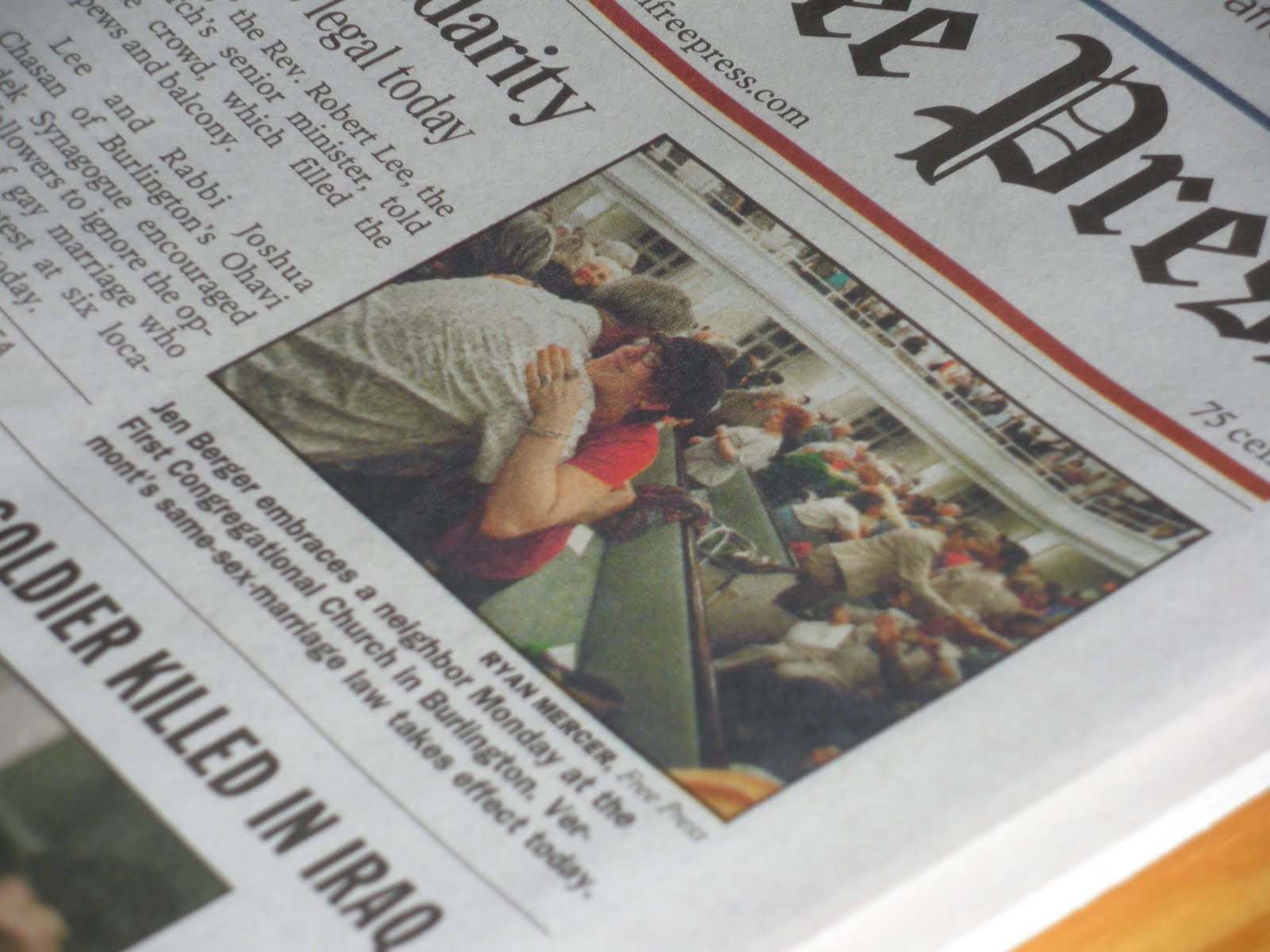
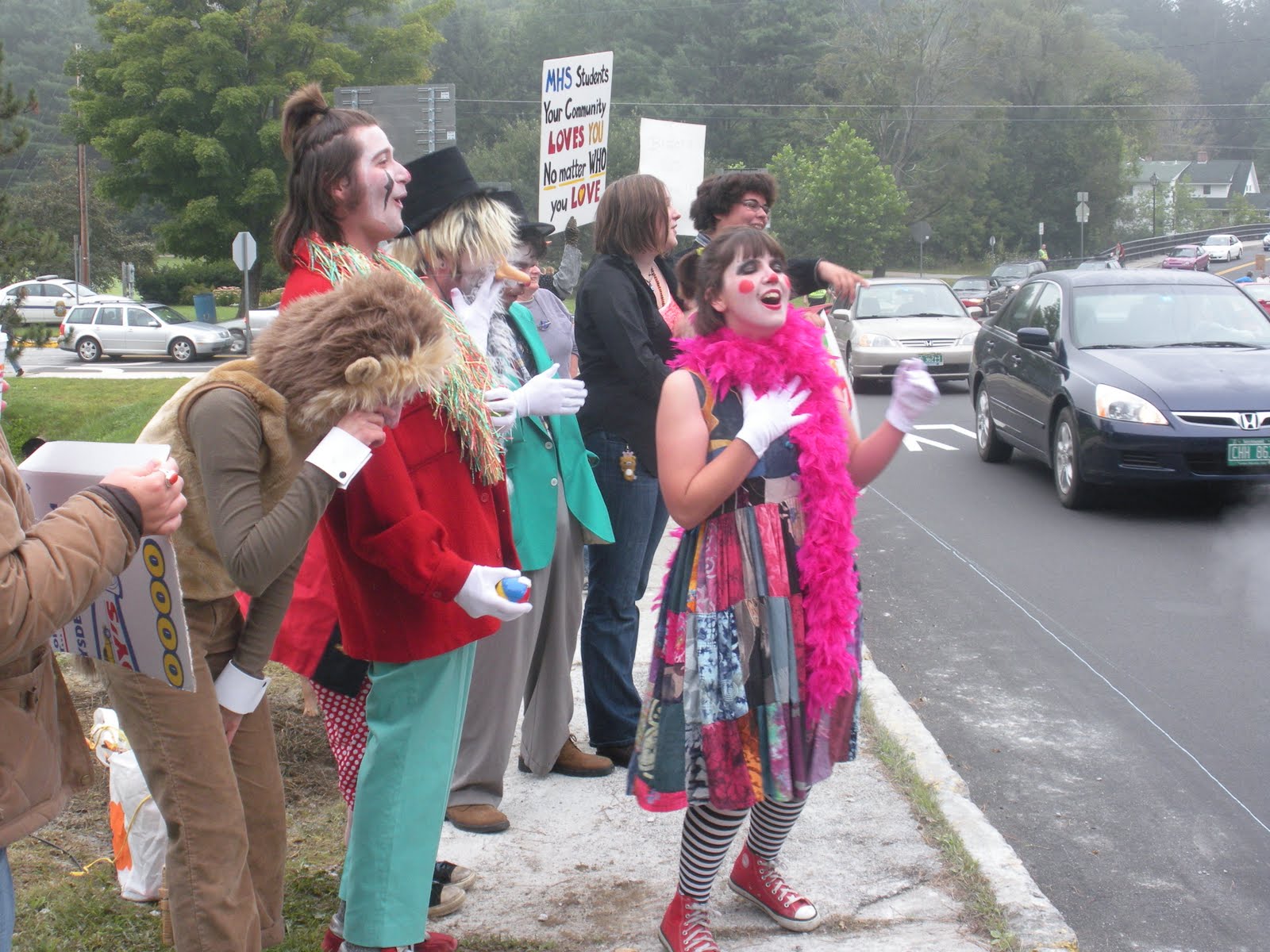
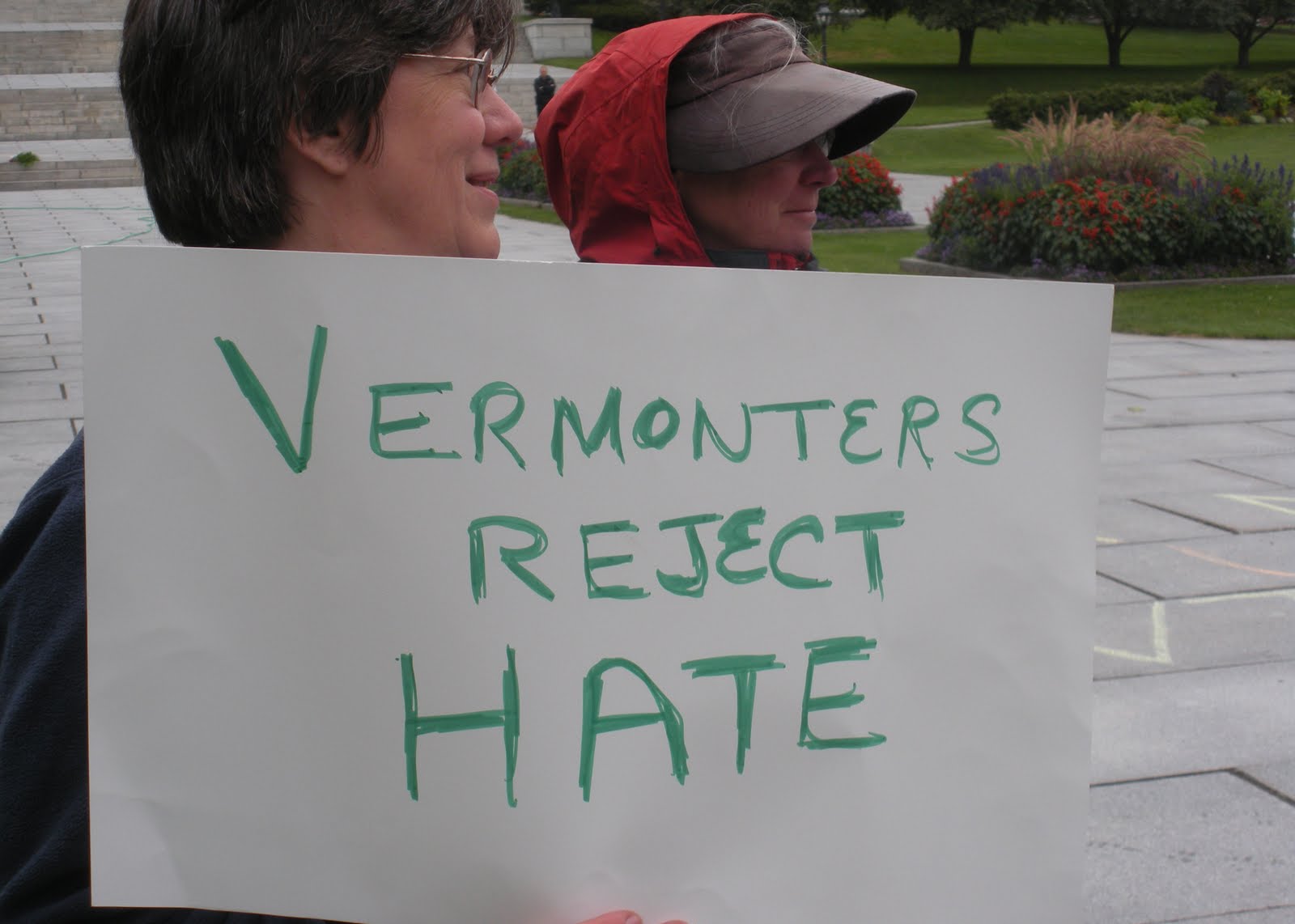
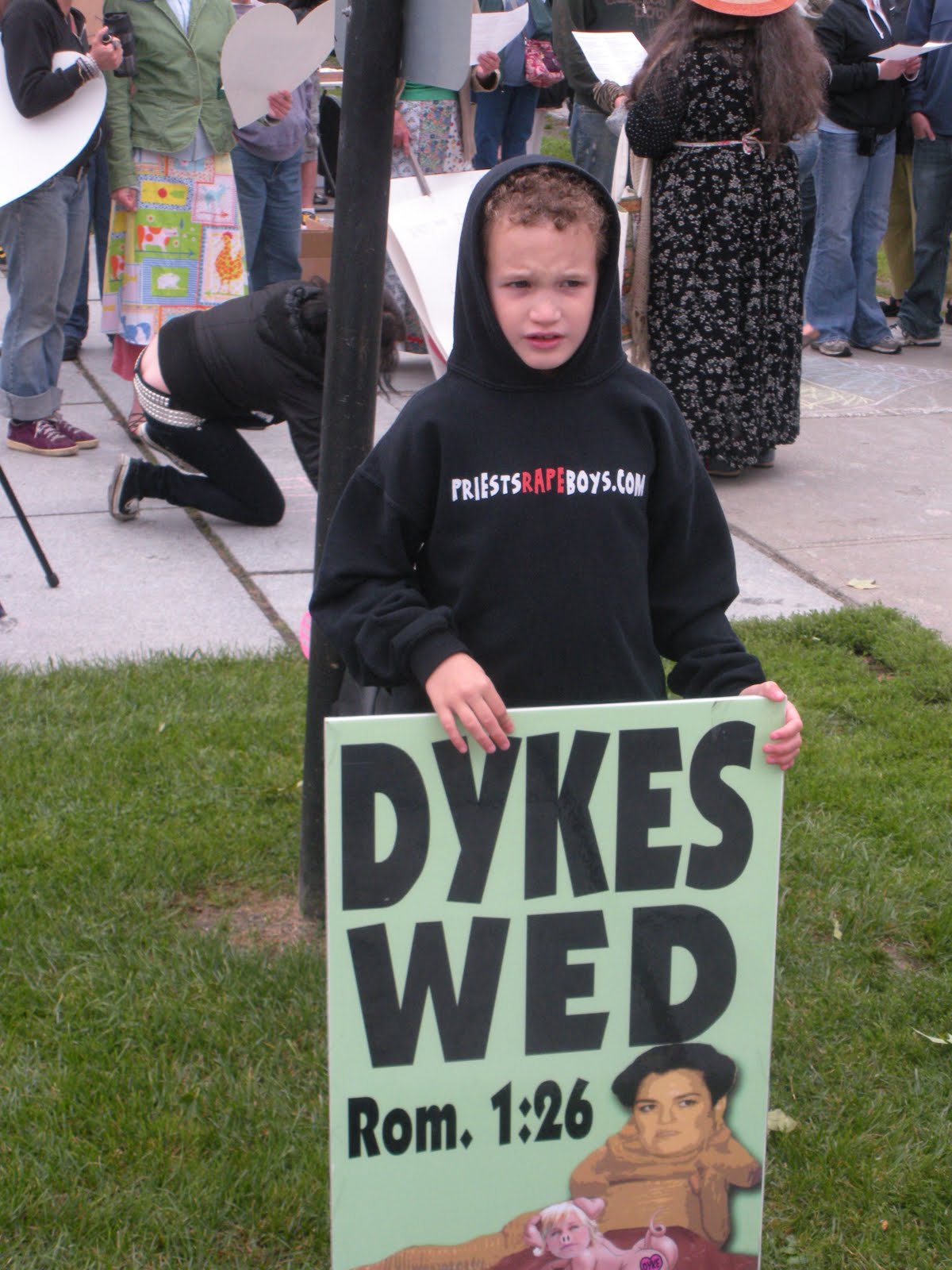
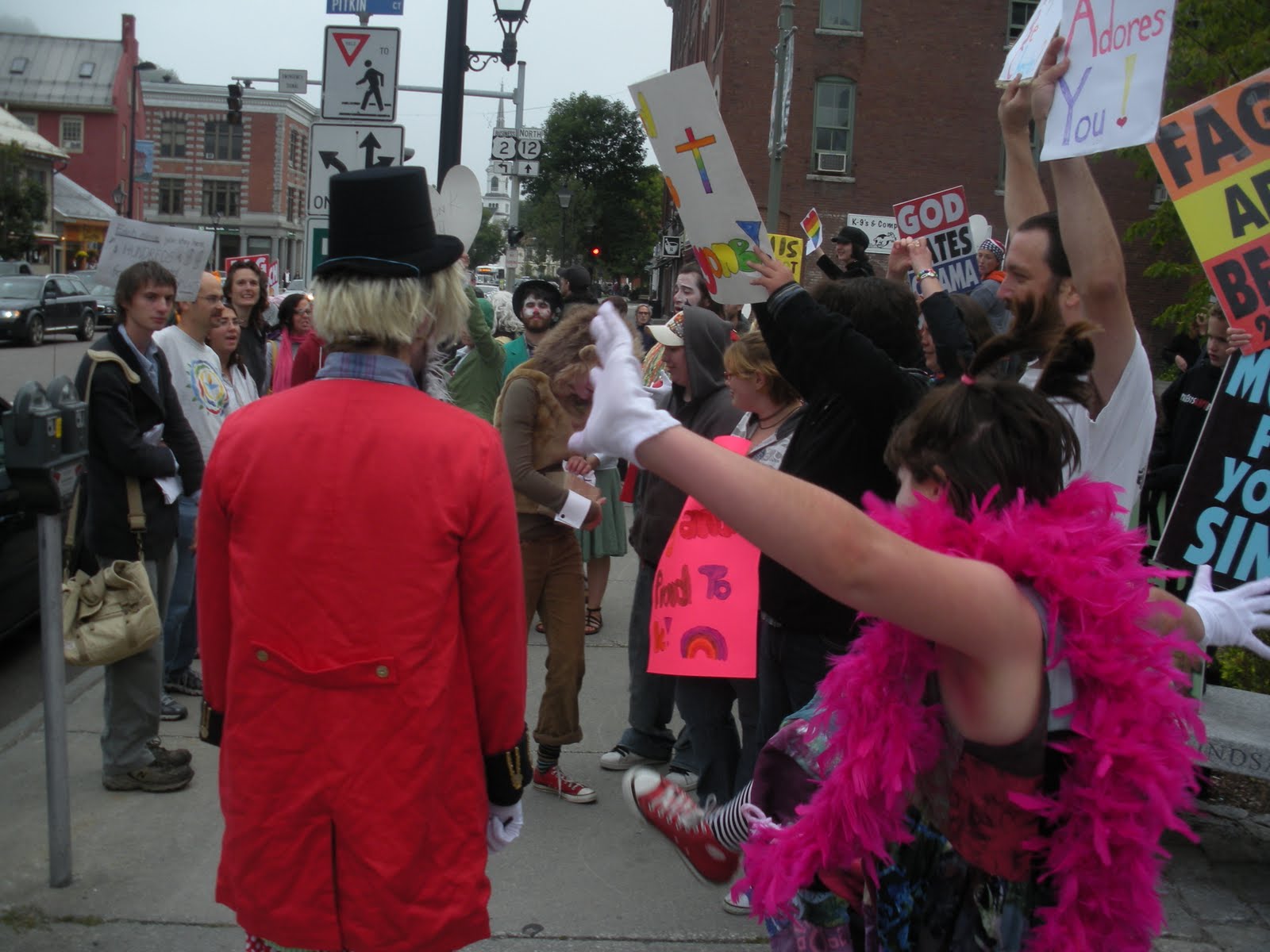
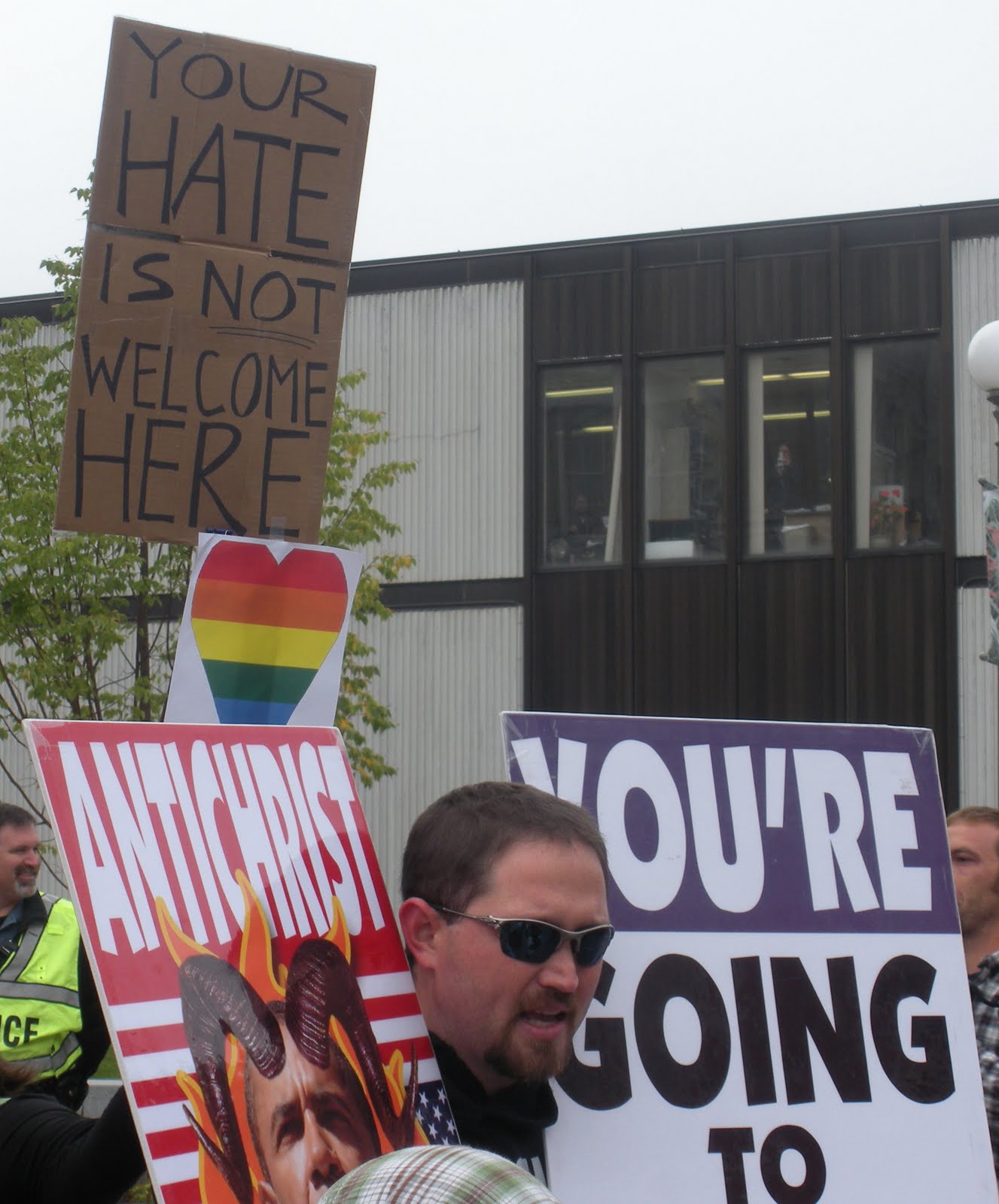
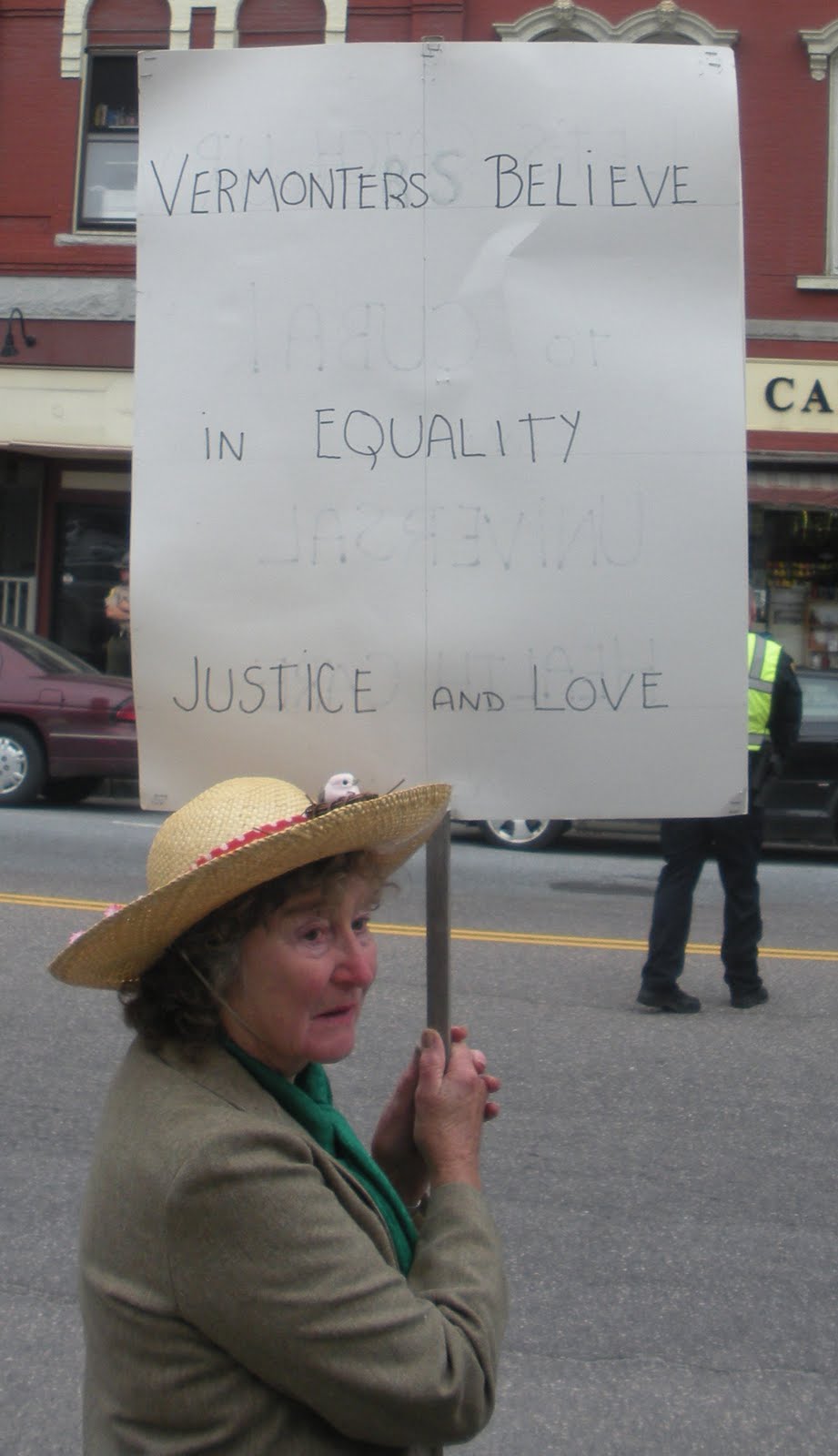
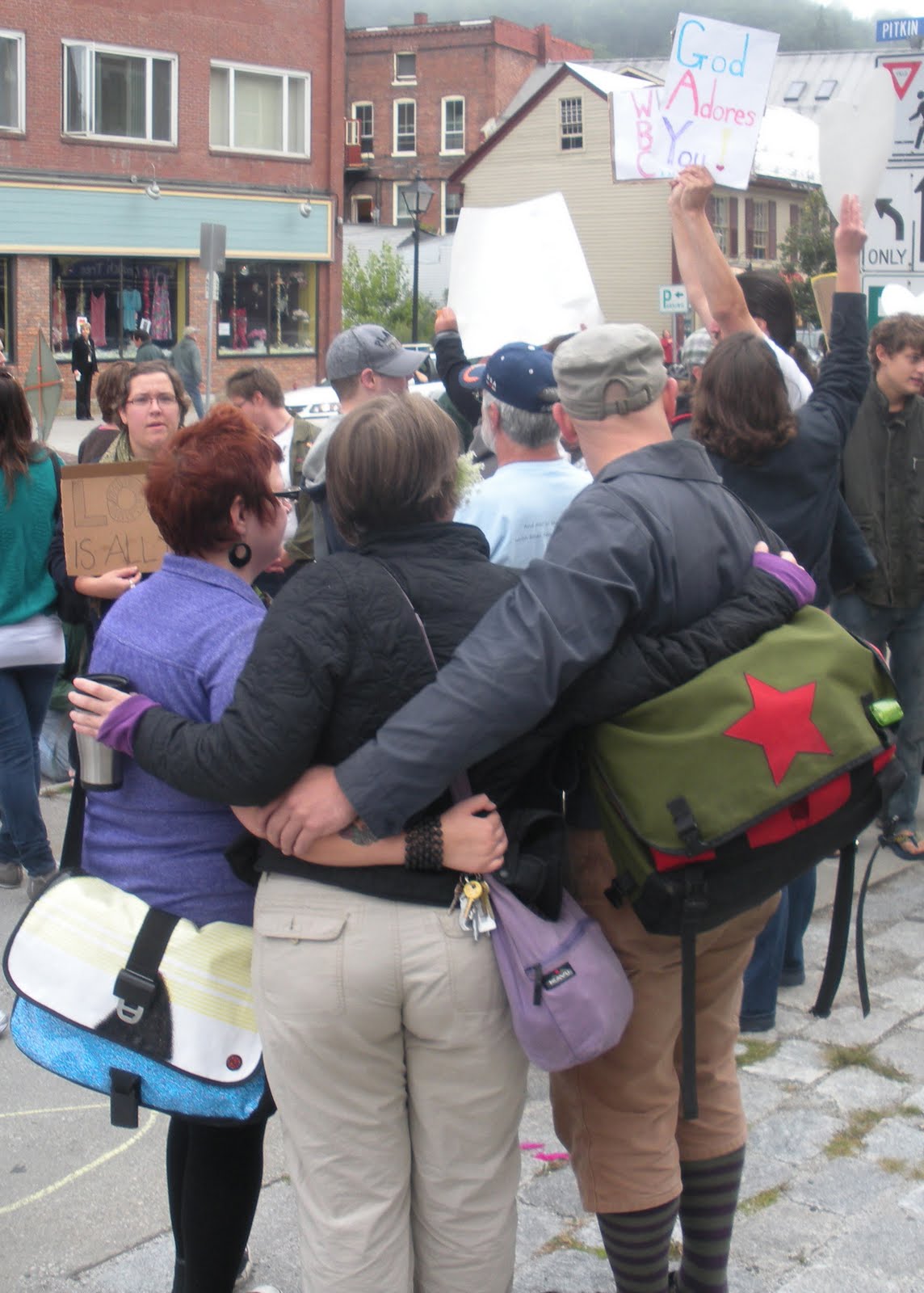
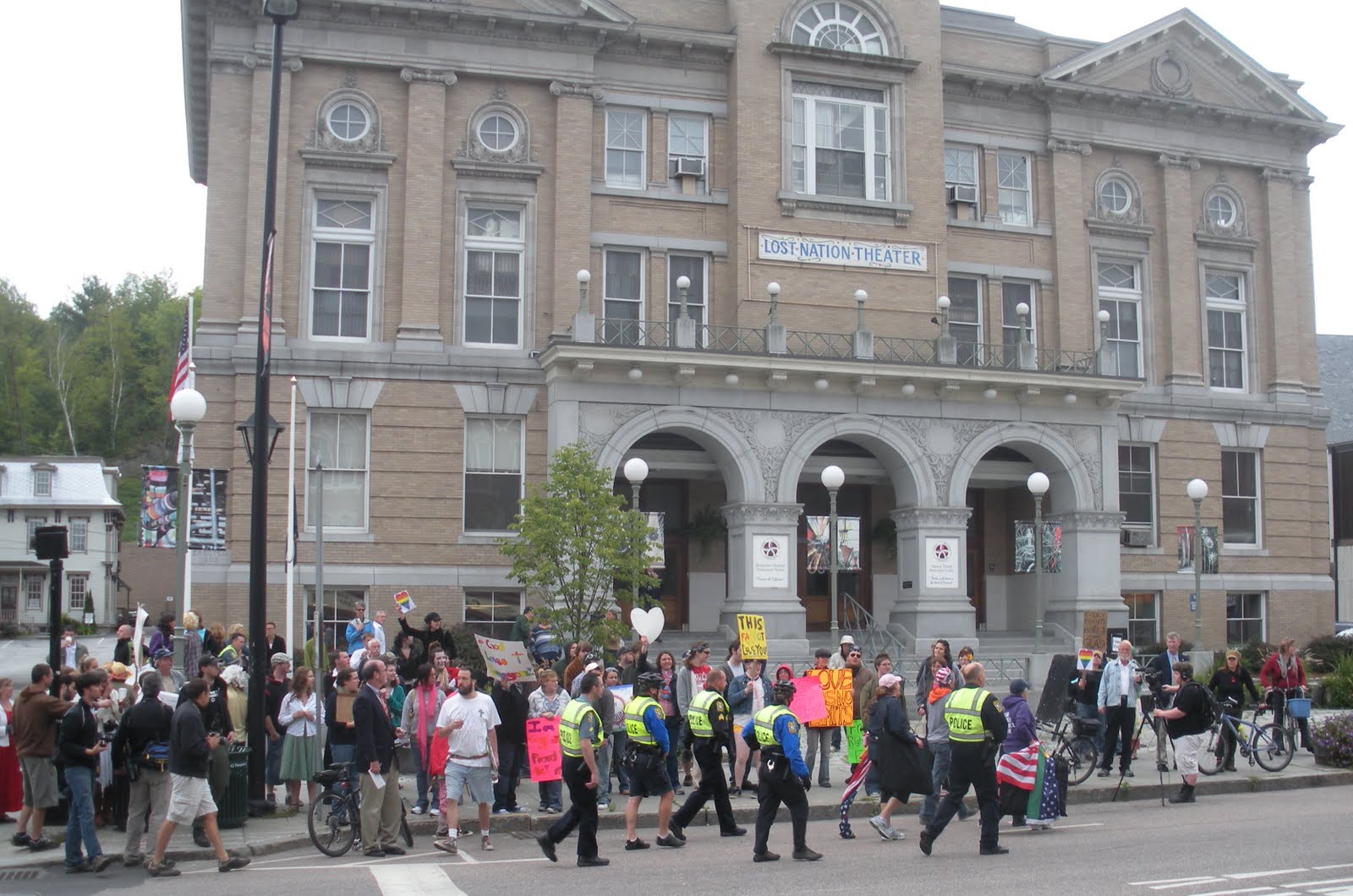
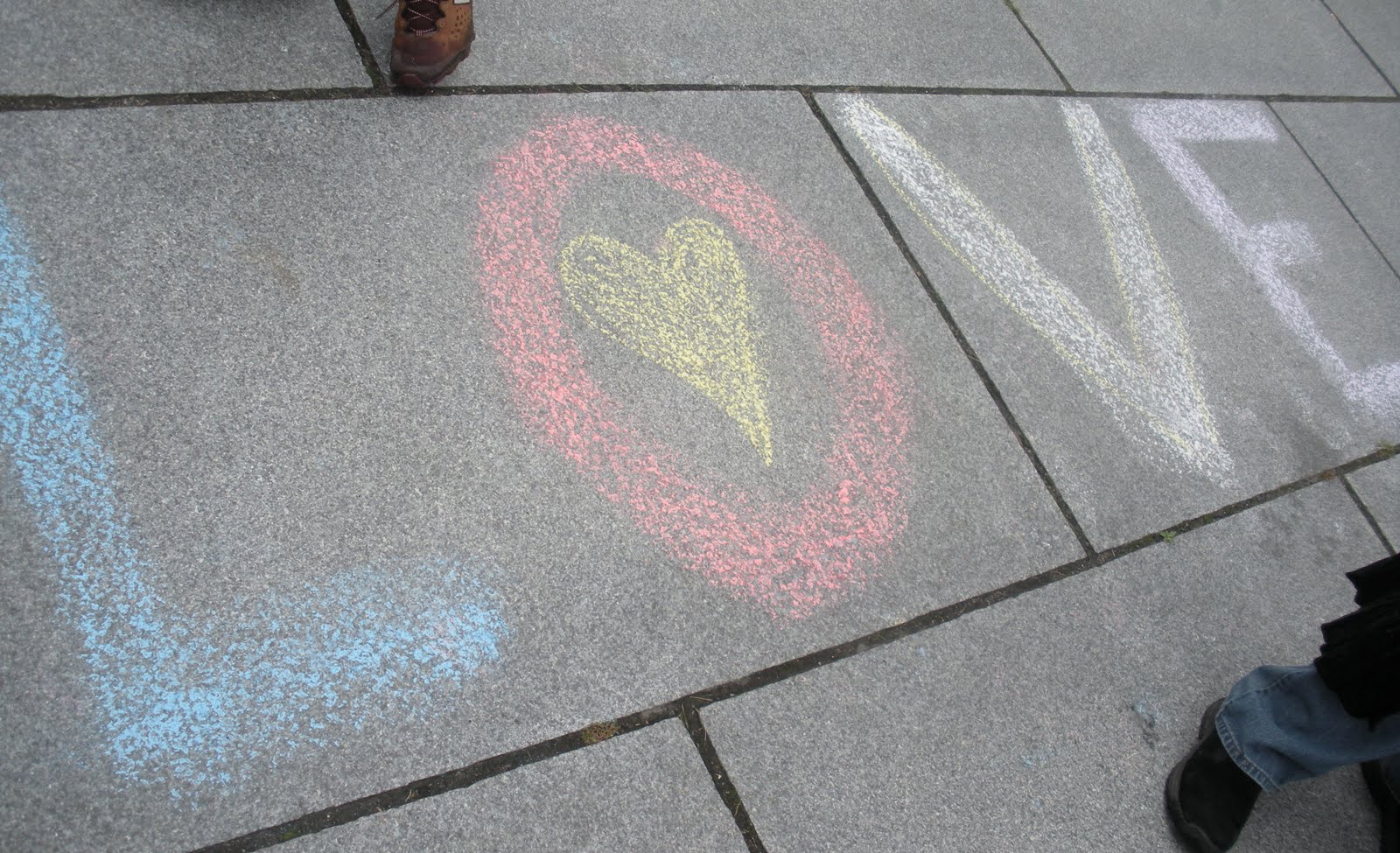
For obvious reasons, this encounter was on my mind yesterday morning when a small group of extreme protesters (or, to be fair, “protesters who some have deemed to be extreme”) visited Vermont to protest gay marriage as well as, it seemed to this biased observer, everything else. They were doing so on behalf of God. I’m not making that up. One of the women in the group said, “you’re darn tootin’ we’re a hate group. We’re preaching the hatred of God.” I can’t begin to imagine what makes these people tick; how one goes about justifying such a message. What I can state with full confidence, though, is that the majority of Vermonters disagree. And disagree they did.

As a writer, my predilection is to use visual aids only when they can complement the written word. After witnessing yesterday’s events, though, I understand that the only proper way to document this story is to complement the photographs with captions.

This story is one of love and hate. While love is appropriate for all ages, the photo essay that follows might not be.

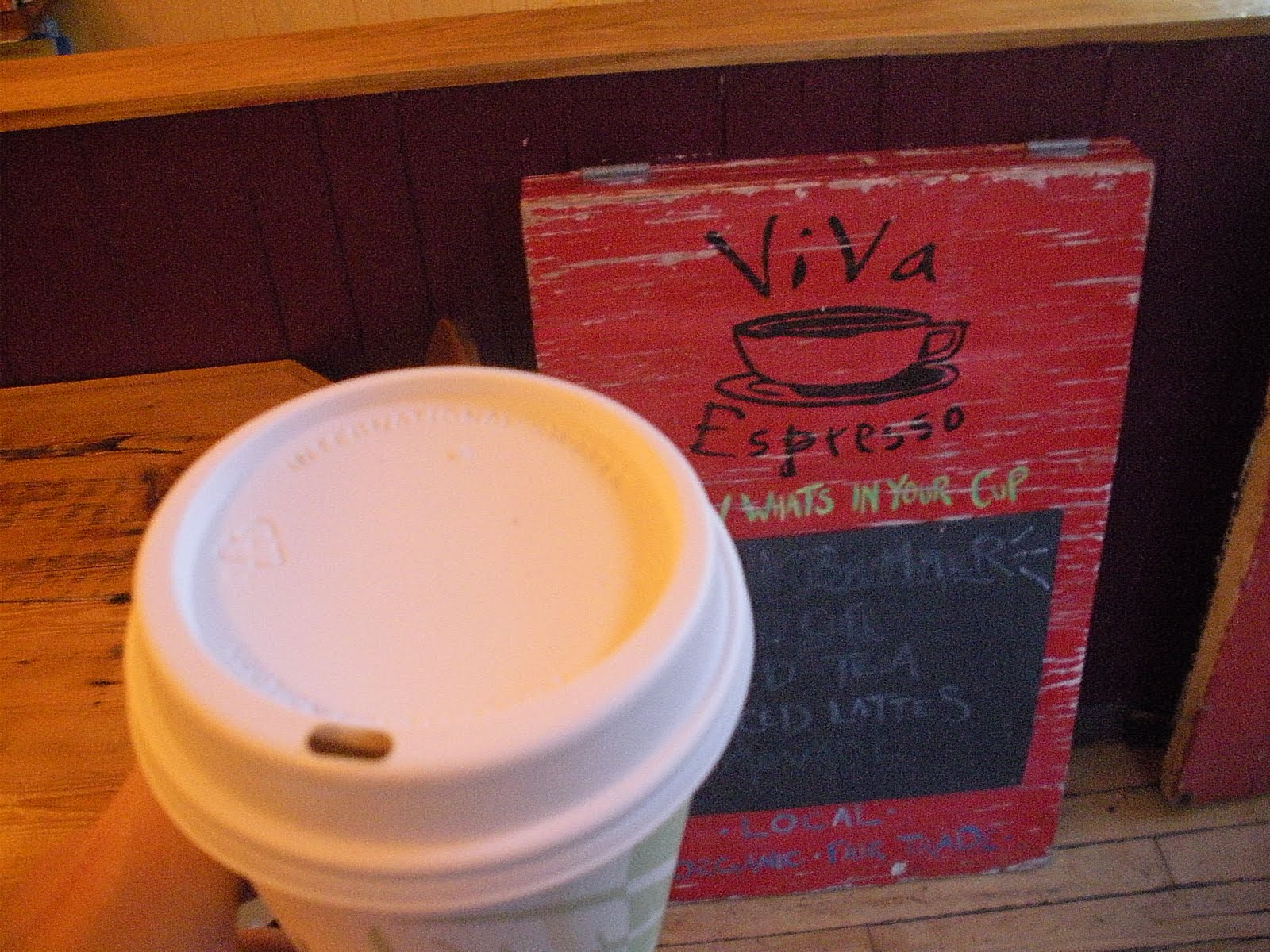
We love Viva Espresso for opening at 6 a.m. …

… so that Sarah and I could get our coffee.
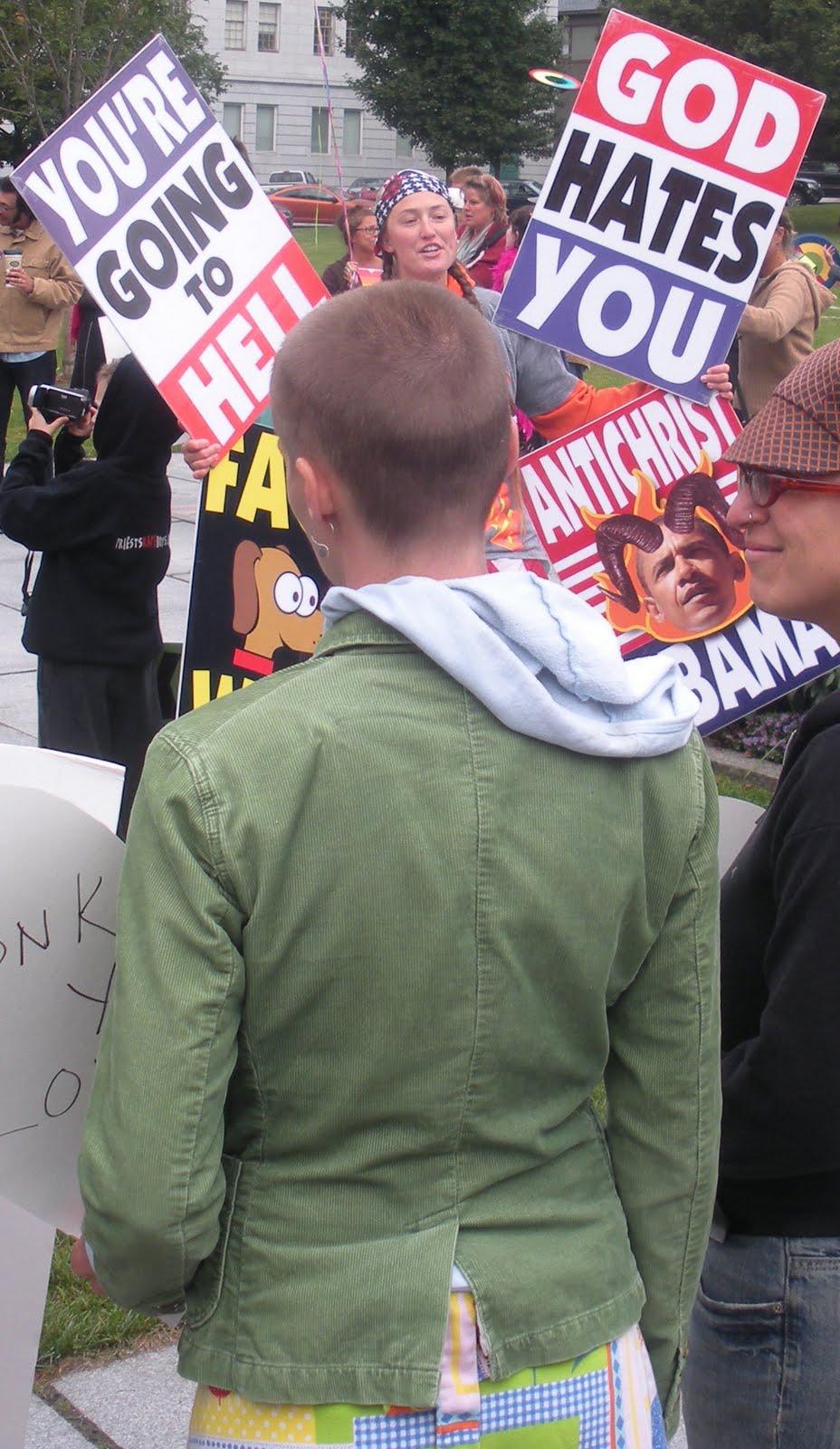
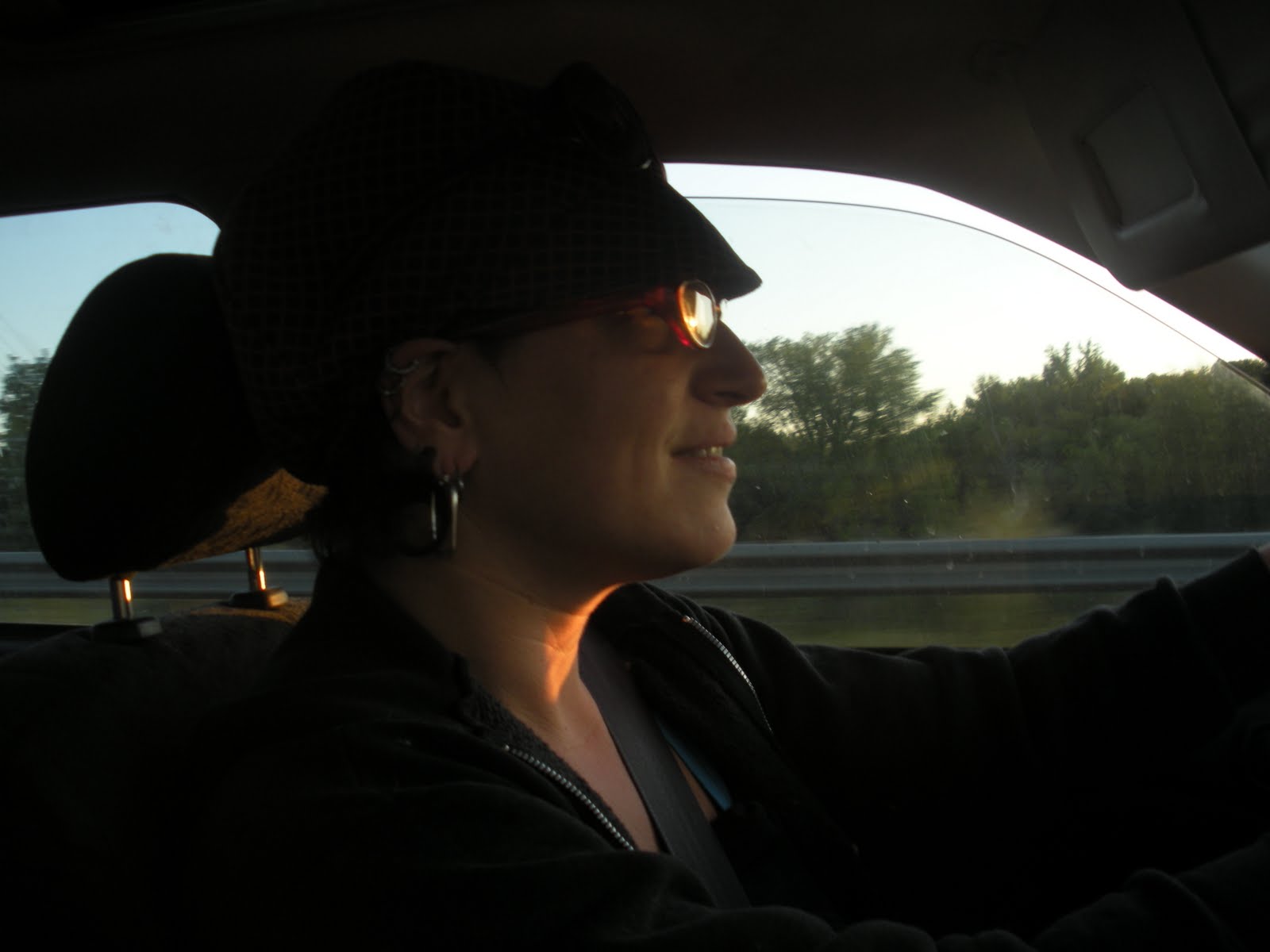
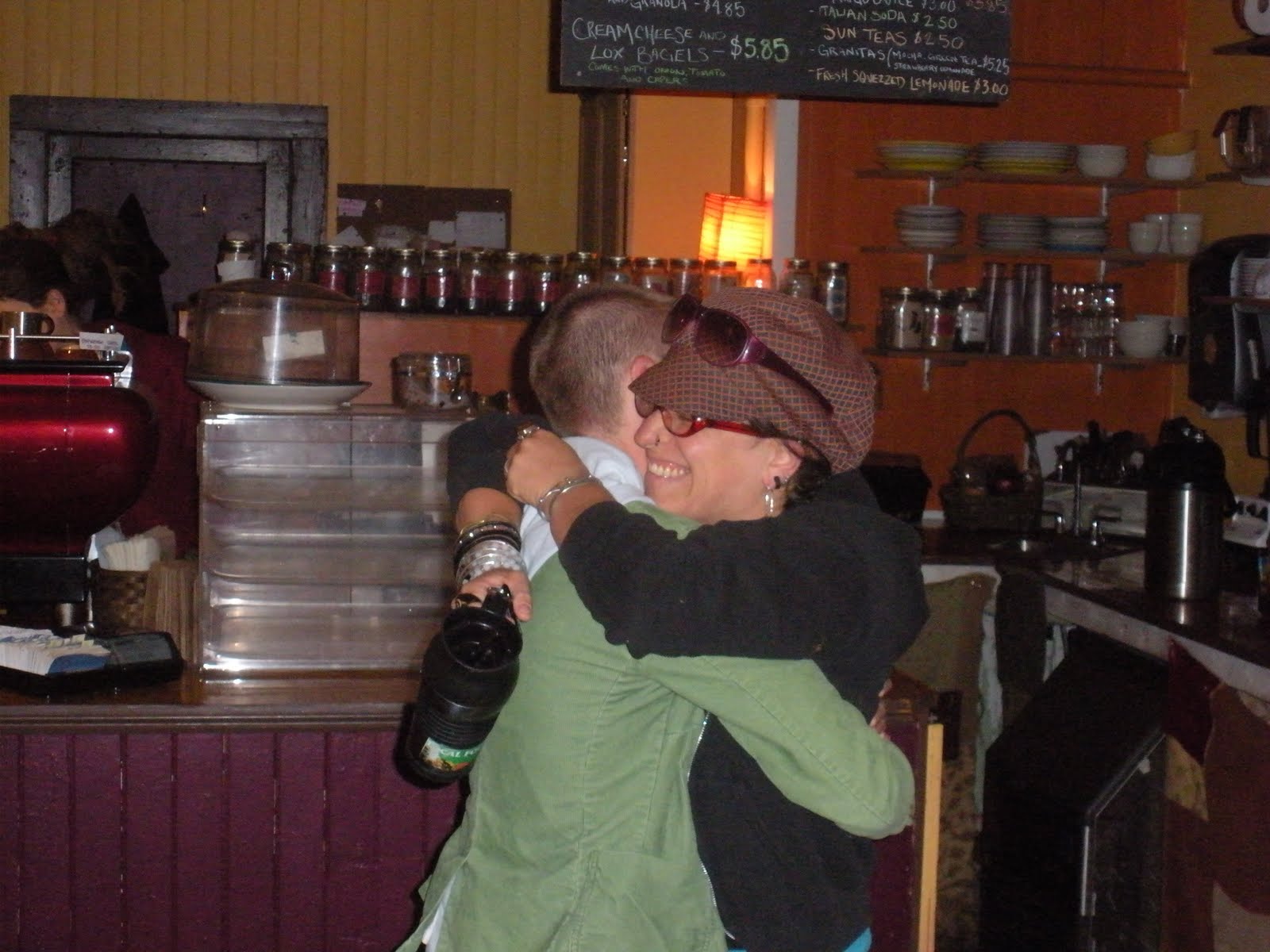
And then Jen showed up and was loved …

… and reenacted the morning’s news.
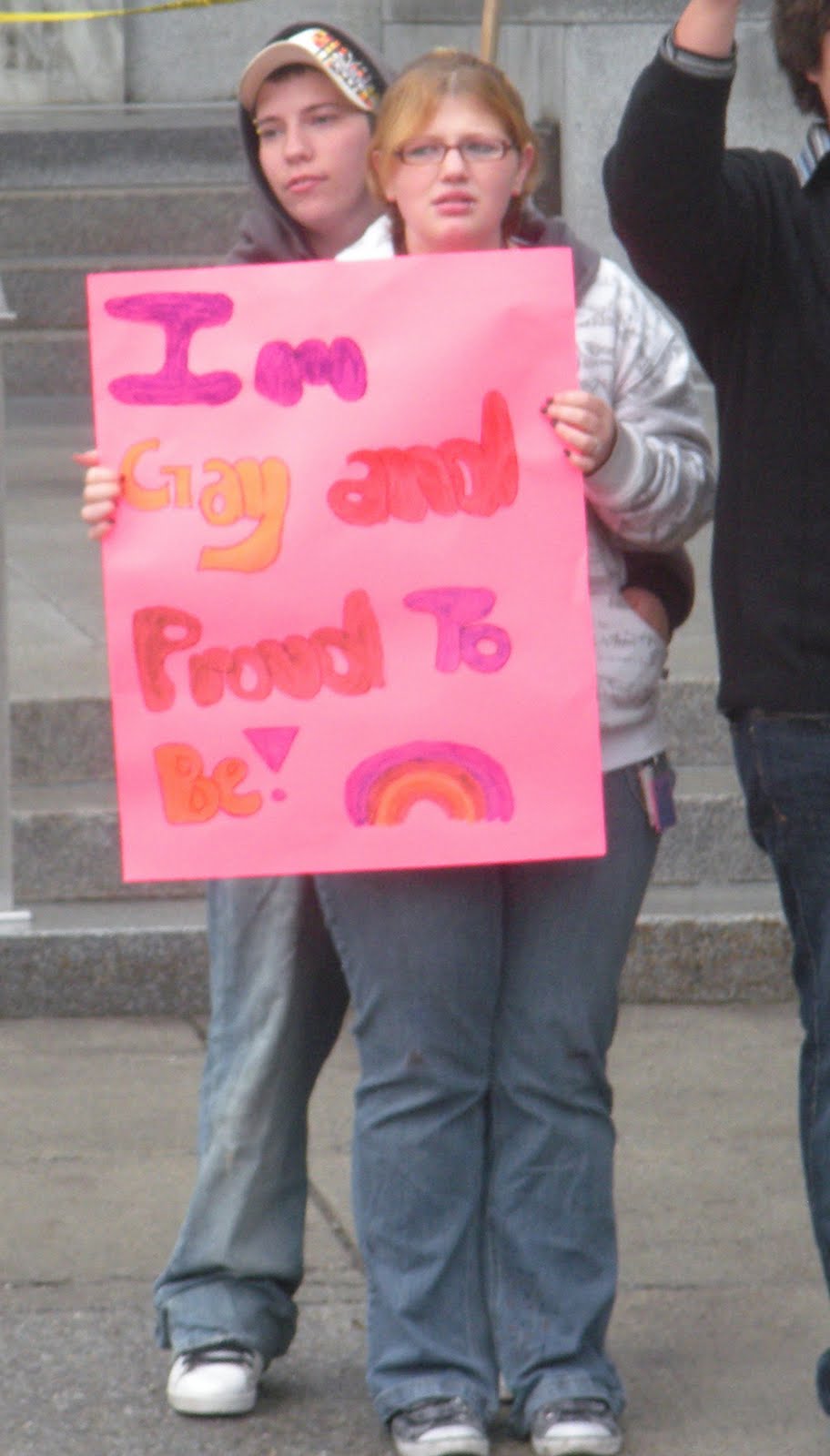
And then the sun showed up.

And we love the sun.

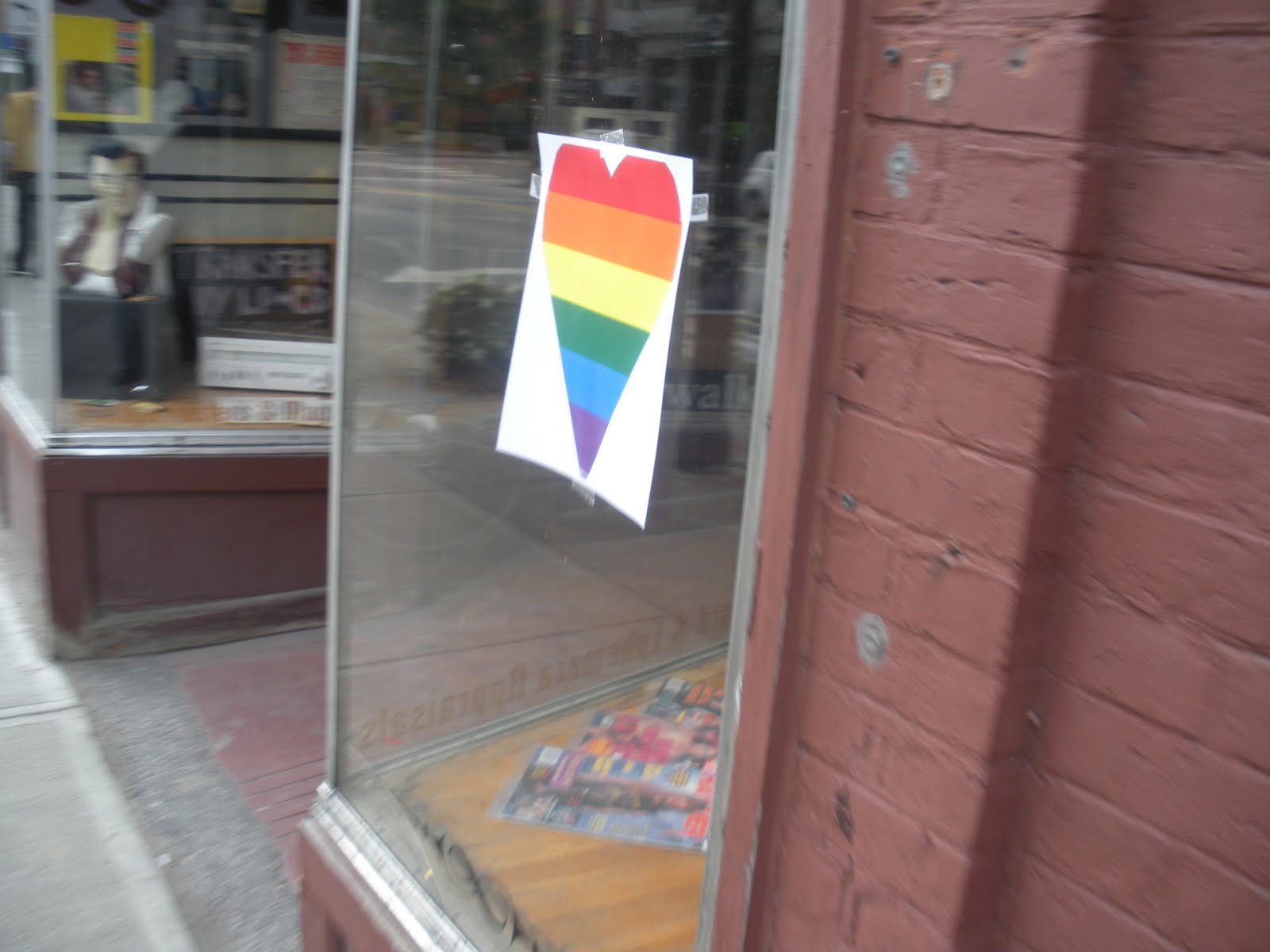
When we saw this, we knew Montpelier loved us.

And God loves Anne.

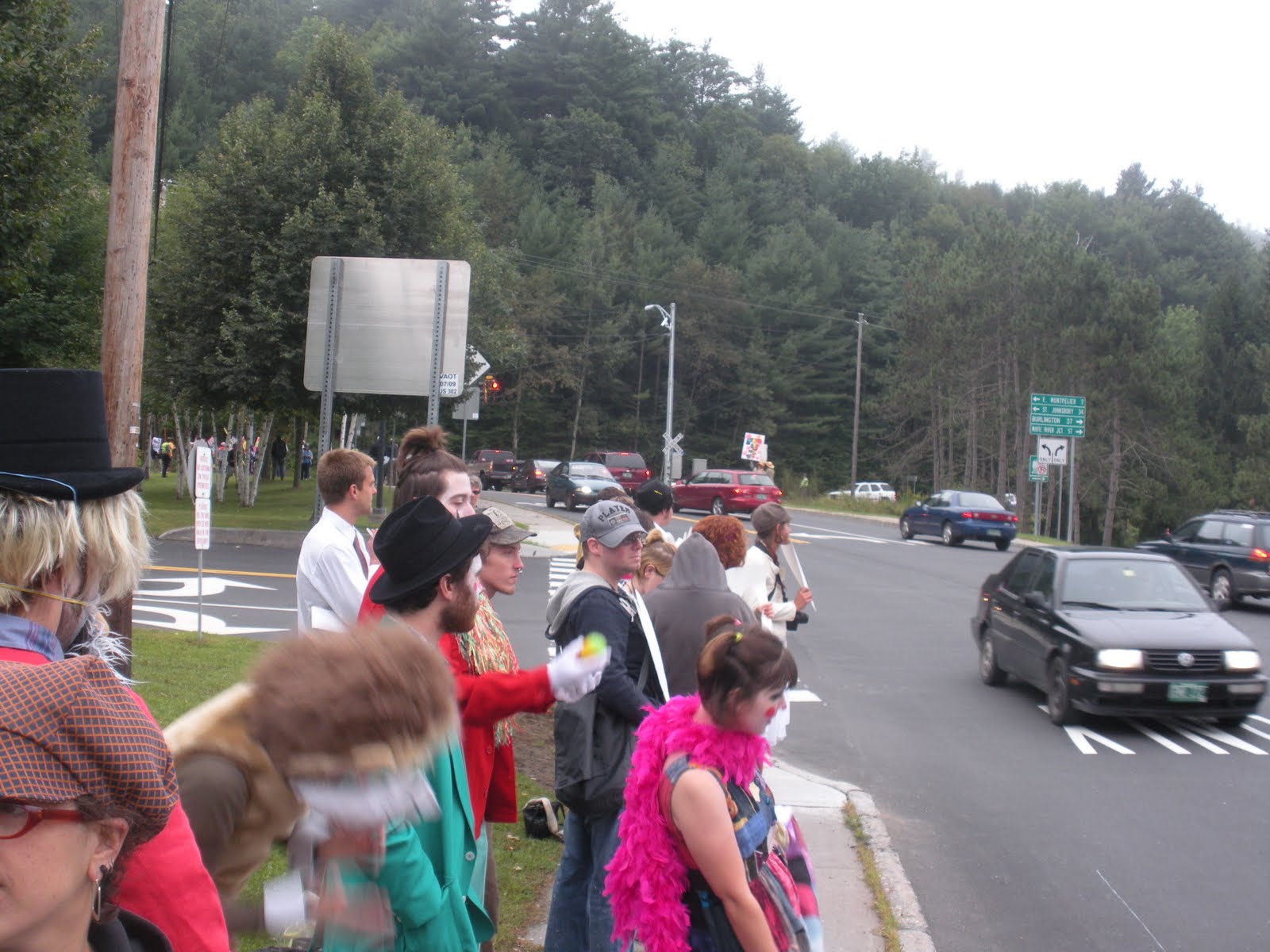
And other people showed up …

… to show their love.

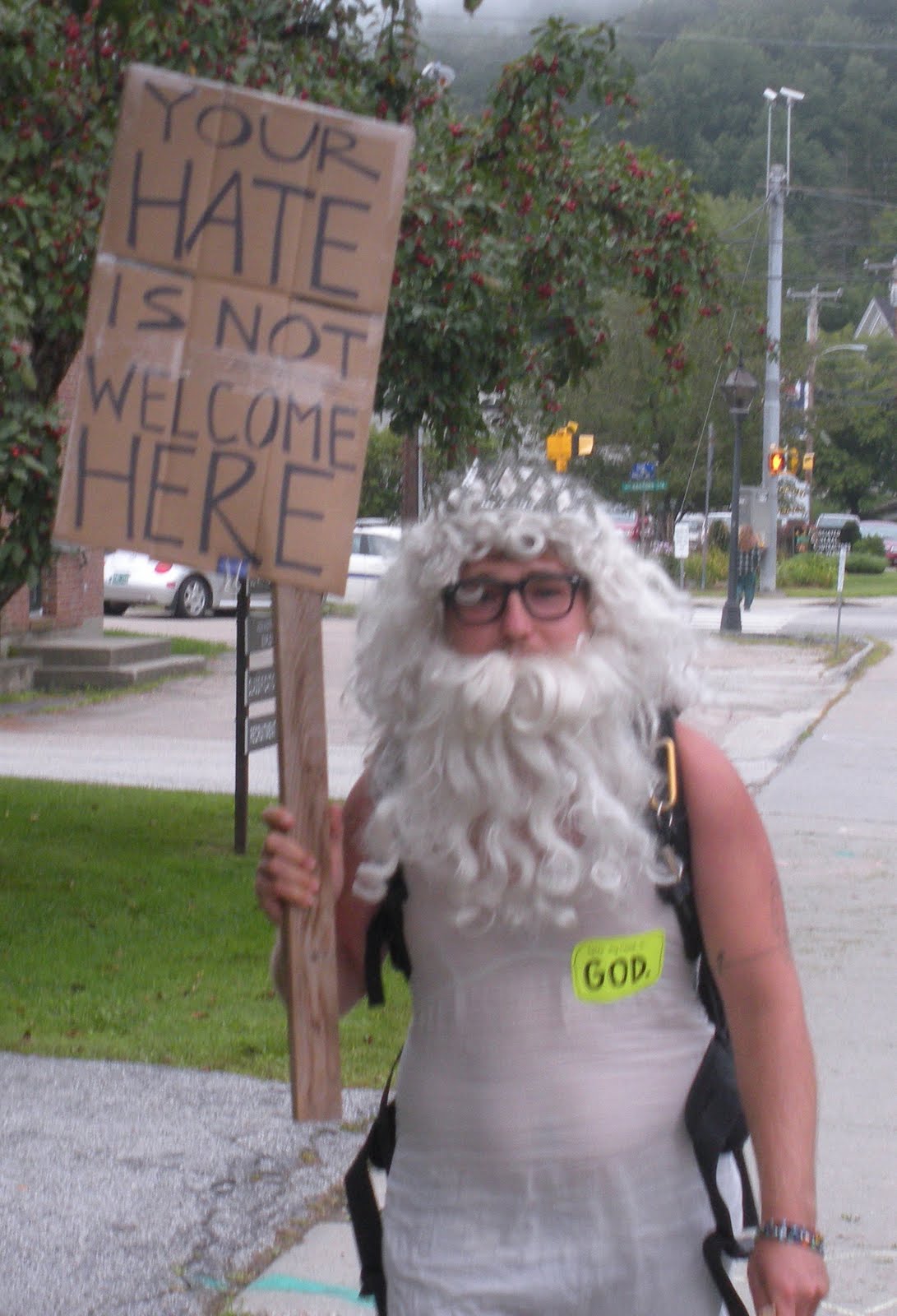
And this guy loved the shirt right off of his back.

And then the hate came.

But that didn’t stop the love.

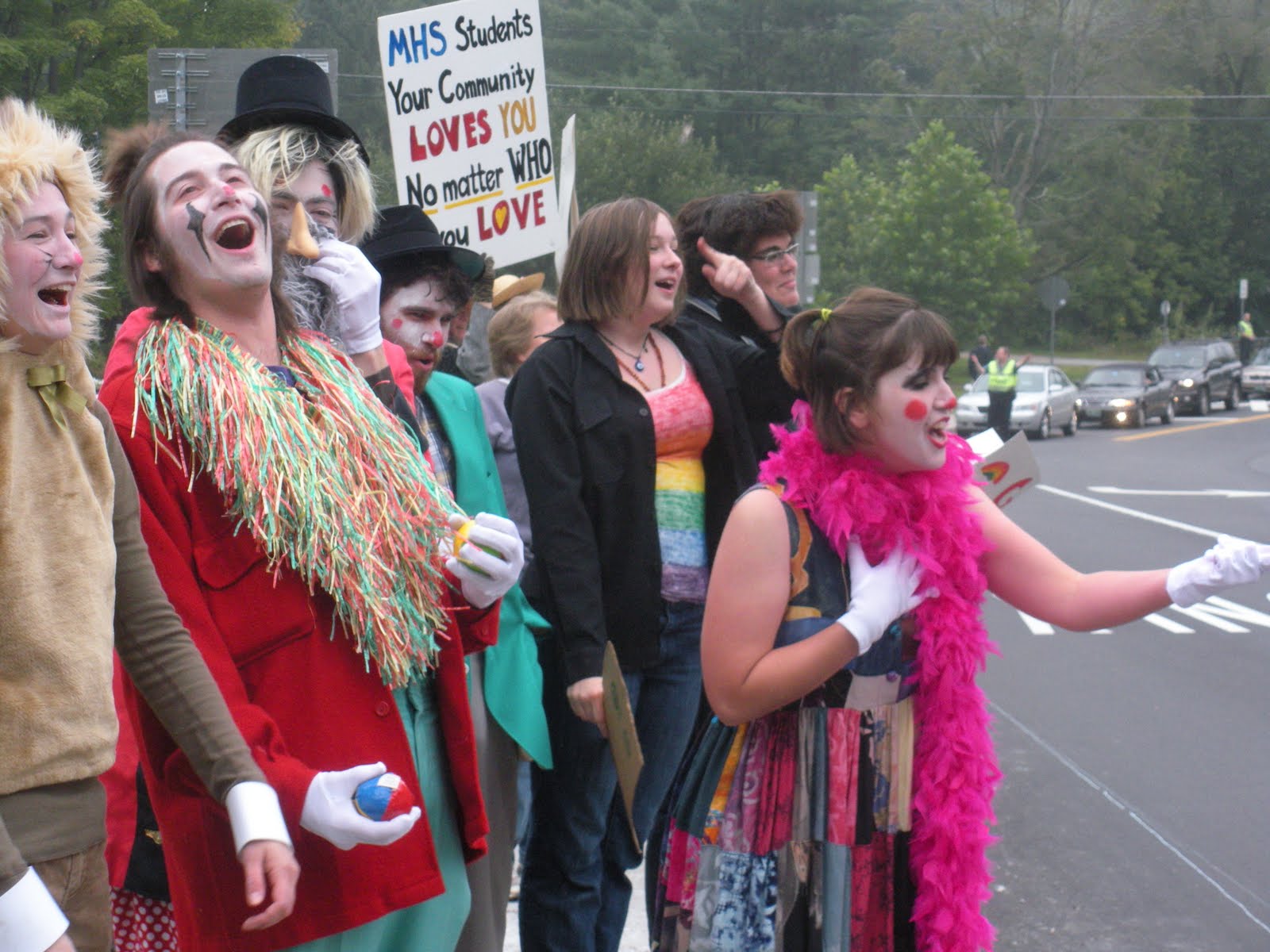
And love laughed …

… and laughed …

… because hate is no match for love …

… and because the joke was on hate.

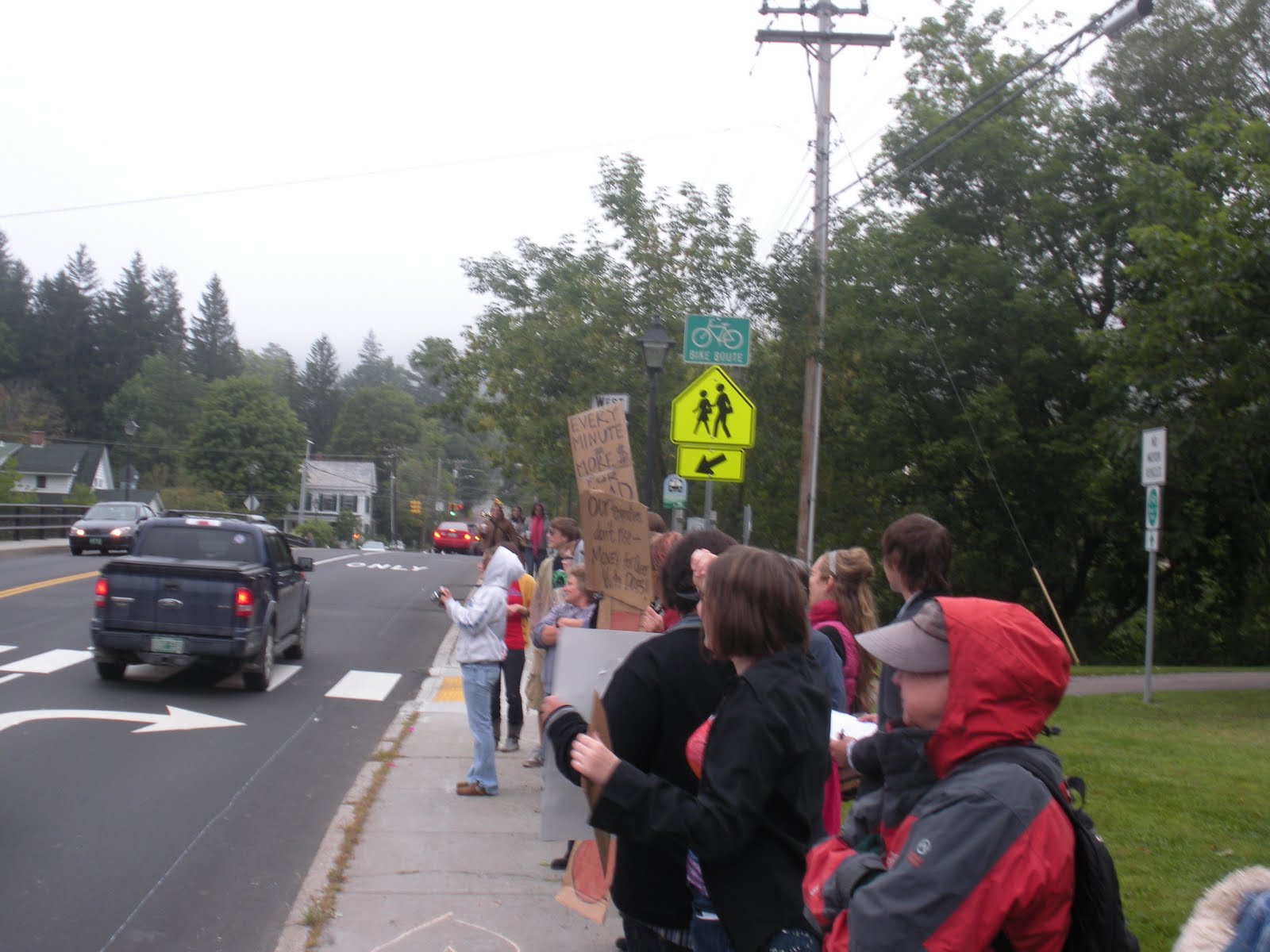
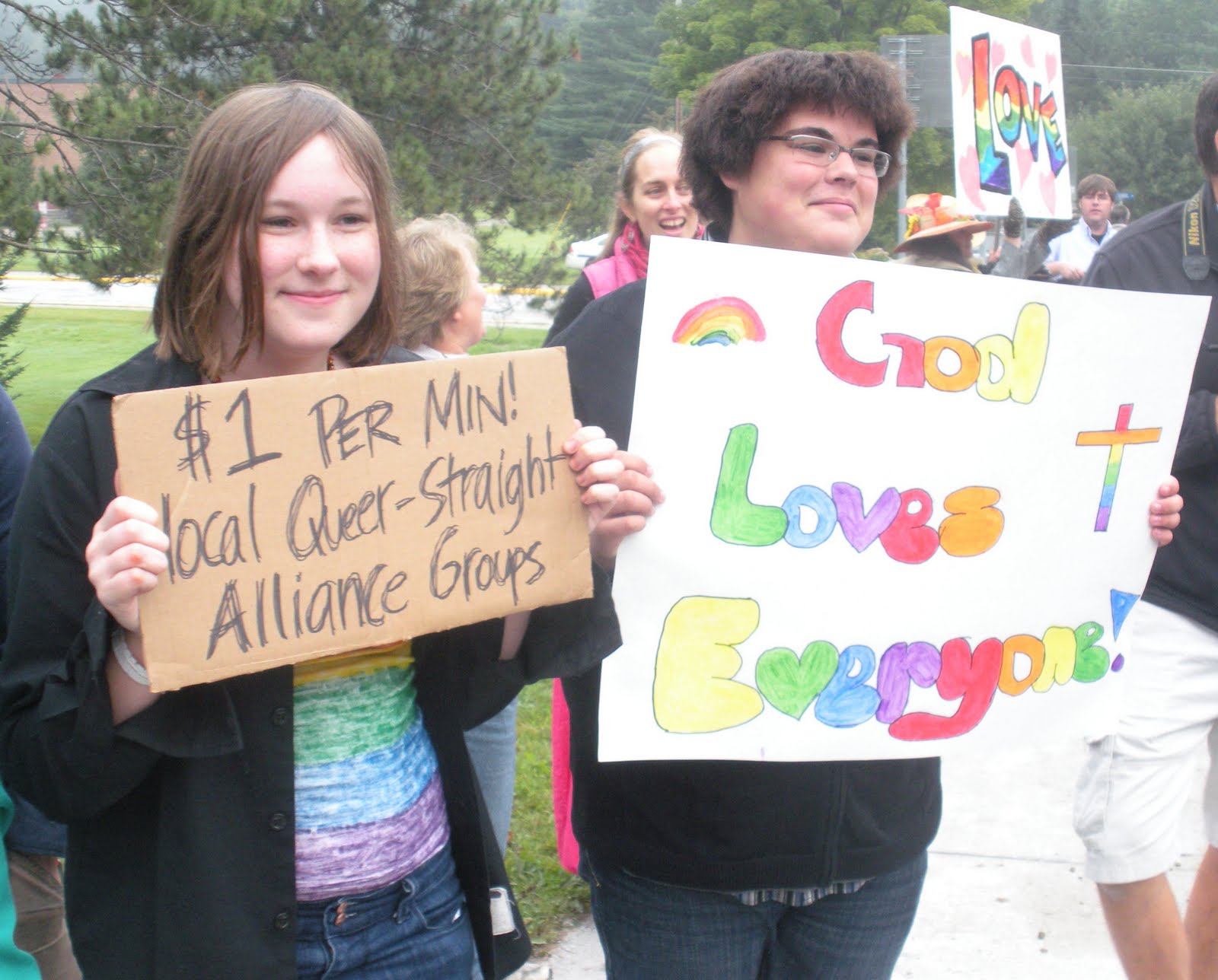
You see, every minute they hated, love raised money. (For more information, see the Facebook group Westboro Baptist Church Hates, Montpelier High School Donates.)

And raise money they did!

Even God helped.

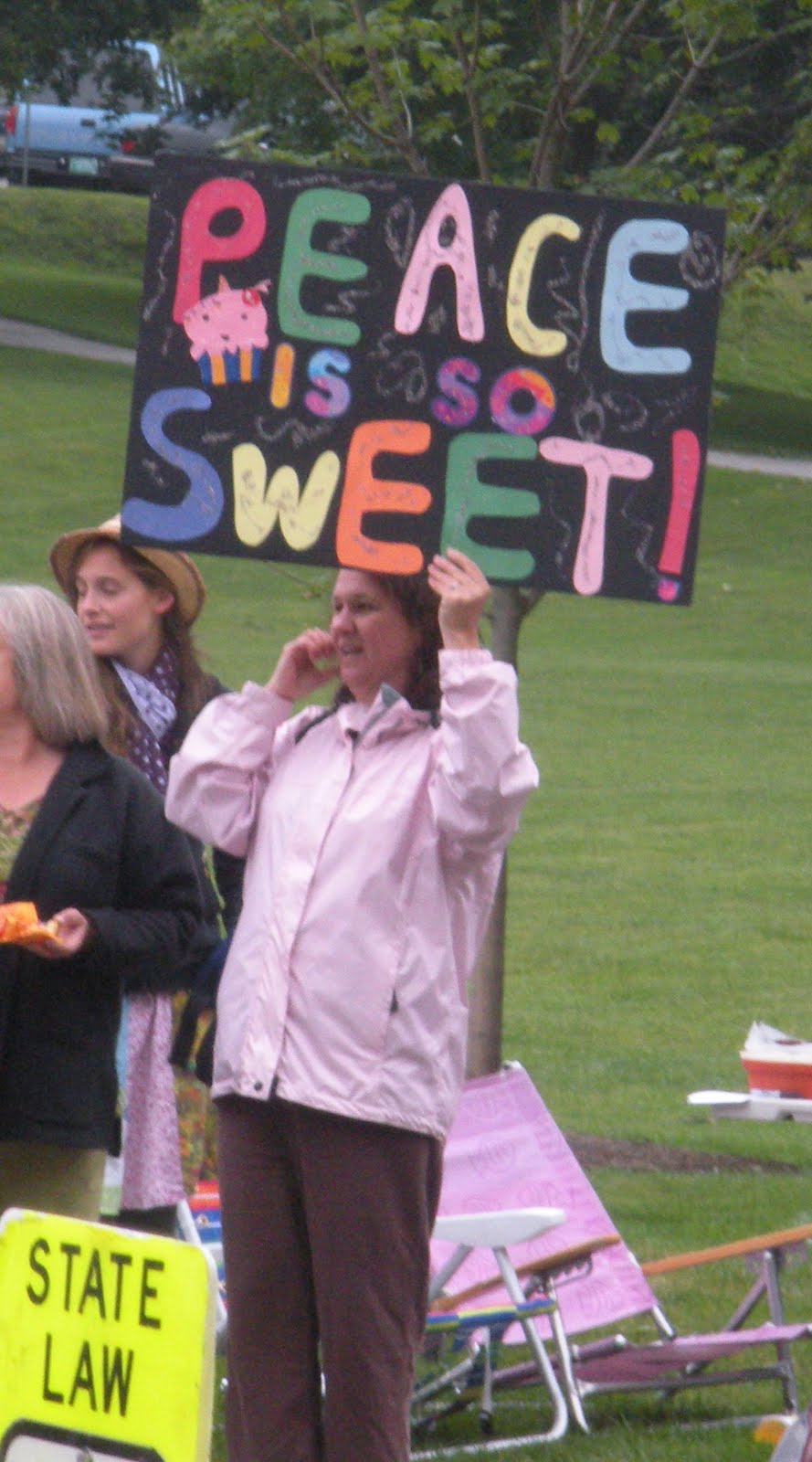
And so did Peace.

And hate kept hating.

And we kept loving …

… even when it would have been easy not to.

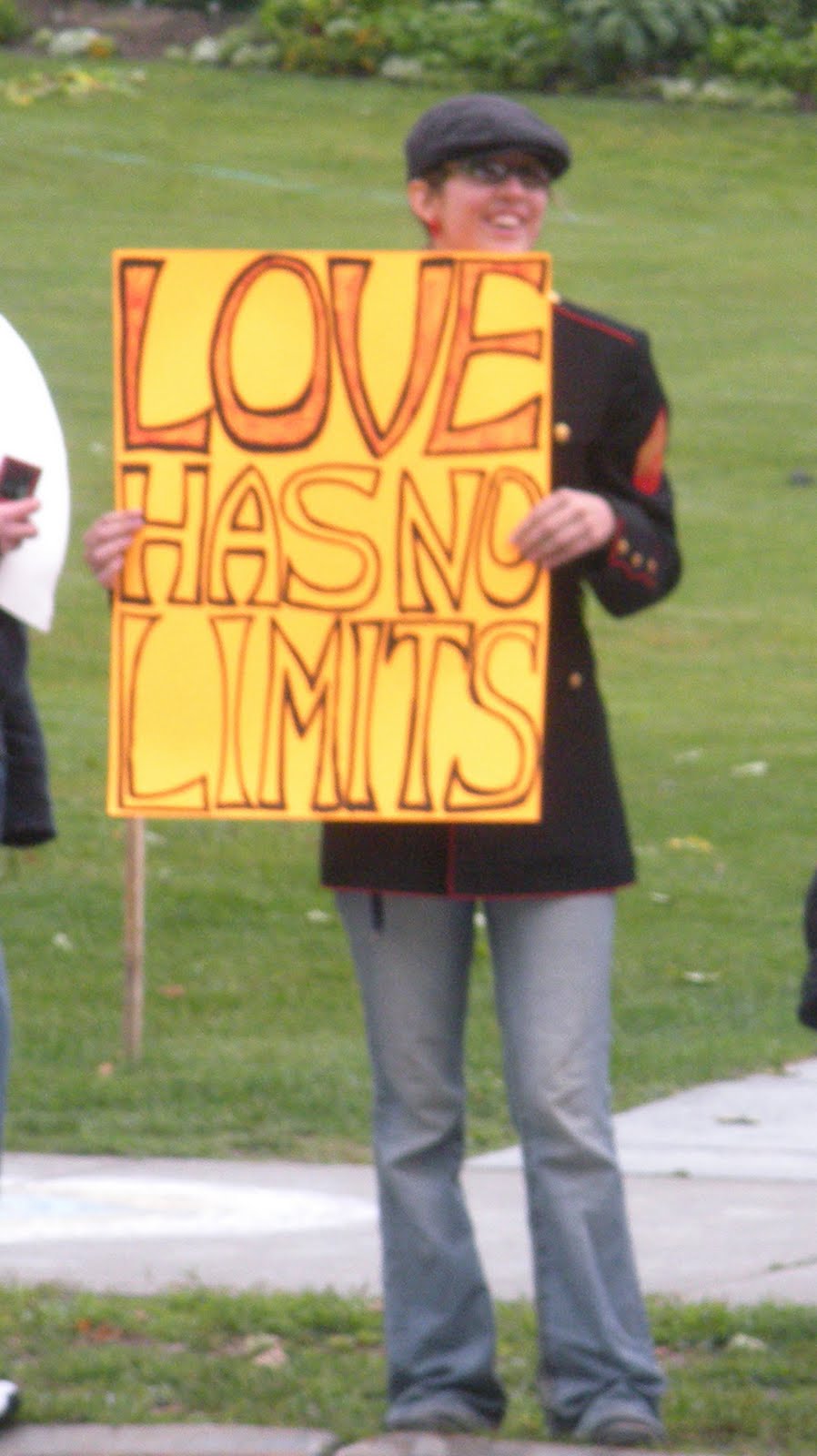
Because love has no limits.

Not even in the eyes of the law.

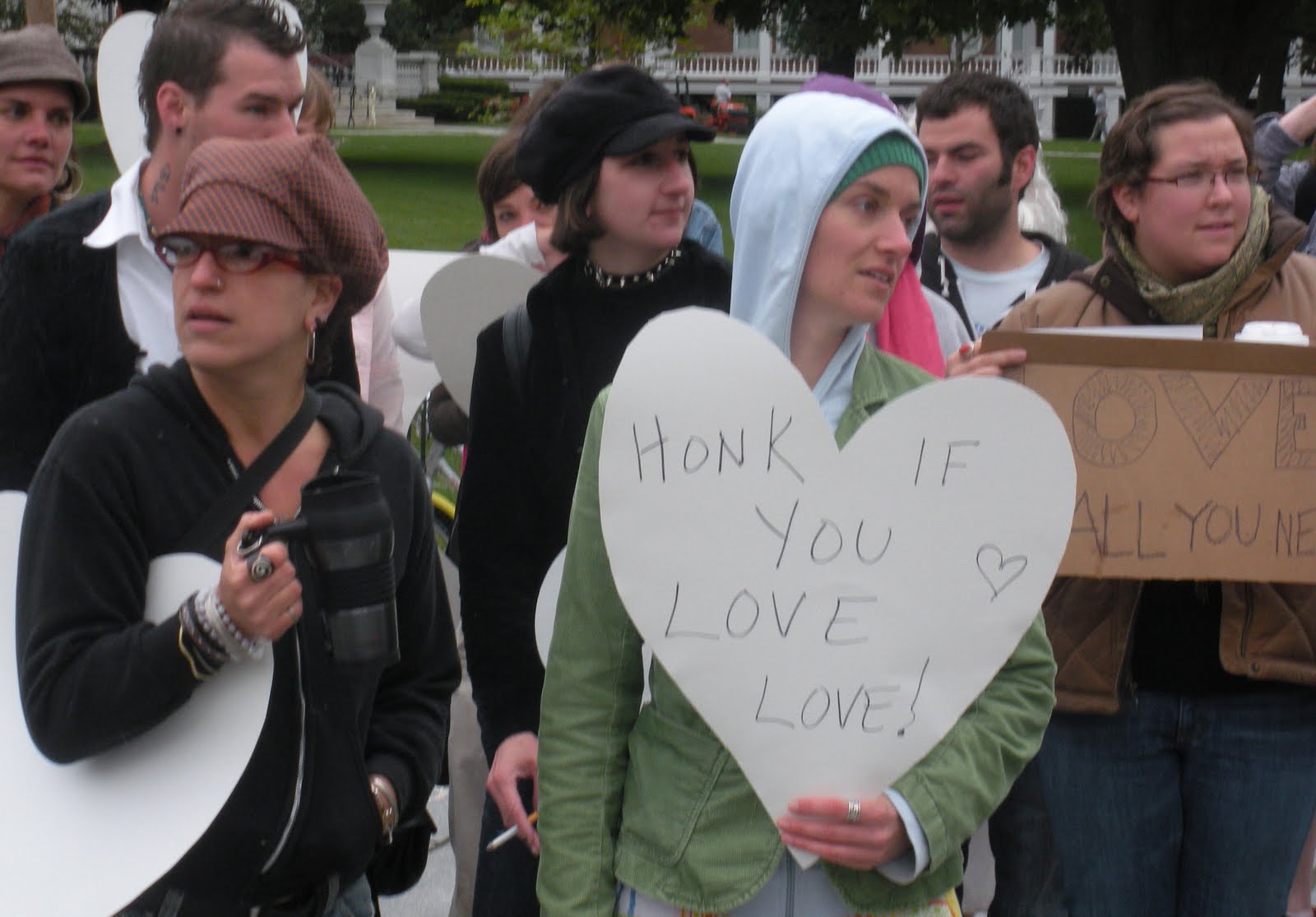
So we honked for love.

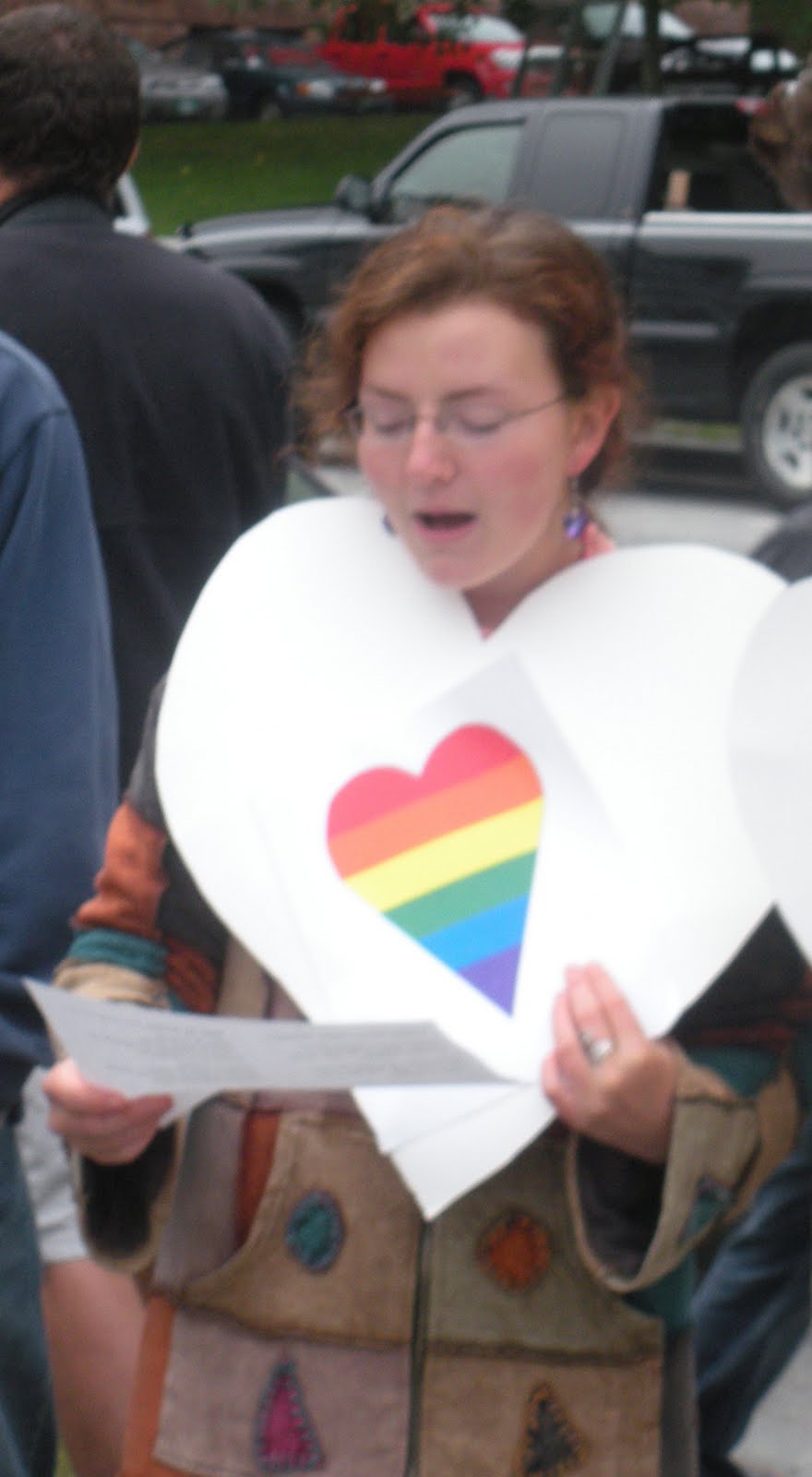
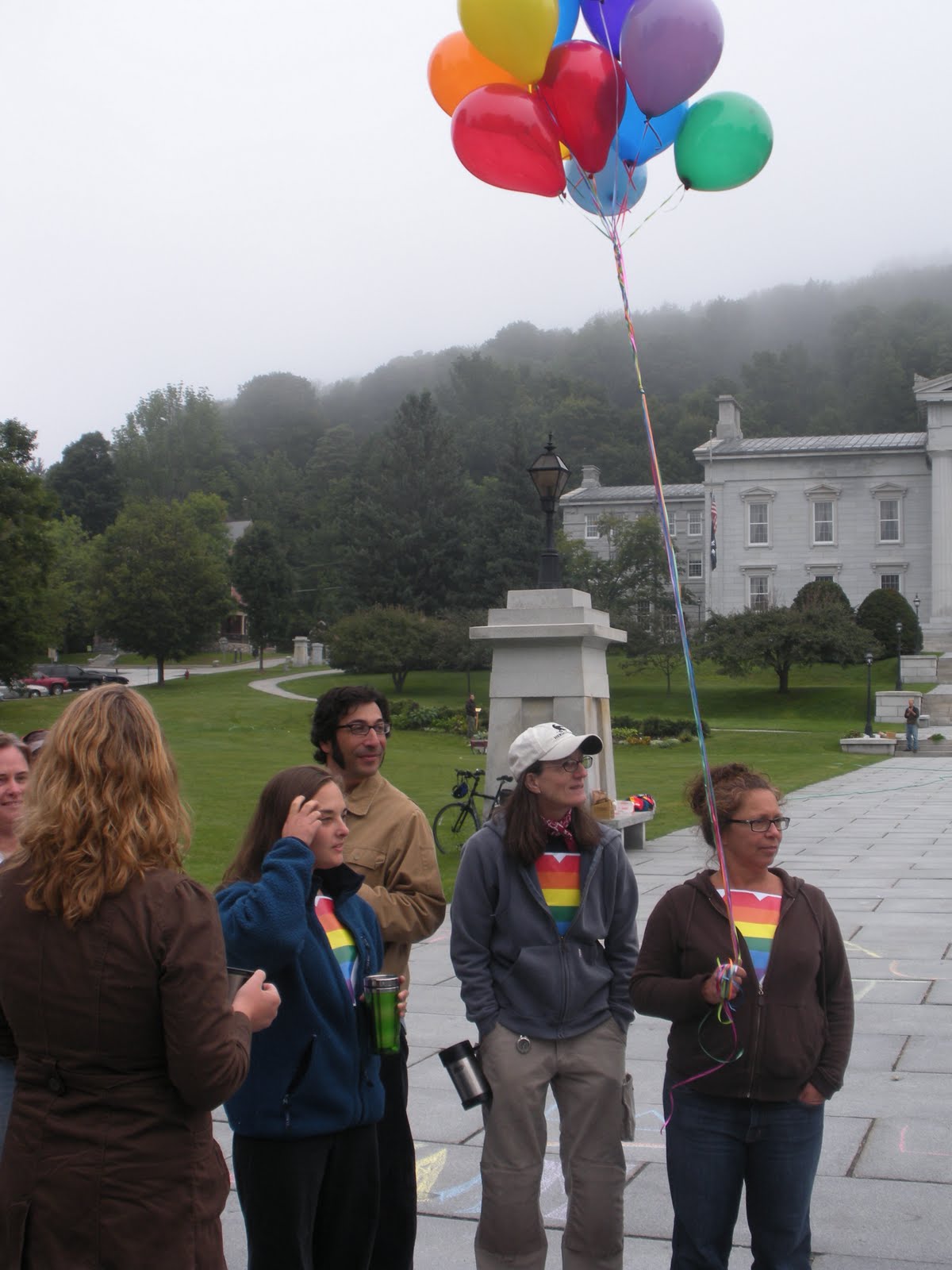
And we sang for love.

And we flew balloons for love.

And they kept on hating.

And we saw their hate …

… and raised them peace.

And because of this …

… we prayed for them …

… and kept on loving.

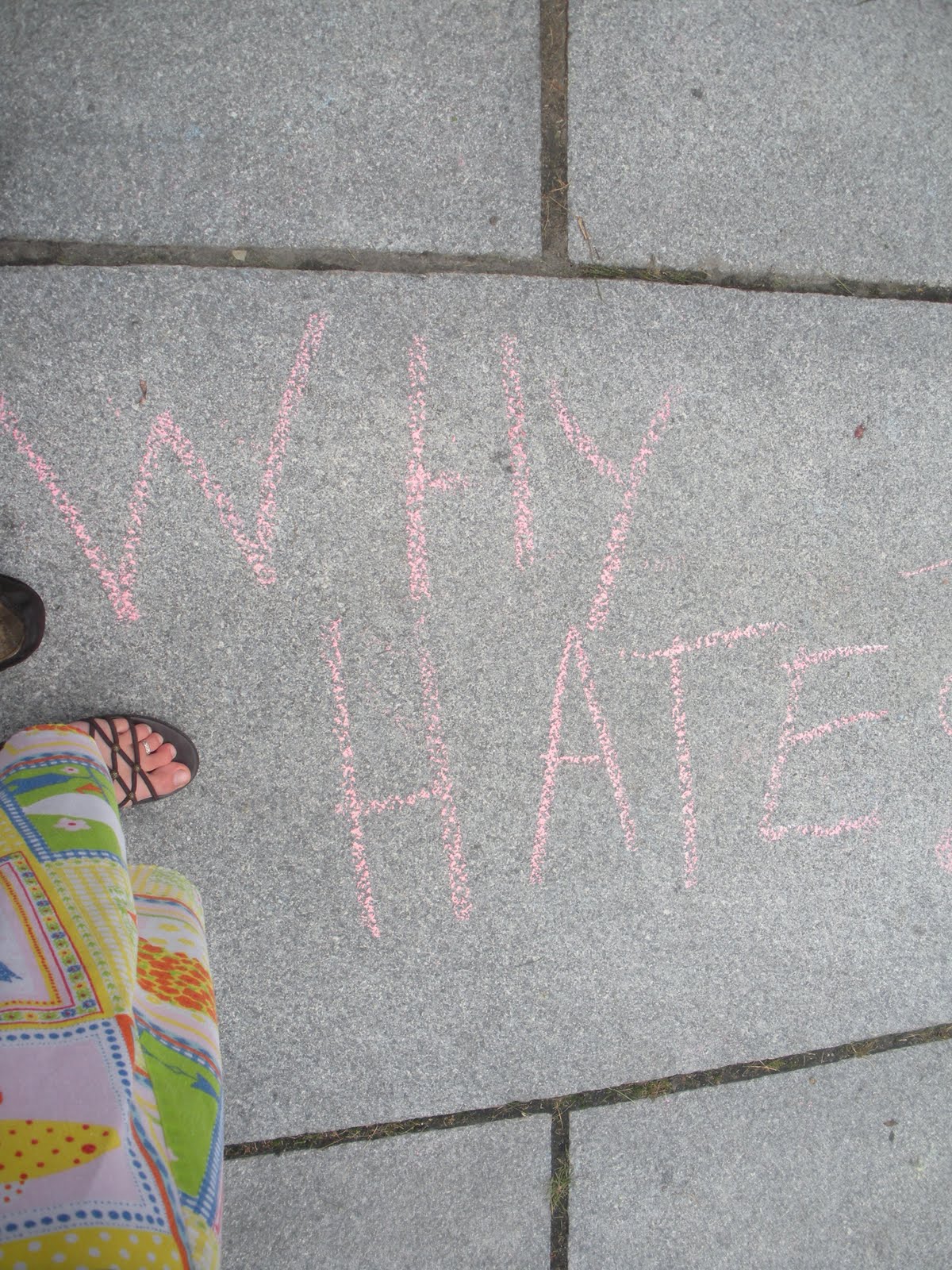
Because why hate …

… when you can smile?

Our love is divine …

… no matter what they say.

And we walked proudly …

… around town.

Wherever hate went …

… love followed

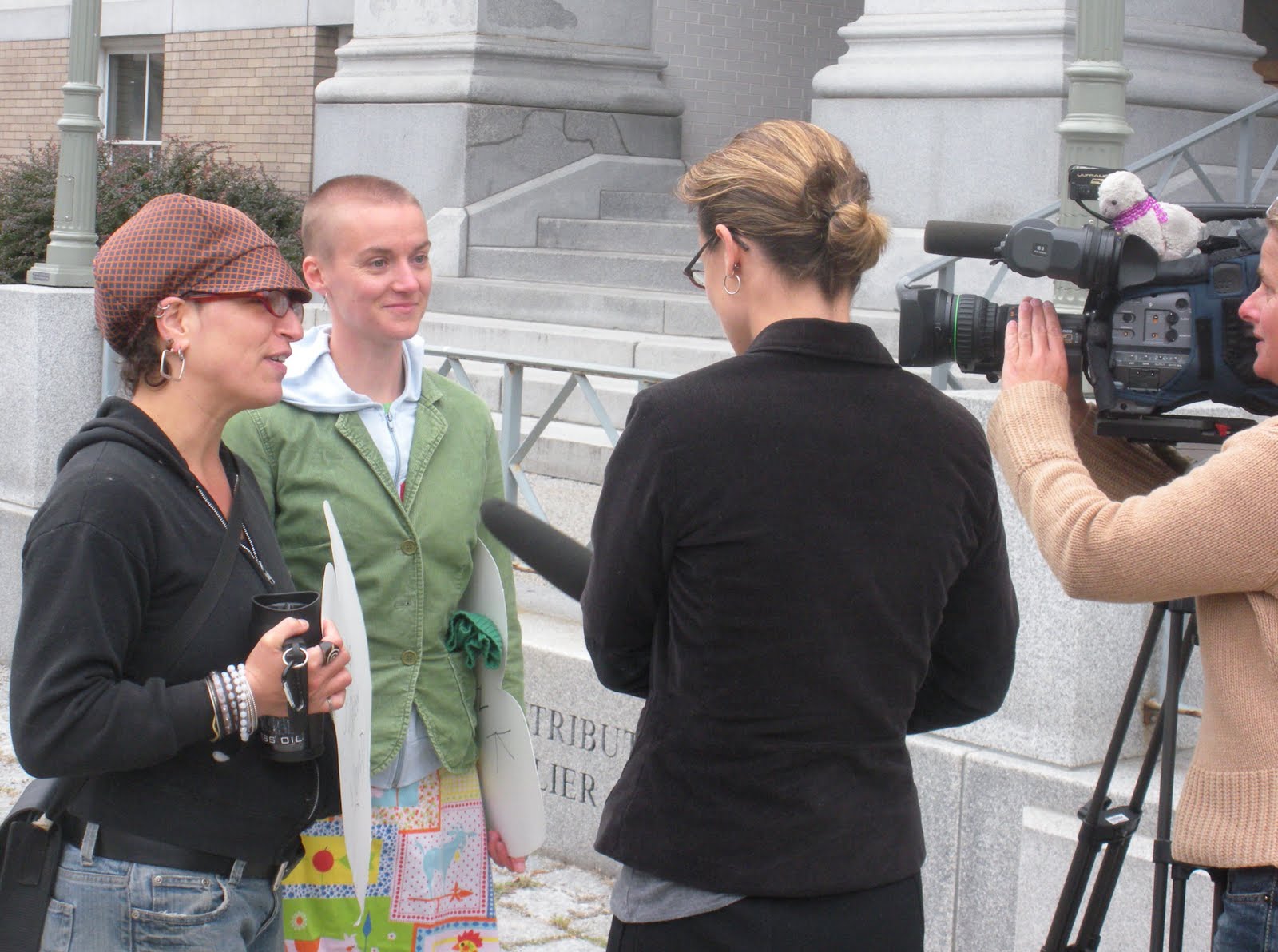
(and the media).

And as much as hate tried …

… love was right …

… and strong.

And while hate disappeared …

… love burned brightly …

… on and on and on and on …

Private Benchly

Forgive me for this.

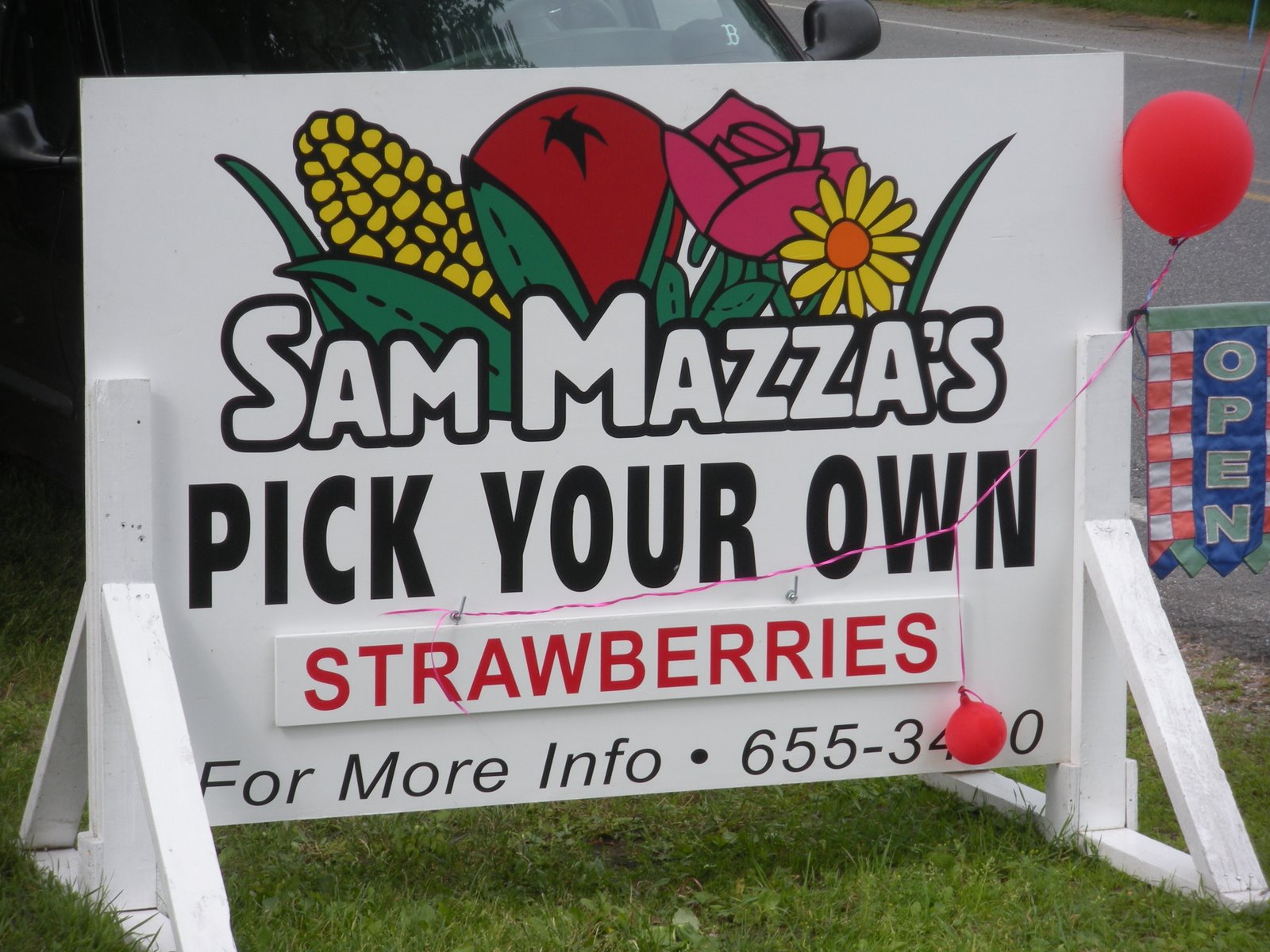
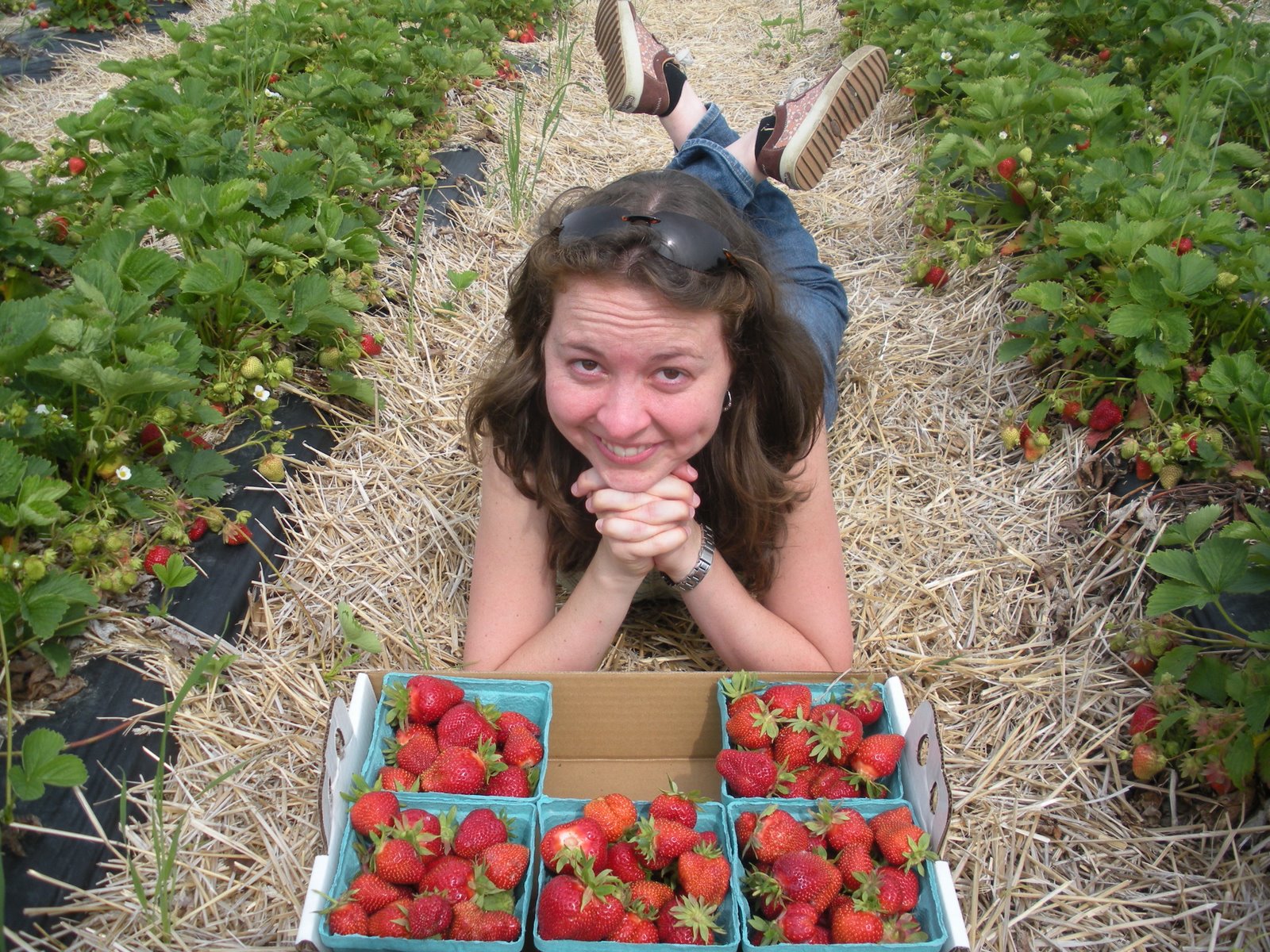
Although the Benchly’sWord Vault to the left will tell you otherwise, my most devoted readers (read: reader) will confirm that these are the opening words to my fourteenth blog entry of 2009. My last entry, a brief photo-essay documenting a recent trip to a local farm to pick strawberries was removed in an effort to preserve the anonymity of my girlfriend. I removed this entry after receiving a hostile comment posted by an anonymous poster (it’s funny how all hostile comments are anonymous) in which my girlfriend’s full name was used. The anonymous poster wondered if someone should warn my girlfriend of my past, which was ironic because my girlfriend is someone I can open up to about my past and also because some days it feels as though she and I are the only ones capable of living in the present. As a result, I’m forced to screen all comments and, though it makes my First-Amendment-bones quiver as if George W. Bush was in the room, all comments containing personal attacks, personal information, and/or foul language are now deleted. Who knew it would come to this?

One question I’m repeatedly asked is, “what’s up with your nickname?” (or some variation). In response, like a ballplayer reciting the daily, monotonous postgame “there’s no ‘I’ in ‘team’” sound bite, I explain the origins of the nickname, delving into as much detail as my mood and schedule will allow. Despite my predilection for long-windedness, though, one detail that is often lost in my explanation is the reasoning behind my use of the nickname as a pseudonym on the Internet. I don’t bother elucidating because I consider the explanation to be implied. The short answer is that I prefer anonymity; of course, when have you ever known me to be short?

When I started this blog, the second entry I published was a rant about a man whom I dubbed The Prick. I kept my real name and his out of the blog for the same reason: in case he ever read it. Even then, I recognized that anonymity was my only chance to feel free to express my uncensored thoughts, which was my only chance at producing anything worth reading. (Whether or not my writing is actually worth reading is a discussion for another day.) I wanted to be uncensored without risk of hurt feelings. What an unrealistic contradiction, right? I guess that’s the fate of a writer. From the very start when Professor Hudnall and others were teaching us the art of storytelling, we were told to write what we know. And then we graduated and entered a world where successful writers based some or most of their stories on their personal experiences, all the while pretending that any similarities between real life and the fiction presented in their work was a coincidence. The writer for the motion picture (500) Days of Summer even makes light of this when he prefaces his film with the disclaimer, “The following is a work of fiction. Any resemblance to persons living or dead is purely coincidental. Especially you, Jenny Beckman.”

Regardless of how hopeless my goal of anonymity seemed to be, I had to try. I wanted my writing to speak for itself, not the facts and feelings behind the words. (And incidentally, to anyone who complains that I’m only telling one side of my life’s story, I say of course I am, and if you have a problem with that, get your own damn blog.) My writing is important to me and as such, this blog is doubly important. The birth of this blog came at a time when, as a writer, I worried that my creativity had died like a fly ball at the warning track on a windy day at Candlestick Park, and now, five years later, Candlestick Park has been torn down and replaced by a new literation-friendly ballpark. I built it and my blog counter tells me that people have come, so I must be doing something right. There’s just one tiny problem …

As the Peer Pressure links to the left will tell you, like 200 million people around the world, I have a Facebook page. I created a page for the same reason some people buy an Oprah book; or like a certain band; or wear a certain style; or say a certain catchphrase: I followed the masses. And though I’m sure that once the American sheep herd starts to venture to a different networking hill, “Facebook” will be said with the same nostalgic-yet-disapproving tone as has been reserved for “Hootie and the Blowfish” and “skidz” (among other unpopular fads formerly known as popular), I will acknowledge that it has worked wonders in reconnecting me with lost friends, cultivating current friendships, and establishing new ones. Unfortunately, it has also introduced a new level of anonymity-related problems.

When I signed up for Facebook, I used my pseudonym. I did this because I knew my blog would be linked to my Facebook page and vice versa, and in order to preserve my anonymity and subsequently maintain a freedom to write in my blog, I needed to keep my name private on Facebook. I also set my Facebook profile settings as private as one can get without being unwelcoming to friends both old and new: stated simply, for a person to see anything other than my pseudonym and profile picture, he/she would have to be my Facebook friend. I’ve even gone so far as to use the pseudonyms for my nieces in the pictures of them that I’ve posted on Facebook. Sure, that’s a picture of me with Niece #3, but unless you know her, you don’t know her name or where she lives. I’ve done my best to create an online identity as close to the real one as is possible when using millions of ones and zeros. This has included dropping Facebook “friends” with whom I no longer maintain contact (including exes, former coworkers, etc.). And as a result, for the last Facebook year, my sense of privacy has begotten a sense of creative freedom. And yet.

A month ago, the anonymous poster left the aforementioned comment that included my girlfriend’s full name, a piece of information to which, in my perfect world, only my Facebook “friends” would have had access. I admit that there are loopholes through which an obsessive person could travel to ultimately find her way to private information reserved for my Facebook friends. It would be grossly naïve to think otherwise. And I admit that even though I’ve since taken additional steps to ensure my online privacy, there is probably a backdoor I’m missing through which someone may someday enter. This is the world we live in.

And I won’t forgive you for that.

October 2, 2010

You can count this among a seemingly endless list of blog entries begun in a setting that has been an all too common one for me lately (as opposed to “not Uncommon”): the same coffee shop I once swore I could never love (because I considered it as cozy as an Amtrack train car rolling slowly through the bad parts of Connecticut [the parts I like to call “Connecticut”]) and the same coffee shop that, for the last 6 months, has served as the figurative and literal outlet for my creativity. A year ago, as I walked down Church Street on a rainy Jazz Fest day, I could have counted on one hand the number of times I had crossed over this particular shop’s espresso-scented threshold (preferring instead to patronize a rival and cozier [albeit slightly muddy] shop instead). A lot can happen in a year, though, and my change in coffee shop preference is just the tip of that life-lesson-flavored coffee cake. And so it was that one year later, on yet another Jazz Fest day, instead of walking by this shop’s doors, I walked through them without hesitation. Of course, it didn’t hurt that last year’s rains had been replaced with a hot and muggy day accurately described in Webster’s Dictionary under “unbearable.”

It’s worth noting that, despite my complaints to the contrary, these hot and muggy days are actually part of the reason why I love this town. Taken separately from the rest of the variety of weather in New England, and specifically, Burlington, these “unbearable” days don’t have much of a bright side to them; when considered with the rest of the 4-season (or is it 5?) package, however, and their purpose becomes clear. It seems that they were added to our climate to produce that all-too-elusive perspective: you know, the one that helps us appreciate the good times by reminding us of the bad. It’s the same effect that results from the bitter nose-hair-freezing winter temperatures of late January. This perspective is on the minds of every Vermonter in the summer when the college kids leave, the lake temperatures climb, the winter-stomped grass turns green, and every sunset seems to be drawn by a kindergartner with a 96-color Crayola crayon box; and in the winter when the temperatures are cold but bearable, the snow hasn’t yet been corrupted by exhaust and sanding, and the streets, lit magically by tree lights and a vibrant moon, with the mountains as a backdrop, make you wonder whether Van Gogh had ever visited Burlington.

The best part of our region’s different seasons is that all of them last a significant amount of time, and yet not one of them lasts too long. It’s almost as if each season is an equal part to a 4-course dessert meal. The strawberry summers end as you begin to crave the apple-pie falls, which end just in time for the hot fudge sundae winters, which last just long enough to make the lemon-tart springs seem like a well-earned reward for the belly-ache-inducing lengthy winter. Rinse off your plates and repeat, making sure, of course, to save your forks. As someone who appreciates whimsy as much as he appreciates structure, it’s comforting to have an idea of what to expect for your next meal, without quite knowing how the meal will be prepared. Will it be an unseasonably hot fall, or a spring whose afternoons are just aching to turn into summer? And if you’re unsatisfied with a particular season, don’t worry: next year’s offering will most surely please. Our seasons are Vivaldi recordings set to repeat; until the sun turns black, they’ll always come full circle.

We’re nearing the Summer Solstice yet again and as the sun perfects its six-month dance with prime time, I can’t help but focus on the connection between New England’s four seasons and my own life. (You had to know that this blog was going to be about more than the weather!) As I’m sure you know, there’s a sister phrase to the idiom “come full circle”: “what goes around comes around,” which basically means you end up receiving what you give (aka, karma). And I’m sure all four of my readers have considered this phrase on more than one occasion when contemplating the fate of someone who has hurt them (i.e., “just wait till he gets his … what goes around comes around!”) or when dealing with a bad string of luck that leaves you with a sneaking suspicion that your past of giving poorly has finally come back to bite you on the receiving end. And I’ve thought these thoughts, too, but for the sake of today’s blog, I’d like to consider another point of view: “what goes around comes around” is just a five-word phrase for something Elton John could describe in three words: “Circle of Life.” Like the yin and yang, New England’s four seasons, or a Quentin Tarantino film, when it comes to life, the beginning is the end is the beginning, and all points in between are connected.

With this in the front of my mind, like Neo at the end of The Matrix, lately I’ve felt as if the layers of my life and the world around me have been removed and in their place I can now see the patterns connecting us all that have always been hidden just beneath the surface: a book I finished editing over 5 years ago that found its way back into my life in the most symbolic of ways; the feeling that my penultimateness has faded away exactly when it was supposed to, and that my bad luck has rubbed off on someone deserving of it; the fact that a year has passed by me since the last rainy Jazz Fest and that the rain has been usurped by the sun; and the realization that I’ve encountered four very distinct seasons in the last 12 months: the incipient decline of autumn, the frost bite of winter, the rebirth of spring, and the life, love, and warmth of summer. What went around has finally come around back to me, as fast as it possibly could.