
"Life is what happens to you…"

On the drive to the climbing gym the other night, while Mr. Extracurricular and I caught each other up on the happenings of our respective lives, I silently planned the climbs I was going to attempt that evening. Considering that each new trip to the gym carried with it an improvement from last time, I planned to conquer a personal-best 8 routes this time. And after a quick start up the white route and an equally quick (and efficient) trip up the red one, I tried my hands (and feet) at the black one in the corner, which was set one level higher than the beginner level. And that’s when I fell off. Disappointed but not discouraged, I next attempted an easier green route that had always seemed made for me. And then I fell off that one, too. Then the light blue one and the green one proved too challenging and I had to cheat a number of times on an easy blue one. I ended up leaving the gym with a bruised ego, a battered body, and the need to run home as quickly as possible to wash away the night with a hot shower. My plans did not come to fruition. (On a related note, Mr. Extracurricular’s plans also fell through when he realized the orange route he had not yet completed and which was proving to be his nemesis, had been replaced by another route.)

In the beginning of, at the end of, and even during my past relationships, among the number of things I’ve been called (including sensitive, over-sensitive, a leader, a follower, anxious to the point of creating an imbalance, etc.), the one that stands out the most (read: for the purpose of this blog entry) is “a planner.” And depending on the context and my mood, I’ve been known to take this as both a compliment and an insult. What I won’t question is whether or not it’s true; it is. Whether it’s the directions to Sister #2’s house for Thanksgiving, or a detailed itinerary of the hotels I’ll be staying at in England, or the iPod playlist started early in the year that’s called simply Possible Super Mix Songs, or the fact that I carry a first-aid kit on even the smallest hikes, or the fact that I’ll rent two or three different movies because I’m unsure of which one my movie date will want to watch, or when I run around town looking for the right flowers and dog bone, hardly a day passes for which I haven’t been preparing some sort of plan. Some exes found this annoying. Others thought it was cute and complementary. One even thought it was cute, annoying, and complementary.

I’m sure the Trash Heap would have a junior-high-school field day with this, but off the top of my head, I have no idea why I want my life to be so structured. It’s not like I was born on my due date or anything; I was early, with so much energy the doctor said my parents should just put shoes on me and let me walk home. And it’s not like my childhood had any major traumas that might force someone to desire stability in his/her life; it was your basic son-of-a-preacher-man life that was equal parts consistent and unpredictable. And it’s not like I spent my adolescence swimming in an abnormally large pool of plans; like everyone else, sometimes I had plans and sometimes I didn’t. So then what? We’re all reflections of our parents, right? Well, a thorough investigation of the Benchly house reveals the same varied qualities as the rest of my life: a checklist for every grocery item imaginable, printed out and used each and every trip to the grocery store, sitting beside a messy stack of random papers that may or may not have been placed there during the Clinton administration. Whatever the reason, I am who I am, I’m not going to change, and you can love me for it or not. Your choice.

The reason I bring this up is because lately I’ve been spending an inordinate amount of time (even by my standards) thinking about plans, both made and broken. In the past month, I’ve made plans to spend time with pretty much every friend and/or loved one within driving distance (read: 3 hours or less). I’ve even made a handful of new friends (which is a big deal for me) and am beginning to include them in my plans. You see, I got pretty lazy about making plans with friends after Labor Day and have been trying for the past month or so to make up for it. As I’m sure you know, spending time with friends and loved ones is great therapy for the soul. And sometimes it’s comforting to sit back and think of all the people in this world who think of you every now and then. Doing so reminds me of a belief I heard once that a person’s spirit lives on so long as someone is alive to tell his/her story.

Also, in the past month, I’ve been doing my best to learn how to accept when plans change. To paraphrase one of my all-time favorite Douglas Coupland quotes, “sometimes I scare myself with how many of my thoughts revolve around making me feel better about not having plans.” It’s incredible to think that this latest obsession with plans is the direct result of one plan that didn’t come to fruition: I had a cozy picture of a Thursday night in winter, waiting all day to finally be able to lay down on the couch to watch the newest episode of LOST, speculate about what’s going to happen the next week, and then fall happily to sleep. I’ll still be able to do this; just not the way I originally planned. And I’m planning to one day be OK with that.
Away With Words?

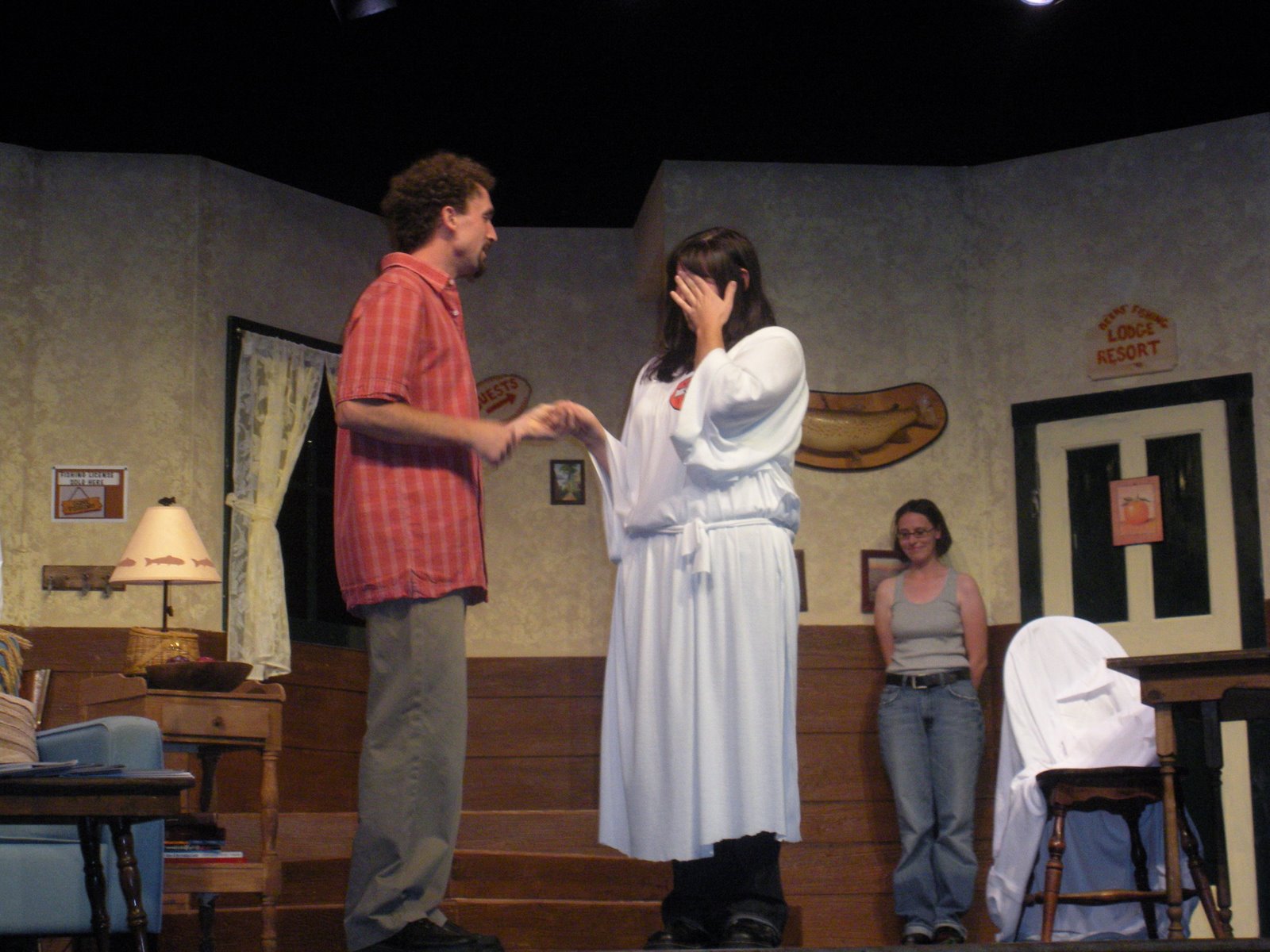
Two weekends ago, after a 3-person, 4-phone, 2-state, text-message, voicemail, super game of Telephone with Ms. Darling and her family, to ensure that she would return in time to the green mountains from her Beantown night with Madonna, Ms. Darling and I found ourselves at the Vergennes Opera House for a Friday night performance of The Foreigner, by Larry Shue, starring my friend Jay Peak, and with a brief cameo by his girlfriend Gee Wiz.

The Foreigner is a 2-act play that takes place at a fishing lodge in Georgia and centers around a pathologically shy and insecure British man named Charlie (played by Jay Peak who, jokingly [I hope] said he found some inspiration in the personality traits of yours truly) who, in an attempt to avoid any awkward social interaction with the other guests, pretends to be a non-English-speaking, non-speaking foreigner. When certain events force Charlie to communicate with the other guests in his pretend non-English language, hilarity ensues. And though the ultimate message of this play might be that even the unspoken word can communicate a human’s inherent goodness, one lesson I drew from the play was the power of language.


As the banner on my blog confidently tells my reader(s), and as most of my English-major friends will attest to, the pen is often mightier than the sword. Words matter and are often more powerful than ever intended by the person communicating them. Exhibit A for this argument can be found no further than the fact that I still remember the five most negatively influential comments made in my direction, even though all occurred at least 12 years ago, and some, a quarter of a century ago:

“You’re the worst sorry-assed student I’ve ever seen,” said Gary Perry, 11th-grade chemistry teacher after discovering me looking at a college basketball tournament bracket in class; “God is ashamed of you!” shouted Chris Ortloff, a church member after I dumped a bucket of water on his son at a church youth group meeting (I asked Papa Benchly if God was ashamed of me. His paraphrased response was, “you shouldn’t have done what you did, and that’s not something God would condone. With that said, he probably had it coming.”); “You’re Benchly. You’re asexual to us,” said Ms. Scharf, describing why I was “just friends” with 8 women in college; “Ew, Benchly touched my arm! Now I have cooties!” screamed nameless female elementary school classmate when a bump in the road knocked me into her seat on the bus; and “That’s not a real Dukes of Hazzard matchbox car, Benchly. You can’t play with us,” said nameless 1st grade classmate when I attempted to pretend that my orange matchbox sports car was The General Lee.

Though ranging from comical to typical to stereotypical to tragic, all affected me, and The Trash Heap would opine that all continue to affect me to this day. Words are powerful and have a shelf life that rivals that of even the most nonperishable foods. Whoever first claimed that names couldn’t hurt you like a stick or stone was lying or kidding him/herself, just like anyone who claims to be rubber, not glue. For instance, the names with which you’ll inevitably tease me after I quote You’ve Got Mail in the next two paragraphs will most likely sting for a long time.

This past year, I’ve been proud of the blog entries I’ve been able to craft with the words that I’ve sewn together. After two depressingly barren years of blogging, I’ve doubled the number of entries from those two years and still have two months left in the year with which to write the stories of my life. In perfect contrast, however, I feel as though I’ve slowly lost the ability to verbally communicate effectively. Anyone who has suffered through my bumbling retellings of a story or a joke lately will surely agree. Like Kathleen in You’ve Got Mail, I always “get tongue tied and my mind goes blank. Then I spend the rest of the night tossing and turning over what I should have said.” I may have a way with the written word, but the spoken one feels increasingly foreign to me.

When I do “have the pleasure of saying the thing [I] want to say at the moment [I’m] wanting to say it,” as Joe Fox warns in You’ve Got Mail, “remorse eventually follows.” For proof of that, I need to look no further than the difficulty I’ve had as of late in my attempts to communicate my feelings to Ms. Darling or my frustrations with certain family members. In each instance, no matter how carefully-crafted each thought was, I exited the conversation either feeling as if I had failed to accurately express what I was thinking, or that I had said too much. Considering how important words are, I’ve started contemplating communicating only in writing. And if this wasn’t the first step to a J.D. Salinger-like reclusive lifestyle, I’d probably go for it.

After all I’ve said, if you’re still left doubting the power of words, consider how they affected the life of Gee Wiz two weekends ago. After The Foreigner‘s curtain fell and the performers took their well-earned bows, Jay Peak stood in his rightful place at center stage, took Gee Wiz by the hand, and spoke the first nonfictional, but nevertheless well-rehearsed and deeply personal words of the night: a proposal. And in response, in between nervous snorts and tears of happiness, Gee Wiz uttered perhaps the most meaningful word of her life: “yes.” And in response, we say, “Mazel tov!”


"With every mistake, we must surely be learning…"

Thanks to the Photo Album Project of 2003–2008, the majority of my photographs since 1992 are now filed chronologically in no less than 10 albums, each with its own decorative cover carefully selected to suggest a maturity void of any effeminate qualities (see also my dark red, manly-patterned Martha Stewart comforter). Buried deep within one of these albums is a photograph taken at the Holocaust Museum in Washington, DC in 1994; a picture whose purpose is actually expressed in the biblical quote contained within its frame: “Only guard yourself and guard your soul carefully lest you forget the things your eyes saw, and lest these things depart your heart all the days of your life. And you shall make them known to your children, and to your children’s children” (Deuteronomy 4:9). In simpler (read: more John-McCain/Sarah-Palin-friendly) terms, the heart of this message is clear: honor history by learning from it and ensuring it isn’t repeated.

In an unintended bit of poignancy, this photograph is surrounded in these 10 albums by photographs of the various serious, semi-serious, and not-so-serious girlfriends/dates/girl-space-friends in my life, each of whom has been responsible for at least one valuable lesson about life, love, my flaws, my strengths, what I’m capable of in relationships, what I need to improve, what I want out of a relationship, what I shouldn’t put up with, etc. Whether it’s the woman who first called to attention my caretaker personality trait, or the ones who made me realize my susceptibility to dependency, or the ones who forced me to take responsibility for my role in our relationships, or the ones who helped me understand that disagreements can be healthy, I’ve learned a lot in the 15 years that I’ve been dating. And although I feel a tad shameful applying the lesson from a Holocaust-related-quote to a 30-something’s love life (I find my solace and justification in another lesson learned from the Holocaust: that each life is valuable and worth discussing), I think it goes without saying (though when has that ever stopped me from saying it anyway?) that if I ever want to find myself in a healthy relationship capable of sustaining the Long Haul, I need to protect these lessons learned from being erased in my memory like out-of-focus digital photos taken one-too-many-glasses-of-wine into a Friday night.


Now that I’ve started seeing a therapist, my past relationships have taken center stage in my memory’s playhouse. Although quite a bit of our 50-minute hours have been spent discussing the Benchlys who, in the last two and a half months, have started to resemble an overly dramatic and meddling family straight out of a bad 80s nighttime serial drama, we have also taken the time to figure out why my past relationships have failed, in hopes that my next one won’t. And though I finally caved at Mama Benchly’s twentieth suggestion that I seek therapy simply because I wanted to vent about my family, I’ll be the first one to admit how nice it has been to discuss my ideas/fears/questions about relationships with an educated, soft-spoken professional, affectionately nicknamed The Trash Heap (I can’t take credit for this one; this was Sarah the L’s idea). For although I pay her and so we’re naturally at risk for the “customer is right” mentality creeping in, her brutal honesty thus far has assured me that I can consider her opinion to be unbiased and caring.

The Trash Heap has been invaluable lately for a reason I’m sure my reader(s) won’t be surprised to hear simply because today I’m about as transparent as a political ad or election running-mate choice: I’ve started dating someone new. Her name is Ms. Darling (Ms. Parker: I have faith that you’ll figure this one out) and a darling she is. In the grand scheme of things, “what it is we’re doing” is fairly fresh and still carries with it that new car smell called Confidence that excitedly says, “This is the greatest car to ever be driven off the lot. I can’t believe it only has 2 miles on it! And look at the cup holders!” In other words, we’re still in that stage when you’re blown away by the refreshing and exciting new addition to your life, and you spend your time together discovering that second glove compartment or whether or not two bikes can fit in the back. But we’re not kidding ourselves. We’re hopeful that this is going in the direction of the Long Haul (and there are certainly days when I’m convinced that it is), but we expect road bumps. We expect headlights and taillights to go out, and maintenance required lights to go on. We expect them because that’s what our respective pasts have taught us, among many other lessons, and to remember and learn from these pasts is to honor them.

(I must admit, this time around I feel an overwhelming sense of comfortable calmness. Ms. Darling excites me and makes me feel relaxed at the same time. This is new for me and most definitely worthy of The Trash Heap’s input.)

I realized recently that the time has come to purchase an 11th photo album. I’m starting to feel overloaded with developed pictures awaiting their appropriate place in my chronologically documented history. Included in those pictures are new ones of Ms. Darling from the hikes we’ve been on, one of our marathon dates, the night we got lost under the stars, and a recent bike ride. These are moments I already know I don’t want to forget, lest these things depart my heart all the days of my life.