
Back in the mid-1980s, like most single-digit-old, elementary-school kids, I developed a strong case of America’s pastime. I’m pretty sure I joined Little League in 1985 simply because it was the thing to do, and when you consider my team’s 3-year record of 3-45, it’s remarkable to think that I’ve stuck with the game for so long. Not only did I stick with it, though, I also grew to love it, both on the field and off.
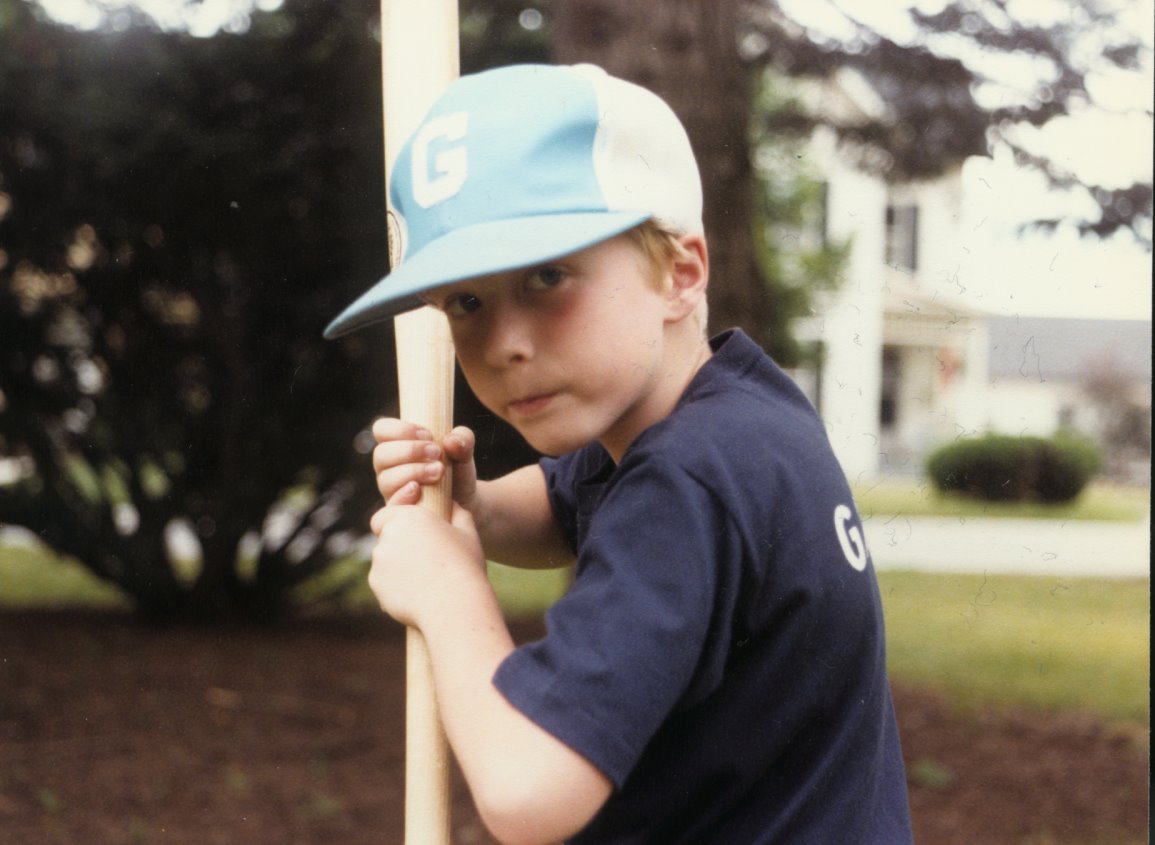
Around the same time that I learned how to play baseball, I began to take interest in watching it. I can still remember, with the kind of clarity that hardly ever accompanies a nearly 25-year-old memory, sitting in front of my grandparents’ television in 1984, watching the Oakland Athletics play, and seeing their speedy outfielder Rickey Henderson steal second base and then run to third when the throw sailed into center field. I ran as fast as Henderson into the kitchen where my parents and grandparents were discussing parental/grandparental things and proudly declared that Henderson was my new favorite ballplayer. In the winter months, when Henderson was traded to the New York Yankees, I declared that the Yankees were my new favorite team. But let’s be honest here: my heart ultimately would have led to the Yankees regardless of their roster. Like my father and his father before him, the Yankees were in my blood.
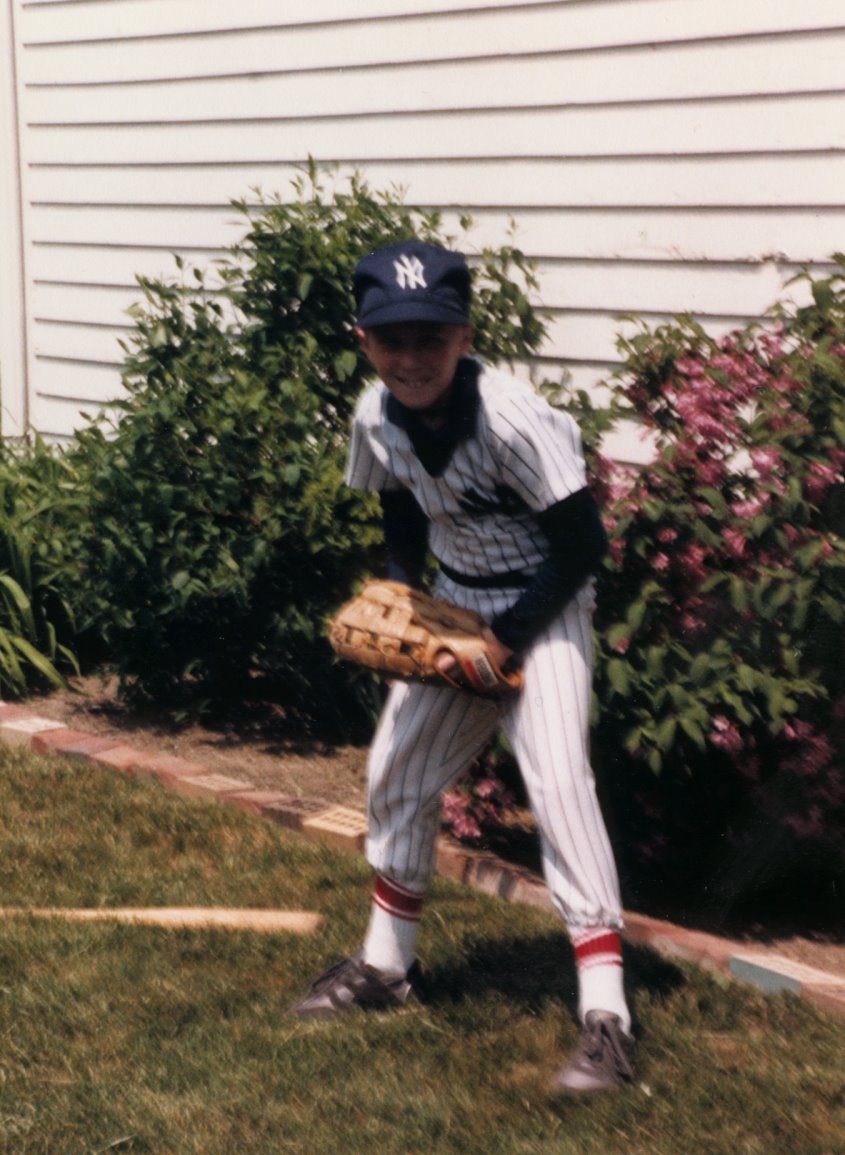
When my grandfather discovered my new love for his old team, it was like if the day you realized you loved candy coincided with the revelation that your home had a chocolate pond in its backyard. Suddenly, I was receiving hand-me-downs of the Yankees Magazine, I was going to an actual Yankees game with him and my father, and the sounds of a ballgame could be heard coming from the back room in his house nearly every time we visited. The games were on so often that I wouldn’t have been surprised if the letters “WPIX” had burned themselves into the screen. The Yankees were in my blood, yes, and my grandfather ensured that it would stay that way forever.
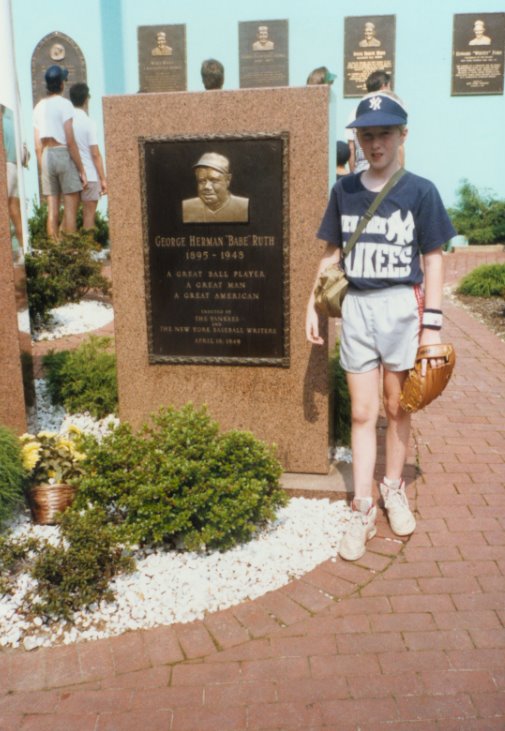
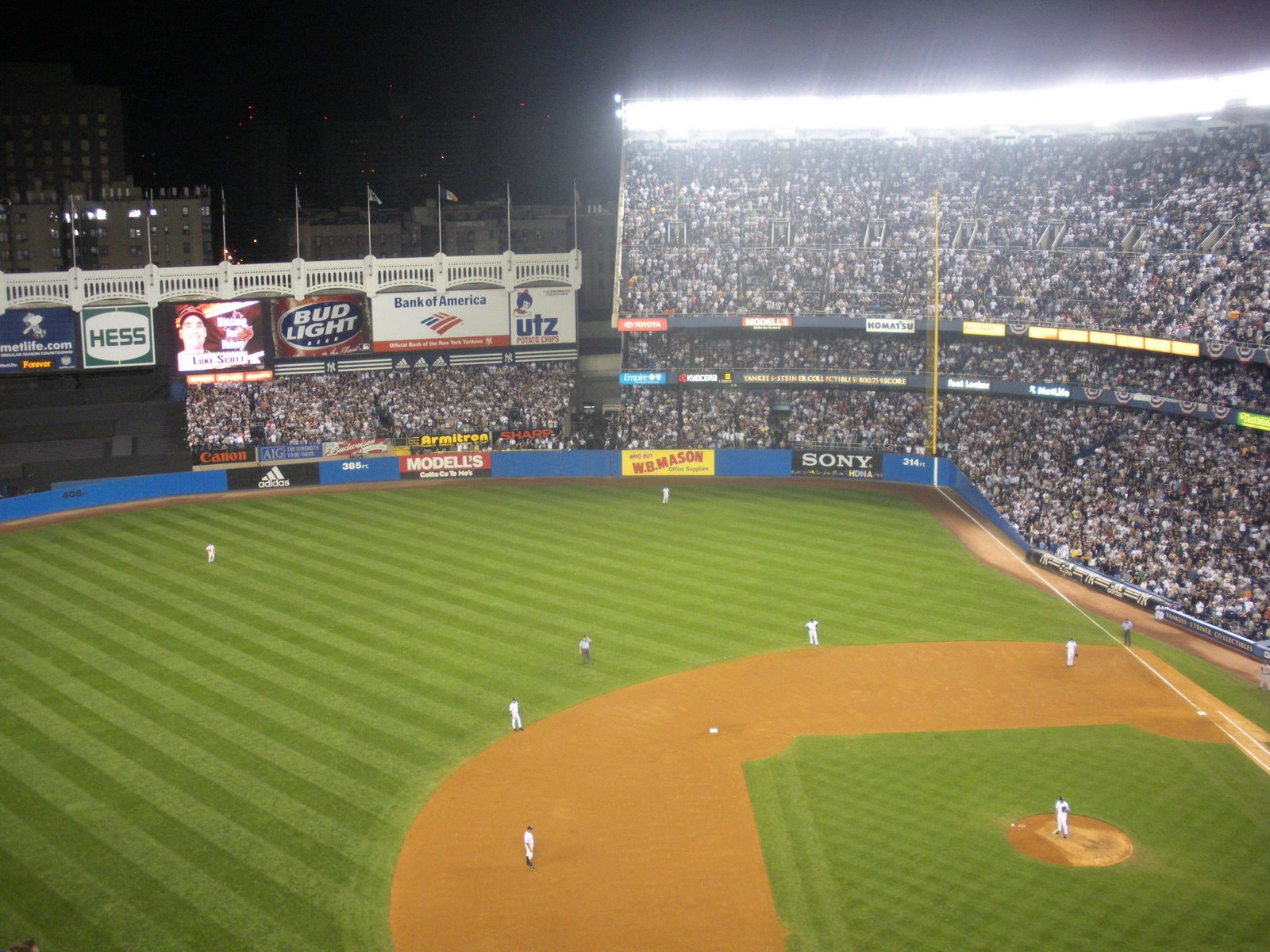
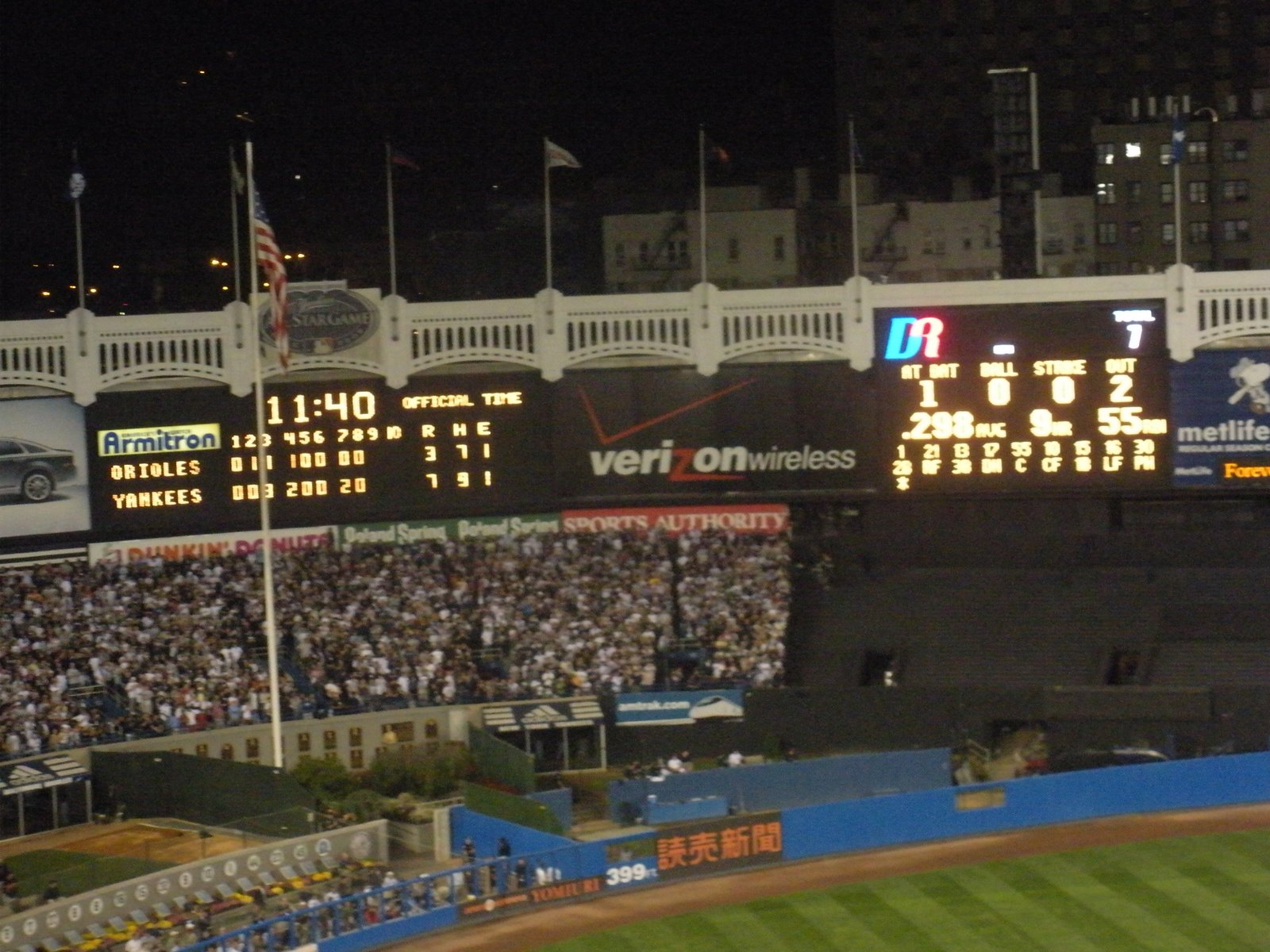
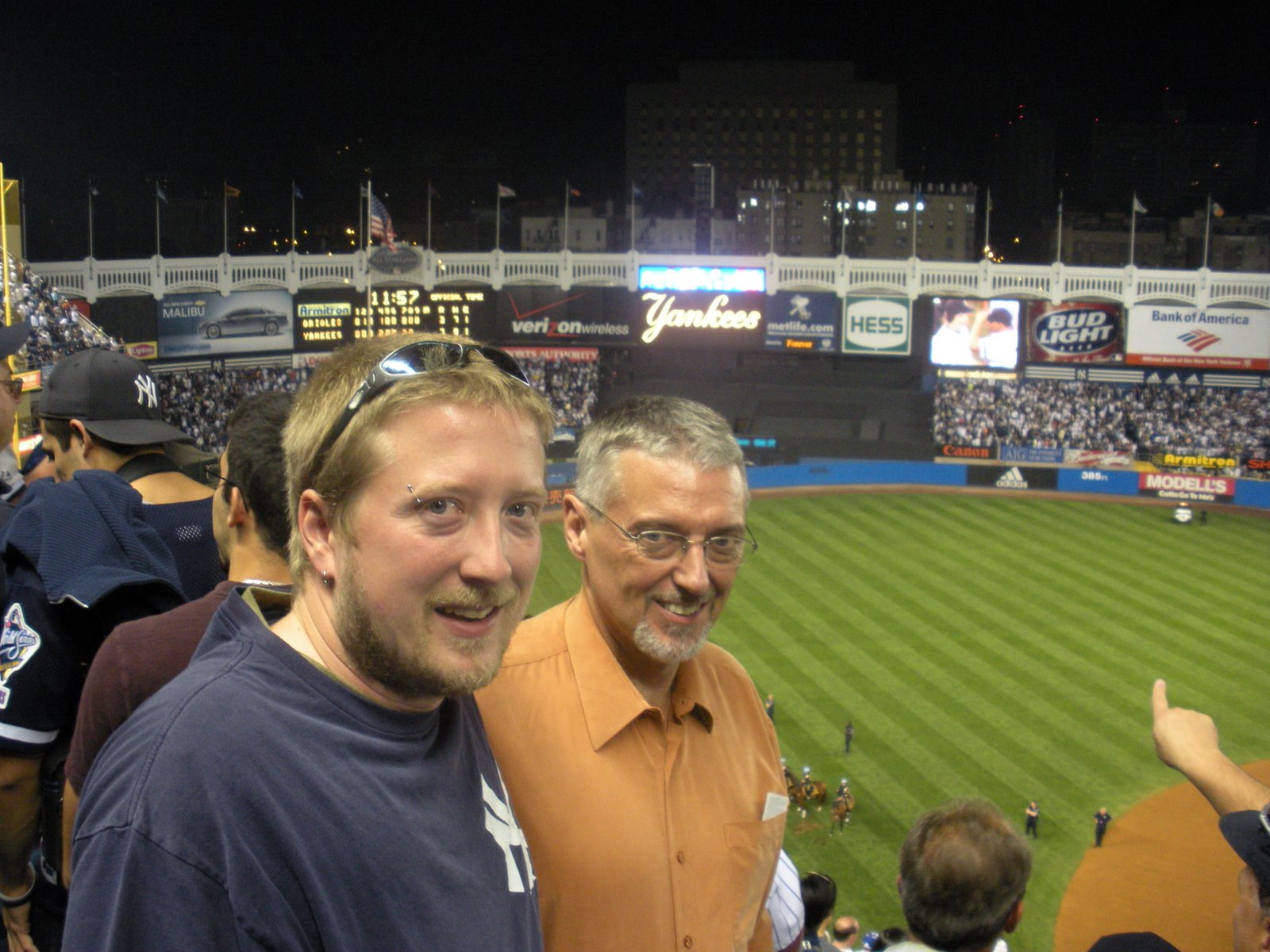
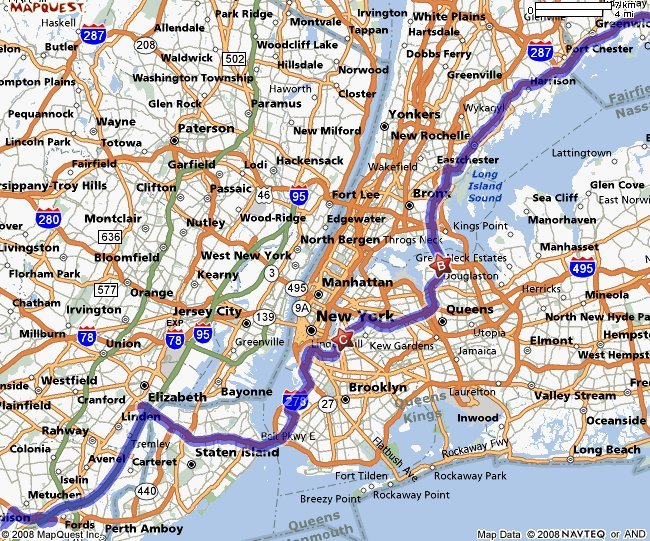
As some or all of you know, Papa Benchly and I made a bittersweet pilgrimage to Yankee Stadium this past Sunday, the last day of summer. It was sweet because this was the first Yankees game that he and I had been to together in approximately 20 years. It was bitter because the Yankees had all-but-mathematically been eliminated from playing in the postseason for the first time since my senior year in high school. It was sweet because the pre-game ceremony paraded out a long list of Yankees, including two of our heroes: Yogi Berra for me and Bobby Richardson for him. And it was bitter because the ceremony had been planned to honor the final baseball game to ever be played in the cathedral, which can now, three days later, be referred to as “the old Yankee Stadium.”

The flags atop the white frieze that helps to envelop the fans within the Stadium, sat motionless in the warm, summer’s night; if the ghosts of the building were going to have their way, we’d have to wait another day for the end of the seasons, both baseball and summer. Papa Benchly and I sat in the upper deck on the third base side (in about the same spot as where the entire Benchly family sat in 1987 when Papa Benchly and I were convinced by Mama Benchly that bringing the entire Benchly family to a Yankees game was a “good” idea [considering Sister #2 probably only remembers the music she listened to on her walkman, and Sister #1 probably only remembers Don Mattingly’s butt, and Mama Benchly probably only remembers the incredible heat that forced us to leave the game early {!}, I think it’s safe to say that this wasn’t a “good” idea]). In the final game at Yankee Stadium, Papa Benchly and I sat in seats that originally cost 3 times as much as they did that fateful Benchly family day in 1987, and for which in 2008 we paid the scalper 10 times the face value: a price worth paying.
On the long and sunny drive down to the Stadium, Papa Benchly and I reminisced about past Stadium trips and how every trip culminated in a Yankees loss. We saw an Old Timer’s Day game, an Opening Day game, a doubleheader, an extra-inning game, and the game in which Don Mattingly extended his home-run streak, among, we’re pretty sure, many other games. And the Yankees lost every single one of them. It’s safe to say that this affected me. When the Yankees finally made it to the World Series in my freshman year of college, I turned down the opportunity to buy tickets simply because I didn’t want my presence to hurt their chances of winning. And when this losing streak was finally broken at an early-2001-season game against the Boston Red Sox, it required not one but two 9th-inning home runs to save the day. And, of course, that particular season marked the end of the team’s run of World Series titles so it could be argued that my presence at a regular season game changed the course of the postseason’s history. Needless to say, this was a curse my father and I hoped would be broken that night, but we understood: when it comes to baseball, the unexpected is expected.
For a long time, and including a previous post in this blog, I’ve been a fan of former baseball commissioner A. Bartlett Giamatti’s quote about baseball. He says we “count on it, rely on it to buffer the passage of time, to keep the memory of sunshine and high skies alive,” and that just when we need it most, “when the days are all twilight, it stops.” What I had never noticed until recently, however, was the rest of the essay from which this quote was taken, entitled “The Green Fields of the Mind.” In it, Giamatti expounds on his opening theory and how it relates to the illusion of eternity: “It breaks my heart because it was meant to foster in me the illusion that there was something abiding, some pattern, and some impulse that could come together to make a reality that would resist the corrosion; after it had fostered again that most hungered-for illusion, the game was meant to stop and betray precisely what it promised. There are those who were born with the wisdom to know that nothing lasts. I am a simpler creature, tied to more primitive patterns and cycles. I need to think something lasts forever, and it might as well be that state of being that is a game; it might as well be that, in a green field, in the sun.”
Anyone who has ever spent 11 hours in a car in one 24-hour span knows that the open road allows for the opportunity to get lost in your thoughts. And so it was that in between conversations with Papa Benchly, I found myself thinking about how my life had changed so much in 31 years while a building on a 5-sided plot of land had resisted corrosion and remained almost entirely the same. I couldn’t help but notice the differences: instead of being driven to the game, having my way paid for me, and discussing school and baseball, I drove us in my car, paid for my half, and found pleasure in our conversations about our family’s history, and baseball, and the upcoming election, and the economy, and the current Benchly family drama. 20 years later, while our relationship with one another had not changed, our relationships to the rest of the world had: I was now an adult, he was now a grandfather. And there we were driving to and from a landmark that, for my 31 years, had always been ready to serve as a backdrop to my life, and which, a few short hours later (after a long-overdue win), would no longer be available, and I realized that Giamatti was right: nothing lasts forever. Stadiums. Baseball. Youth. Life. And the only comfort I can find is that of a green field in the fading sun.







 Benchly'sword
You must be logged in to post a comment.