Enough already

On a Monday last September, after my employer had decided to eliminate my position but three and one half weeks before the Zoom meeting they scheduled to tell me, when the calendar hinted at autumn but the Vermont weather did its best to convince you it was still summer, I sat outside in a circle with ten coworkers on the first day of our annual staff retreat. With sunglasses on to block the sun and our respective opinions of the retreat, we listened to the instructions of a storytelling workshop trainer before taking ten minutes to draft our personal stories to share with the group. 

I followed the trainer’s storytelling prompts down the hall to the left and straight back to my childhood. To Q-Bert on the Atari. To candy cigarettes and baseball card bubblegum on the walk home from the local pharmacy. To two new outfits for school every fall. To made-for-TV movies about nuclear fallout. To family road trips to campsites or grandparents’ houses. To the day our family bought a CD player and my sisters and I each got to pick out a new CD. To the black and white TV in my parents’ bedroom that had 13 channels—14 if you counted the UHF channel. To the Dukes of Hazzard.

I was most definitely a child of the 80s. And as a child of a minister and a child care provider, I was also a member of a lower-middle-class family. The family that only bought used cars, whose vacations were only ever road-trips to campsites or grandparents’ houses, who could only afford two new outfits for school every fall. The family whose budget meant superfluous gifts were out of the question, even if I desperately wanted to upgrade my generic orange Chevy Corvette Matchbox car with the official Dukes of Hazzard General Lee one—that gorgeous, orange 1969 Dodge Charger featuring the Confederate flag and all of its implications none of us white suburbanites yet understood. My parents did their best to provide for us, and come Christmas time and our birthdays, we were certainly more fortunate than some children. But I still went to school every day feeling unprepared to face the gauntlet of abundance and judgment.

When my classmate, Jacob V, bragged about Super Mario Brothers and asked me if I also got the new Nintendo console for Christmas, I said I was more into baseball cards while silently convincing myself that Q-Bert and Pitfall 2 were as good as video-gaming would ever get. When Jacob teased me for wearing the same pair of jeans as the day before, I lied and said he was mistaken. When he called my bluff and said I should mark the jeans with ink so I could prove the next day that I owned more than one pair of jeans, I agreed, and then spent the evening trying to remove the ink mark from the denim. When the boys in my class started playing Dukes of Hazzard with their respective orange General Lee matchbox cars, I pretended not to be crushed after Matt W. told me I couldn’t play with them because my Generic Lee wasn’t enough.

The storytelling trainer’s prompts were so powerful, it seems, that with my sunglasses now blocking watery eyes, I ultimately landed in a childhood moment I hadn’t thought of in over 30 years: a quiet time of independent play with my Cabbage Patch Doll—as I said, my parents did their best to provide for us. I’m roughly 8 years old and through the powers of imagination, I have stepped into the shoes of a lower middle class parent struggling to provide for his child/doll. It’s Christmastime and I’m explaining to my child/doll through very real tears that all I can afford to give her is a small pillow.

“Simply having a shameful Christmas time.”

This repressed memory has no doubt been lurking in my subconscious for at least the last 7 years, feeding my parenting insecurities, nudging me almost daily to diligently save my pennies so my family is never without, while also quietly pushing me to give my child as much as I possibly can so that he’s never without. So that he has enough.

When it was my turn to share my personal story and these memories with my coworkers, I struggled with how to conclude the story. We all struggled, really. Ten minutes isn’t a long enough time to draft a personal story that’s both compelling and cogent. This was my rationale when I ended my story with a punchline about striking out Matt W. on three pitches in a Little League baseball game. And this was the rationale I told myself when my boss’s personal story about ensuring a healthy work–life balance ended with her seemingly advocating for an unhealthy work–life balance. And so I left the retreat that day, eager to finish crafting my personal story, completely baffled as to how to end it, and wondering if my boss was maybe trying to tell us something. And then.

Three and one half weeks later, I signed on to a Zoom meeting where I was told “it’s not us, it’s most definitely you,” and I found myself staring down the barrel of unemployment, cursing the can of repressed memories the storytelling trainer had opened up, and fighting off visions of giving my child one small pillow for Christmas. On cue, my old friends, anxiety and depression, showed up for an unannounced visit; they truly are the worst houseguests. And I became terrified the ghosts of my unknown future were going to send me spiraling into a melancholy state of Generic Lees and ink-stained Levis and of never being enough. But … a funny thing happened on the way to my 40s. 

At some point during the trials and tribulations of my younger Benchly (see nearly every previous blog entry), I managed to snag myself a healthy relationship with an extraordinary woman. How, you ask.

Well, dear readers (read: reader), while I was busy lamenting gifts I did not receive as a child, I overlooked the ones I had been given: compassion, honesty, respect, and love. Each of these gift-wrapped treasures from my parents laid the foundation upon which I’ve built my entire life. They enabled me to cultivate and nurture a relationship with the Mrs. for the last thirteen years so that, as I lay there on the cold, hard gurney transporting me to joblessness, Mrs. Benchly’s calm and confident bedside manner eased my worries, evicted our uninvited houseguests, and, faster than you could say “Possum on a gum bush!,” nursed me back to confidence and straight to LinkedIn.

On a conscious and oft-subconscious level, these presents have also been at the forefront of nearly every parenting decision I’ve ever made. From how to talk to Baby Benchly about his adoption, to listening to and valuing his opinions, to cautiously allowing him to interact with the world and find his place in it. And combined with the gifts of storytelling, creativity, and curiosity my parents also bestowed upon me, these presents helped me face this career transition head-on and to quickly land a new job at a righteous organization four weeks and four days later. (Thus far, the work–life balance has been appreciated!).

I still don’t know how to end this story. I suppose that’s OK. As a parent, I have really good days like when my son is given a gift and offers to share it, or when he volunteers to donate some of his toys so less fortunate kiddos can enjoy them. And then some days I don’t necessarily want to write home about, like any day he’s had a case of the “Gimmes” and I’ve been short with him in response.

Fortunately, no matter what, each day always ends, a new one always begins, and with it an opportunity to start over. It’s calming how episodic parenting can be. You just have to make sure you freeze the frame every once in awhile so Waylon Jennings can help you appreciate the parenting challenges you’ve overcome, the loved ones who helped you along the way, and the moments when you can admit to yourself that who you are and what you have to offer are enough.


I do not think it means what you think it means

There are approximately 7.2 billion people in the world today. At some point in our world’s history, one of those 7.2 billion people studied the other 7.2 billion people in the world and determined that the females in the bunch were giving birth to 255 people per minute.  Four and one-quarter babies every second.  In the time it will take you to finish this paragraph, more than 130 little Aries kids will have unhappily come into this loud, bright, scary, cold world; more often than not born to happy parents proud of what they had accomplished. Forgive me if I’m dwelling. I wrote this paragraph after spending a few days in Philadelphia, dealing everyday with the consequences of overpopulation, of men and women who couldn’t keep it in their pants: thousands of similarly-dressed parasites involved in the same deeply-meaningful conversations about careers and love and the world’s problems; all while fighting for the last stool in the bar, the last parking spot on the street.
 
Three and one-half years ago, Mrs. Benchly and I invited 100 or so of the aforementioned 7.2 billion people to gather outside by the Maine seaside in their Autumn Saturday Best. After the familiar “Once Upon  a  Time” melody serenaded all 7 of the beautiful  flower girls, and with the sun shining down upon us, preparing itself for one of its more memorable sunsets, one of our friends, a man of the [friendly] cloth, informed the other 99 or so guests that “marriage, marriage is what brings us together today.” She was not The Princess Bride, I was not Westley, but ours was indeed true love, passionate and pure, which ultimately became a green union of yellow and blue built confidently as if by Masons, sealed with a kiss and a vow that “we shall keep together what share of trouble our lives may lay upon us. And we shall share together our store of goodness and plenty and love.” After a seemingly endless journey to find love, a journey at times so disheartening and soul-crushing that it inspired Papa Benchly to say­—a month before I met Mrs. Benchly—that some people were just not intended to find love, this was the ending promised to us by Hollywood and its subsidiaries. When we said “I do, I do, I do,” we were signing on the dotted line of our Happy Ever After contract. This we believed, because how many married folks remember the fine print of their vows, anyway?
 
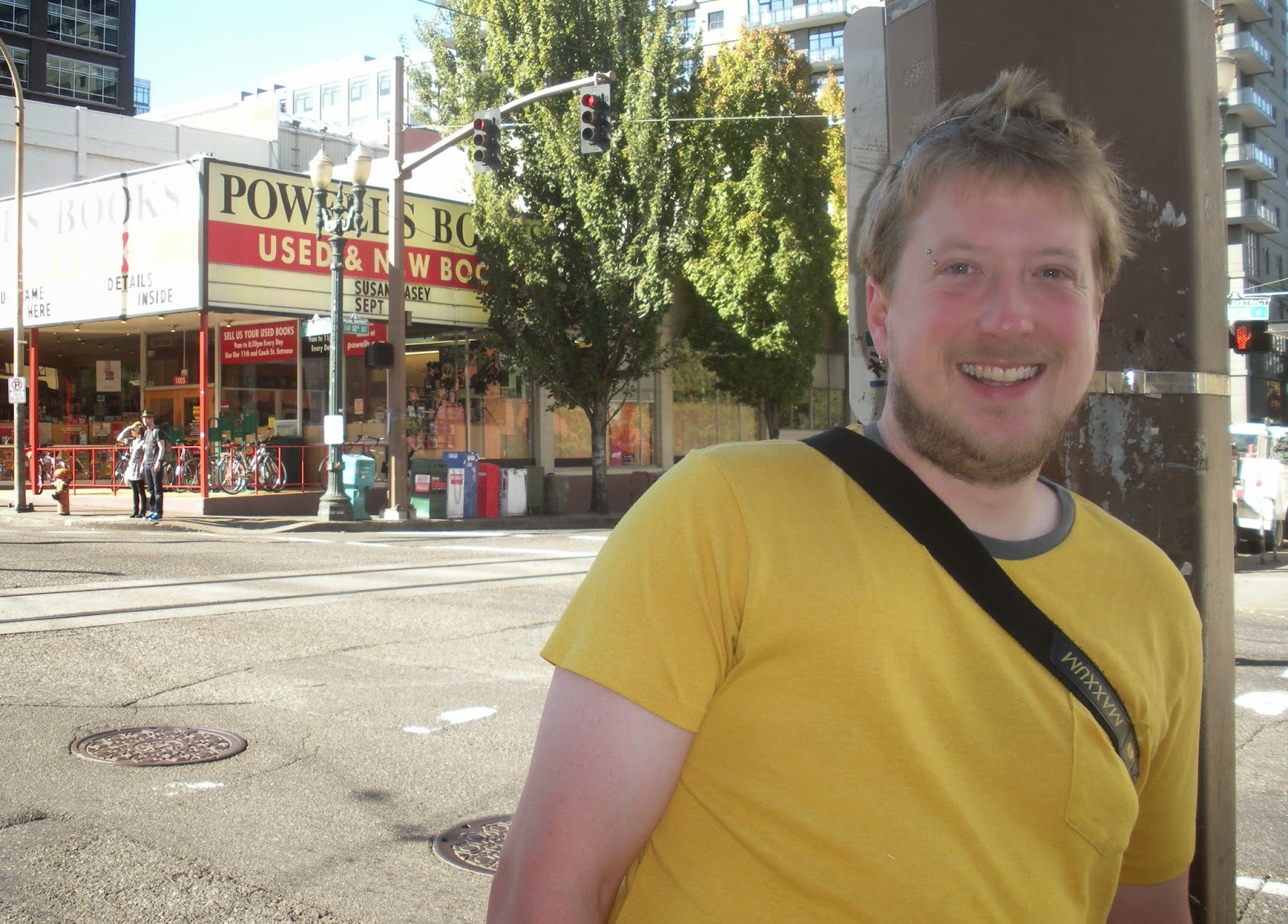
Our honeymoon was, cliché or not, perfect. We ventured to the Pacific Northwest in the autumn, with raincoats in tow, and returned home two weeks later nearly sporting suntans. Mrs. Benchly rearranged our travel itinerary so that I might browse the hallowed grounds of Powell’s Books. On. Our. Honeymoon. Love. On more than one occasion, I walked around a park taking pictures of flowers. Again, love. We returned home to our dog, Agatha, the best dog in the world who smiles when she greets you and who falls—into your body and asleep—when you ask her to “snuggle.” For our first anniversary, we ventured to Germany in the autumn, and two weeks and 1400 pictures of sunsets, castles, and mountain peaks later, we returned home with those same unused raincoats folded neatly in the same spots in our luggage, two metaphorical foreshadows thinking to themselves, “should we be worried?”
 
We suspected there might be a problem before there was one. Mrs. Benchly told me her fears before marriage, before law and God said we should try. If you were naïve, as I was then, you would say, as I tried to say then, that we were prepared for anything. But you wouldn’t be prepared, as we weren’t, because when you prepare for anything, for your share of trouble, what you’re really doing is praying to whomever will listen (wishing, really) to ensure your store of goodness and plenty and love. Isn’t that what Grandpa made you believe you’d get?
 
After a year, I wasn’t nervous. Maybe I was a little bit concerned, but that’s not the same thing. But then we entered a university study at the hospital because it gave us free access to expensive medicine. And then the study ended and we found ourselves stuck in congestion on life’s highway surrounded by lanes of traffic flowing freely until we moved into  them; two Michael Boltons watching their loved ones speed by them to their full-house destinations. And then we went back to the hospital (sans university study) because it gave us access to expensive medicine. We placed our checks in their hands like tokens in a slot machine; hospitals and casinos are not all that different. And then the treatments ended and we found ourselves staring at the same mile marker, faced with a realization that our dream of a life without pain was sold to us by a con artist.
 
There isn’t really a good word for our current reality. I keep coming back to the word that does not mean what one might think it means. It applies in a sense—our reality is not one either of us ever envisioned for our future—but the word still doesn’t mean what one might think it means. Even so, I can’t help but use this word. I use it to describe the reality that has been written for us. I use it to distance ourselves from this reality; to pretend that we’re characters in a beloved movie just two hours and one wheelbarrow away from a happy ending. Because then, when I can imagine our life existing in such a script, I don’t mind so much the countless scenes in the lives of those around me. The lives whose scripts don’t feature the word that does not mean what one might think it means.

A Flawed Life

I remember getting into an argument with Mama Benchly when I was 7 or 8 years old and tantrums were the logical and normal choice of attack. The tantrum most likely occurred after Sisters #1 and 2 refused to include me in whatever it was they were doing at the time, as was their right and responsibility as older siblings. I pleaded with my mom for her to have one more child and to please make that child a boy. I wanted a brother to play with and my childhood thought process was able to gloss over the fact that such an age gap would have meant that I would have ended up being the one refusing to include a younger sibling in whatever it was I was doing. Mama Benchly’s response was simple: she and Papa Benchly had decided that all of the complications associated with my birth had meant that it would be greedy and dangerous for them to try for more.

Seven or eight years earlier, Mama Benchly was gardening in our family’s Champlain, NY yard one summer evening when her water broke. After rushing to the hospital 30 minutes away, and after a labor that lasted just 90 minutes, I entered the world. At first glance, it seems like the picture-perfect, normal delivery; however, a second glance shows that I gave them a scare by wrapping the umbilical cord around my neck as well as by having an irregular heartbeat. Add to that the fact that I was born with one less pectoral muscle than the normal baby, as well as the fact that a few short years later, two toes on each of my feet would have grown overlapping each other if it wasn’t for corrective surgery, and my parents understandably saw the warning signs written on their son’s pectoral-less flat chest: try for more and you might not be as lucky.

As you can imagine, considering how desperate adolescents are to fit in with the crowd by not sticking out of it, I had a difficult time coming to terms with my pectoral deformity. Though I always loved gym class, I dreaded changing into and out of my clothes in the locker room where I ran the risk of being exposed as a deformed imposter posing as a normal kid. (I’ve still mostly blocked out of my memory the times in gym when the instructor made our teams play “shirts and skins.”) And to be honest, finding peace and comfort with my deformity has been a lifelong struggle against which I often find myself losing. I’m still hesitant to remove my shirt in public, and while it took quite a bit of trust for me to reveal the deformity to past girlfriends (again, it speaks volumes about the kind of woman my future wife is, that I felt comfortable telling her about it on our third date), regardless of how much I’ve trusted my close friends, it’s 33 years after my birth and most of my readers (read: friends) will be hearing of it for the first time in this blog post. I imagine Sarah the L didn’t even know about it. So considering my age, it’s ironic to think that it took a juvenile insult thrown my way from an adult posing as an adolescent to help me come to terms with my deformity.

Like most kids in my generation who grew up loving baseball, trading baseball cards, and memorizing the statistics on the backs of said cards, I became an adult who finds pleasure in playing in a fantasy baseball league each year. And thanks to Mr. Extracurricular, I’ve had the pleasure of playing in a locally-based league for the past two years (complete with a live draft! [I know how this sounds, so don’t bother telling me]). We expanded the number of teams this year and in doing so we welcomed aboard a few friends and some friendly strangers. One of these strangers (for the sake of rhyming anonymity, I’ll call him Brat) beat a returning team in the first week of the season and then bragged about it on a message board (the fantasy baseball equivalent of trash talk). This week, after my team beat his team in what can only be described as a “thrashing,” I felt compelled to defend the aforementioned losing team’s honor by returning the trash-talking favor (word for word the way he had done so 4 weeks earlier). Brat responded by saying he wasn’t going to listen to someone who didn’t even have a pectoral muscle. Oh. (You see, evidently, Brat is friends with my exgirlfriend, she thought it appropriate to share this information with others, and Brat considers physical deformities as appropriate punchlines.)

Instantly, I was transported back to 8th grade swim class when one of my peers looked at my bare chest and asked me if a tractor trailer had plowed into it (I’ll give him retrospective points for his creativity). However, unlike that afternoon and all of the uneasy years that followed, after Brat’s insult, I didn’t feel the urge to hide or be ashamed. Instead, I actually felt proud of my deformity because, 33 years into my life and I’ve finally realized that it’s my biggest flaw, and that rather than focus their attention on having one more deformity-free child, Mama and Papa Benchly instead raised someone incapable of poking fun at deformities; someone of whom they could be proud. I won’t pretend that I’m flawless, or even close, but I’d like to think that thus far, I’ve lived a life of which my parents could be proud.

I emailed Brat a few minutes ago and mentioned that I thought his personal attack was uncalled for. I also wished him well this season and mentioned my envy at his foresight in adding a certain pitcher to his roster. I don’t know if he’ll respond but if he does, hopefully it’s to talk baseball. Isn’t that the normal thing to do?

He looks at the smiles of the crowd on the street …

This weekend, after helping Mama and Papa Benchly prepare for their impending move to a house called Happy Ever After, I slowly made my way through our downtown pedestrian-friendly marketplace to a local coffee shop. Along the way, I passed people preparing for their impending belated celebration called Mardi Gras. Kids wearing beads were crying after being refused additional beads, parents were wearing the kind of facial expressions usually reserved for traffic jams and school snow day closings, and other adults were screaming and swearing at the tip top of their lungs because society told them to do so. Yes, it was a Mardi Gras celebration alright, even if Mardi Gras (aka, Fat Tuesday) happened nearly two weeks ago.

I walked through the crowds wondering if anyone knew anything about the celebration they were celebrating, because, to be honest, I didn’t know that much about it myself. In fact, it wasn’t until last week and thanks to Trivia Night that I learned what the purple, green, and gold colors represented (justice, faith, and power, respectively [of course, what that has to do with Lent I don’t know]). And as sure as I am that society has lost sight of the meaning of Christmas and especially Easter, I’m fairly certain that most of those crying children and screaming adults would be surprised to learn that they were crying and screaming on a day associated with religion. How else to explain the Progressive Party-sponsored float I saw rolling by the coffee shop’s windows with campaign signs plastered on the float’s sides telling us how to vote next Tuesday?

I wonder if the separation-of-church-and-state¬−Progressives knew that they were openly condoning campaigning during a religious event. Not that I blamed them for missing the significance, especially considering how often people in this world (present company included) march blindly and aimlessly toward a common and often meaningless goal. And if you’re surprised that marching “blindly and aimlessly toward a common and often meaningless goal” is a segue into a discussion on marriage, and specifically, my impending marriage, you’re not the only one.

In case you missed the news (an unlikely scenario, considering that all of my readers [read: reader] can be classified as friend or family), I recently became engaged, which, I discovered, is a side effect to proposing to your girlfriend. And because all of the wedding books say so, my fiancé and I have been slowly creating a wedding website to send to our loved ones (if you want the URL, email me). One of the website pages we’ve created details our respective versions of how we met. In my version, I mention how, despite not knowing what I wanted in a life mate, I impatiently went out of my way to find her. Along the way, I attempted to verbalize the attributes that my soulmate would possess in the hopes that my friends would point me in the direction of someone with those same traits. I spent my days dreaming of what she’d look like, act like, sound like, what she would wear, how she would move, what she would say, etc., and I did all of this because I was marching toward marriage.

Since the day I began to expect things in life, my plan was to fall in love, get married, have a family, and live the rest of my life the way I always expected to live it: Happy Ever After. I marched toward that destination, never really knowing why I wanted to reach it, or even if I wanted to reach it at all. It seemed the logical choice for a goal, but only because it seemed to be everyone else’s goal. It wasn’t a meaningless goal, of course, but I certainly didn’t understand the meaning. I was celebrating Mardi Gras because Mardi Gras was there to celebrate. I voted Progressively because I was progressive.

But now that I’ve met the woman with whom I’m going to spend the rest of my life and with whom I’ll be heading toward a Happy Ever After, I can say without a doubt that in the days and months and years before I met her, I was ignorant of what love was, what my soulmate was going to look like, and why I was marching toward her in the first place. And I say this now knowing that in these days of bliss, I’m completely ignorant of what our love will look like in a year, or 10, or 40. How could I possibly know, right? And I guess that’s my point.

It’s taken me nearly 33 years and one long search for a dream to learn that I don’t really understand love and probably never will. 20 year old kids think they know everything there is to know about the world, 25 year olds know they don’t know everything and are eager to learn, and here I sit at 32 knowing that there’s more about this world that I don’t know than there are things that I will end up learning, and that’s the way it’s always going to be. But I’m OK with that because during every Mardi Gras from now until the end, and on every day in between, I’ll be marching in an amazing parade arm in arm with the great love of my life, always thankful that I found her in spite of my ignorance. And that’s most definitely something to celebrate.

Prose and Cons

Earlier this year, just as the summer sun was readying itself for its moment in the New England spotlight, Othello and I moved out of our cozy (read: tiny) Old North End apartment and into our current bigger (read: bigger) New North End home. The move, though a good one, has had an unexpected side effect: instead of walking to work each morning with my time occupied by thoughts of the next great blog entry, I’m forced to spend my morning commute distracted by other drivers and the morning radio’s news. Without that morning walk during which I habitually organized my thoughts on my life and the world around me and subsequently planned how to accurately and entertainingly present them in my blog, I’ve had a hard time compiling these anecdotes into entries worth reading. To compensate, I’ve changed my blogging habits, which is why I’ve spent many a recent evening patronizing Speeder’s, Sapa, and Dobra: three (mostly) quiet coffee and tea shops where I can research (via both the Internet and people-watching) and imbibe in the token Generation X-Y beverage. And so it was that I found my inspiration for this blog entry while seated in a somewhat comfortable chair in Sapa eavesdropping on a what-seems-to-be weekly discussion/debate group.

We love to debate, don’t we? In November, within a span of seven days, citizens of a New England state voted to ban gay marriage, the New York Yankees won a 27th World Series championship, a U.S Army major killed 13 people and wounded 30 others, the U.S. House of Representatives passed a controversial health care bill, and the infamous D.C. Sniper was executed by lethal injection, and though some of these events were more important than others (obviously), they all shared at least one common denominator: their ability to divide people into a heated debate. Whether you were for or against gay marriage, capital punishment, universal health care, the “Evil Empire” Yankees, or a “turn the other cheek” philosophy made popular by the conservatives’ right-hand man, Jesus, and whether or not you made any of these opinions known, it’s a safe bet you found yourself residing on one side or the other of each respective issue. I’d go so far as to say that you took opposition to your stance personally.

And then, as if there wasn’t enough controversial newsworthy material making its way through the airwaves and Internet lately, ready to divide even the closest-knit friends and families, Sarah Palin released her biography (I’d call it an autobiography, but let’s be honest here: her coauthor did the writing.) and it had the expected result: the stage-right liberals criticized her, the stage-left conservatives praised her, and the moderate audience made another bowl of popcorn to enjoy while watching this free entertainment play out on a national stage.

I’m sure my readers (read: reader) will not be surprised to hear that I wasted no time tossing my opinion into each discussion salad, nor will they will be surprised to hear that I didn’t always have the popular opinion. I debated the Boston Red Sox fan, Mr. Extracurricular on his view that the Yankees were an “evil” corporation like WalMart (my argument was that baseball is just a game and if you want to claim moral high ground for other teams, let’s talk about the Boston Red Sox’s all-white baseball team decades after the color-barrier was broken); I called this guy a bigot in a Facebook dialogue that featured him comparing gay marriage to the marriage of a man and a dog (Seriously? I thought that argument died with the fear of catching AIDS from a toilet seat!) (my argument was that government should never have gotten into the marriage business in the first place and that it should start recognizing “civil unions” instead of marriages; but in the mean time, I was tired of people playing the “God loves everyone … except you” card to justify their bigotry); I referred to Sarah Palin as a “moronic conservative woman” to which one of my conservative female friends called my view one-dimensional; and then, after not heeding every warning known to man (emphasis on man), I questioned the necessity of requiring health care plans to cover abortions unless the pregnancy is endangering the mother’s health or is the result of rape.

Considering the sensitivity of some of these subjects, I was surprised to discover the one that affected me the most was the Sarah Palin diss, simply because of my friend’s response. This friend of mine (I’ll call her Maine Girl) is an intelligent, conservative woman who is devoutly religious. I haven’t flat-out asked her, but I’m fairly certain that she voted for the McCain/Palin ticket last November (I don’t mean to single her out because she’s most definitely not the only friend of mine to make that claim). In her response to me, she said that she wondered if I was capable of seeing only one side to an issue (i.e., the liberal side). And that’s what bothered me: I wasn’t sure that I was.

I have spent the last 10 years of my life passionately supporting the staple liberal points of view (gay rights, civil rights, social programs, less military, more education, peace, abortion rights, etc.), while patting myself on the back for being open-minded, and now I’m afraid that somewhere along the way, I lost sight of the justifications for one of the most important liberal commandments: Thou Shall Have Freedom of Speech. Sure, I’ve recognized everyone’s right to speech (e.g., when the Westboro Baptist Bigots visited my state earlier this year, I didn’t fight their right to be there), but I’ve done so with an attitude that listening to their speech wasn’t worth my time. And let’s not kid ourselves here: listening to the WBBs and the Facebook Bigot wasn’t worth my time except maybe for the opportunity each presented me to understand ignorance and hatred. But, not all opposing views are those of extremists and I need to remind myself that just because someone resides on the other side of the aisle, doesn’t necessarily mean he or she is wrong. And if I listened to the other point of view, I might learn something.

There is always, as Mama and Papa Benchly taught us over and over again, more than one side to the story. And even that’s not the whole truth because, in fact, in most cases (especially political debates), a good rule of thumb is to assume that there are at least three: your side, the other side, and the truth. So if it’s common knowledge that there are at least three sides to the story, why do we even bother debating? Why are we willing to debate our friends and strangers over a social-networking website; and travel 1,500 miles to protest for 3 hours; and organize a bunch of Craigslist strangers in a coffeehouse to discuss a weekly topic? To help me understand, I muted Van Morrison in my headphones and listened in on the discussion group.

The identity of the Sapa discussion group’s organizer was quickly revealed through his group moderation tendencies and his propensity to dominate the discussion: he was both Jim Lehrer and John McCain. He did not hesitate to share his anecdotes, which it seemed, had been carefully recited on his morning walks to work, and he did not shy away from bold and controversial statements (e.g., “unlike men, women just don’t appreciate anything that has to do with physics”). Like me, like Sarah Palin, like the WBBs, like Mr. Extracurricular, he wanted others to hear his voice and the message it carried, because, like all of us, he believed deeply in what he was saying. And like all of us, there were folks who disagreed (shame on them if they didn’t!).

After eavesdropping for a bit on Mr. Anti-Women-in-Physics and without the acquisition of any real evidence to support this theory whatsoever, I’m going to try to answer my own question: we debate because we believe strongly about something (i.e., life, health, death, and all the controversial subjects in between), because we are deeply afraid that our beliefs are wrong, because the only way to assuage our fears is to be surrounded by like-minded people, and because, in the absence of a like-minded support group buffer, we are desperate to disprove opposing points of view so that our beliefs can be validated. In essence, we are all insecure schoolchildren hopeful that we can convince others that we possess that all-too-elusive cool trait, and the way to do so is to be the proud owners of indisputably right and morally-sound beliefs.

Feel free to let me know if you disagree, and I’ll do my best to listen.

Little Plastic Castles

After I left work the other day, I walked down Church Street to my bank to withdraw some money. The coffee shop that has been serving as the gateway to my creativity lately won’t serve me at all without cash. On the walk from the bank to the coffee shop, I spotted Sarah the L sitting outside, soaking in the sun and the words of her most recent read. (As small as this town is, I don’t know that I’ll ever get used to these pleasant surprises it has to offer its residents.) I sat down at her table and we caught up each other on our respective lives. We talked about past and upcoming events, what candy we’d choose to have a lifetime supply of (her choice was caramel, mine was truffles), shared life advice, and snuck in one or two metaphors and idioms for good measure. As always, our conversation helped me to finally articulate the thoughts that had been floating around in my head, and considering I was en route to another evening of writing (this blog entry actually), this encounter’s timing was impeccable.

Last month, one of the modern greats, Ray Lamontagne, came to town to play, sing, and prove once and for all that even the socially awkward have a place in the world. The show, albeit a little too short for my tastes, was everything I had hoped my second Ray concert would be. It began with six of my favorite notes (though, whichever saint watches over great musical act beginnings was napping because Ray quickly broke a string on his guitar and had to begin all over again), Ray’s voice filled the Flynn like a smoke ring from a velvet cigarette, his band complemented him without trying to steal the show, and the songs were arranged in a way that was both refreshingly familiar and delectably new. To make the night even more memorable, I experienced the concert in a second row seat next to my father, marking the first time Papa Benchly and I had been to a concert together since my parents took me to see Peter, Paul, and Mary, and the first time Papa Benchly had been to a rock concert in a long time. Mama Benchly doesn’t like to go to rock concerts and so my dad waxed poetic about the concerts of his past, which included The Doors(!). I think this father-son outing was yet another impeccably-timed surprise for both of us.

Papa Benchly accepted the invitation to join me at the concert approximately one hour before he accepted my extra ticket and joined me at the concert, and to ignore this detail is to sugarcoat a night coated with a bittersweet frosting. You see, the extra ticket was intended for Cherry on Top, and ultimately became Papa Benchly’s a few hours after my relationship with her ended. As much as she may have subconsciously expected it, my impression is that our break-up came as a surprise to her (even if we know it’s coming, we still don’t want to believe it). And with as many break-ups as I’ve been through in my life, I still don’t know that I’ll ever get used to the respective pains of breaking a heart or having my heart broken. But to ignore the next surprise of the night is to not acknowledge the other (equally distinct) half of that bittersweet frosting. You see, as great as Ray Lamontagne was, he wasn’t my favorite musical act of the evening. That honor goes to the opening band, the phenomenal The Low Anthem. You should expect to hear more about them in the next year. And I will expect to one day wax poetic to my son about the time I saw them open for Ray Lamontagne.

Whether you call them a box of chocolates (or caramel), coincidences, serendipity, or happenstance, we can all admit that life is full of these tiny surprises. Happenstance is the title of a French film starring one of my favorite actresses, Audrey Tautou, in a plot based on the Butterfly Effect, the theory that even the smallest variant can alter the future in grand ways (the original title was translated as The Beating of the Butterfly’s Wings). The movie was essentially the 97-minute feature-film-version of the ongoing TV series How I Met Your Mother. Both the film and the TV show revolve around a protagonist looking for his/her “true love”; the obstacles and triumphs each experiences along the way; and the seemingly-random, but ultimately-important events that point each in the right direction. And if you think I’m not a fan of both the film and the TV show, then, well, you haven’t been paying attention the last five(!) blogging years.

All of this is to say that the question that has been occupying my mind lately has been whether or not these moments in my life have a purpose; and to be specific, whether they can be interpreted as some sort of indicator of my life’s purpose. We all like to think we have a purpose in life. In the underrated film Road Trip, one of the characters says he can’t die young: “Something tells me the people of Earth are going to need me.” And I’d be lying if I said that on occasion, I hadn’t felt the same way. As chaotic and scary as this world can be, isn’t it comforting to think each life has a master plan in the shape of a big inviting safety net? Get your heart broken? Don’t worry, it’s just part of the plan. Your car got towed because you tested the Rite Aid parking gods one too many times? That’s OK, everything happens for a reason. Afraid of failing? No need to; failure is just a lesson waiting to happen. And the more we believe this, the less we fear those leaps of faith, the more confident we become, and the less inhibited we act. Through our acceptance of the unknown, we find our strength.

But what if we’re wrong? What if there is nothing guiding us except dumb luck and chance? What if we have every reason to be afraid and are naïve to think otherwise? What if, like Wile E. Coyote, we’ve run off a cliff and the only thing keeping us afloat is our ignorance of the air beneath our feet? And to beat this analogy to death, what if the path we Road Runners have chosen through the mountains of life is simply a Trompe-l’œil? As has been the trend lately, I’m afraid I don’t have an answer except to say follow your heart. And because the blessings in my life have me feeling overly optimistic today, I’ll even go so far as to say maybe if you follow your heart, you’ll find your purpose and end up proving you were right all along. In that sense, I guess Ray Lamontagne was right after all: “The answer is within you.”

"Another boring romantic, that’s me."

Ms. Parker has often joked that in the game of our friendship, when points are scored for visits to the other’s home, I have thus far beaten her by a score of 5-0. Not one to be shutout, though, last month, Ms. Parker made the score 5-1 when she led off the third inning of our lives with a solo blast to left-center. For my baseball-challenged readers (read: reader) out there, that means she hit a homerun; and for those of you who are figuratively challenged by metaphors (or is that metaphorically-challenged, figuratively speaking?), that means she visited me in Vermont. Inspired by my close proximity to Ben and Jerry’s (or was it the other way around?), Ms. Parker and her cousin, Cousin J, drove up north to the land of cheese, maple syrup, gay marriages, and me (listed, of course, not necessarily in order of preference).

After a day spent sampling Vermont’s finest, the three of us settled into an American Flatbread restaurant booth where Sarah the L joined us, marking the first time those two Round Table friends had ever met. We ordered salads, a few drinks, and four different types of flatbreads split between two pies from our waitress who happened to be a friend of Sarah the L and proved as much with a hug. At some point during our meal, The Heinous Shrew walked by our booth on her way to crash her friend’s date. Later that night, Ms. Parker commented on how small our small city was and that she would hate to live in such a place where encounters like these were the norm. I think she’d probably go so far as to suggest that this is the same personality trait that makes her, in her opinion, a person whom the homeless find “unapproachable,” which, incidentally, recent trends would seem to suggest is a trait I don’t possess (but that’s a comment on my city’s homeless situation, which is best set aside for another blogging day).

Ms. Parker’s remark made me question my own reality: do I enjoy a city small enough that the aforementioned random encounters occur on an almost daily basis? Or would I rather live in a town with so many bars that hardly anyone knows my name? What’s my perfect balance of community and privacy? This is a question I’ve pondered on many occasions and quite often in the three weeks since I started this blog entry. And until four days ago, I didn’t have an answer. You see, I never know when I’m going to find the inspiration to write a blog entry, and when I finally start one, I never know how it’s going to end. My creative process resembles that of a junior high school metal shop class: countless bold ideas, quite a few stops and starts, and a finished project that never resembles the original plans. (That I’m even capable of producing a complete and coherent sentence is a sort of miracle in and of itself.)

Typically, most of my blog entries begin on my walk to work, an 8-minute jaunt filled with sounds of school children (if I’m on time), school bells (if I’m not), construction workers beginning their day spent fixing up a recently burned house, cars accelerating a little too fast for a side street, and the city busses idling as they wait for their respective passengers. Like that metal shop class, this walk doesn’t exactly overflow with inspiration. Thankfully, it’s what I learned in elementary school (how to be creative) and college (how to tell a story) that lets me utilize this time. And so, I spend my time daydreaming about my life, finding patterns and themes within that life, figuring out if they’re interesting to me, and then slowly attempting to make them sound interesting to you. Sometimes I end up with a finely crafted metal basketball hoop, and sometimes I end up with a pointless piece of scrap metal with no ending in sight. Whatever I end up with, though, you can rest assured it wasn’t what I originally planned to make.

My continuing struggle with the writing process was on my mind recently when I heard the claim that writers are a great source of wisdom because they spend their lives observing human nature in an attempt to accurately reproduce it on the page. The theory is that anyone who studies humans to the point when they know exactly what a fictional character would do in a hypothetical situation must understand nonfictional people in realistic settings. I hardly ever feel bold enough to offer a dissenting view in someone else’s house (especially this particular house), so I chose to keep my opinion to myself and instead share it here: I don’t agree.

I think writers only know what their characters would do in a situation simply because said characters reside in the imaginations of said writers. Claiming that an understanding of their character implies an understanding of society is not unlike claiming to know what another person is craving for lunch simply because you’re craving corned beef. And besides, to believe that this is proof that writers know the answers to most of life’s questions is to ignore how imperfect the lives of these writers are. We can’t answer most of our own questions, so how could we possibly answer yours?

In an effort to have some of my questions answered, and for reasons maybe Ms. Parker, Sarah the L, and Robin Williams would understand, last Sunday afternoon I found myself sitting next to Mary (nicknamed for various reasons) in a church she and her friends had started a few years ago. This is where I heard the theory about writers having answers, and this is where I met an assortment of characters whose (nick)names will have to wait for another day. And through these characters, I Ultimately found myself sitting side-by-side Mary in a Wednesday night discussion group, in front of a coffee table on which the homeowner had placed a coffee mug that had printed on it the name of Papa Benchly’s church. After quick Sherlock-Holmes-like detective work, I discovered that my father was a mentor to the homeowner. A small town, indeed.

The group’s discussion centered on the question, “What is church?” and at one point, a debate broke out regarding how many people were needed for a church to exist. Some claimed you needed a community to help your faith grow; I posited that only one person was needed “to go to church.” Mary’s view was that a person can only evolve (spiritually or otherwise) so much through the lessons he/she learns from personal mistakes; that to evolve to his/her full potential, a person needs to learn from others as well. I won’t say that I changed my opinion, but I will confess that Mary and the others convinced me that it does, in fact, take a village to evolve.

And that’s when I realized how much I loved feeling part of a community and the random encounters that accompany such a relationship. I don’t think I ever feel as alive as I do when one of my trees falls in the forest and my friends are around to hear it. Through these moments, I find joy, the answers to my questions, the inspiration to write, and sometimes even the perfect ending for my blog.

Ready or not…

The Benchly family likes to joke that I’m always the last one to know when something significant happens. For example, Mama Benchly told me once that one of my cousins had had a second child and I was surprised to hear that there had been a first one. And when Brother-in-Law #1 proposed to Sister #1 at a Thanksgiving with both of their families present, I was the only family member not in the room. It was for this reason that I made Sister #1 and Brother-in-Law #1 promise me that I would be the first family member to know if/when they got pregnant. And to this day, I still remember the giddy feeling I felt when my college roommate told me my sister had called and said it was imperative that I call her back that evening, which was eclipsed only by the giddy feeling I felt when she confirmed my theory: she was pregnant with Niece #1.

Ten years after finding out about the inevitable Niece #1, my nieces have multiplied by five, while the nephew count remains at zero, which, as far as I know, is where it will remain. (On a side note, I’ve always thought that if I was ever blessed with a family, that I’d only be able to bless my parents with more granddaughters. Of course, I also thought I was going to play for the Yankees so what do I know about my future?) Like Papa Benchly who has said he wouldn’t trade his granddaughters for all the grandsons in the world, I can’t imagine my life without my five nieces. Though the youngest is not yet two years old, each niece already has an established personality and I love to sit back and watch them learn their way through the world:

Niece #1 is a sensitive and curious leader who wants to love and be loved;

Niece #2 is determined and will make up her own mind about things thank-you-very-much;

Niece #3 is a tireless performer who probably loves to be tickled more than all the other nieces combined;

Niece #4 seems to have inherited traits of both of her sisters (#1 and #2) in that she wants to love and be loved but on her terms; and

I think it’s safe to say that Niece #5 will be running the family by the age of 4.

But as anyone with nieces or nephews will confirm, sitting back and watching is not an option. Aunts and uncles have important responsibilities and, ten years into my role as Uncle Benchly, I’m convinced that mine are to love unconditionally and to tirelessly entertain. The loving unconditionally part was easy: these girls were my first experience with instant unconditional love; they opened their eyes, I was in love. As for the entertaining part, my résumé includes helping Niece #1 learn how to play chess, taking Nieces #2 and #3 for a spin around the pool, watching Niece #4’s already obvious soccer talents, taking Niece #5 on my famous Uncle Benchly Airplane Express (complete with propeller sounds and arm wings), hundreds of board games, countless games of tag, and scavenger hunts, among many other activities including, I’m convinced, the most rewarding game of Hide-and-Go-Seek known to any niece or nephew in the world.

Whenever one or more nieces is gathered, it isn’t long before a game of Hide-and-Go-Seek is suggested. The rules are simple: everyone takes turns and we usually keep the hiding to one floor. So why is this game so rewarding for the girls? Simple. Because once a niece starts counting (hopefully to at least 20), despite my 6’2” Benchly frame, I squeeze myself into hiding spots in which no child would ever dream of fitting. And I stay there. I stay there despite the pain that, at times, has led me to tears; despite having to go to the bathroom; despite my nieces announcing that they’re giving up searching for me; and even despite the times when my nieces actually gave up searching for me. Occassionally, to keep their interest, I’ll wait until they’re in another room and I’ll shout out “I’m in here!” And if I feel that they’ve become more discouraged than a game for children should ever make a child feel, I’ll quietly leave my hiding spot and “hide” in plain view. After I’ve been discovered, I’ll convince the niece that I’ve been hiding there all along.

There have been times when my uncle tricks haven’t worked as well as I had planned (e.g., if Niece #4 or Niece #5 saw me hide and give away my hiding spot by staring at me and giggling), and there have been times when my nieces have shown that they’ve sadly lost some of their naïveté (e.g., when Niece #1 refuses to believe that I’ve been hiding in plain view the entire time), but for the most part, as long as I have enough time to hide, I have no trouble entertaining them with memorable hiding spots. Of course, how many children are capable of counting slowly when they’re overcome with excitement? And so, often times, they’re shouting “ready or not, here I come” when I’m obviously not ready. But as in life, when things happen before you’re ready for them, it’s in how you respond that determines your fate and so, with this in mind, I sprint and leap and shove myself into the best hiding spot available and hope that I don’t stub my toes along the way.

Benchly’sleeve

As Papa Benchly’s and my checkbook will confirm, nine years ago, I purchased four years of education at the University Whose Name Shall Never Be Said. And though I was paying for the classes, I found most of my education outside the classroom. While a student there, I wrote a newspaper column that often critiqued the university, its people, its departments, and its policies. And though I admit that the column was borne out of contempt for the university, I gradually found myself writing words that I hoped would help positively change the university (while maintaining my often sarcastic tone, of course). In a sense, I was seeking change I could believe in. But as President-Elect Obama and his supporters know far too well, when you criticize something, even if it’s something you love, often times the response is essentially, “if you don’t like it here, leave,” and criticism is most certainly what I received, even in the form of threats (unless, of course, those five fraternity brothers who showed up at my apartment were telling the truth when they claimed they only wanted to talk).

It was in dealing with negative responses to my newspaper column that I learned a valuable lesson in journalism: a journalist should respond to criticism only when there’s a gross misstatement of fact, when questions have been asked of the publication, or when the criticism needs some sort of clarification, lest the journalist risk alienating his/her readers with a most-likely never-ending argument/contest of who can have the last word. Most importantly, the very same freedom of speech that allows journalists and bloggers the opportunity to speak their mind must provide the same blanket of protection and opportunity for those who raise their voice in disagreement. And so, nine years later, these are the thoughts that are on my mind as I sit here and contemplate what, if anything, to do about the recent feedback hand I’ve been dealt on this very blog.

As my reader(s) most likely know, my last blog entry had the honor of receiving not one, but three comments from my fans (just about doubling my fan base), two of which from “Anonymous” could be classified as “Constructive Feedback.” (The other, authored by Ms. Darling, I’ve filed under “Obligatory Adoration.”) For the technologically savvy (read: those who can operate a mouse), I’ve included a link to these comments so that Anonymous’s words can speak for themselves.

For the technologically challenged, I’ll briefly summarize them here: Anonymous was concerned that my written words might be harmful; that good communication required listening, which became difficult when communicating in writing; that if I wasn’t open to stepping out of my comfort zone to listen to what others had to say, it would be because I was afraid to hear criticism or I was simply self-centered; and that if I stopped hiding behind my words, I’d be better off for it. A few days later, Ms. Darling’s sweet (pun intended) blog entry about me received another Anonymous posting, which seemed to be related (pun not quite unintended): “Be kind, and remember that while a second or third life can be lived online, you are still left with the first.”

I have no way of knowing if the comments from Anonymous #1 and Anonymous #2 are related, but for the purpose of this blog, I’m going to pretend that they are. And though I have a hunch that Anonymous #1 wasn’t responding to my blog but rather to my actions and/or inactions in my “first life,” since she claimed to be “offering a response to some of [my] musings,” I’ll treat her comments as such. With that in mind, it seems to me that the argument being made here is that there is a time and a place for a blog, and that maybe Ms. Darling and I have crossed that fine line by speaking openly about our recent dating adventure/challenge, which has occurred fairly close (some would consider too close) in time to our previous relationships. I’m going to resist the temptation to debate who is right and who is wrong; with such an ever-changing technological world, I think even Emily Post would have trouble finding her social etiquette footing. What I will do instead is offer up for your consideration and clarification my brief (read: non-Benchly-like) philosophy on blogging:

When I first started blogging back at the obviously-trademark-infringed,-though-cleverly-named-nonetheless The Continuing Story of Bungalow Benchly, I had a discussion with Ms. Parker about how personal one’s blog entries should be. I don’t remember her opinion on the matter (I think she said if it was meant for your journal under your bed, it shouldn’t be in your blog), but I remember mine as it’s one I’ve tried to maintain to this day: I want to write only about what I would feel comfortable discussing face-to-face with anyone tomorrow. My aim has been to express the same respectful honesty in my happy-ever-after blogs as can be found in my heart-broken-again ones. And though, admittedly, a few of my blog tirades crossed a line (the snoring banishment episode comes to mind), I think for the most part I’ve done a great job. I may be a screenname as I post this, but as Anonymous #2 pointed out, I’m human first and foremost, and so it’s no surprise that I’ve made some blogging mistakes. At the very least, I can say that they’ve been genuine ones with honest intentions.

So to Anonymous #1 and Anonymous #2, thank you for your feedback. I appreciate that you’ve taken the time to read my blog and to consider all that I have to say. And I hope that you continue to do so. If you do, I promise you that what you will find is what you’ve always found: an honest, sensitive, and respectful portrayal of my feelings about my life and the world and people around me. Like my wet sleeves in my “first life,” I wear my emotions in my second life here on my blog. If I’m happy, if I’m sad, if I’m heartbroken, or if I’ve met an amazing woman and am hopeful that things will work out for us in the end, you can rest asssured that you’ll read it here, either boldly stated, or somewhere between the lines.

Away With Words?

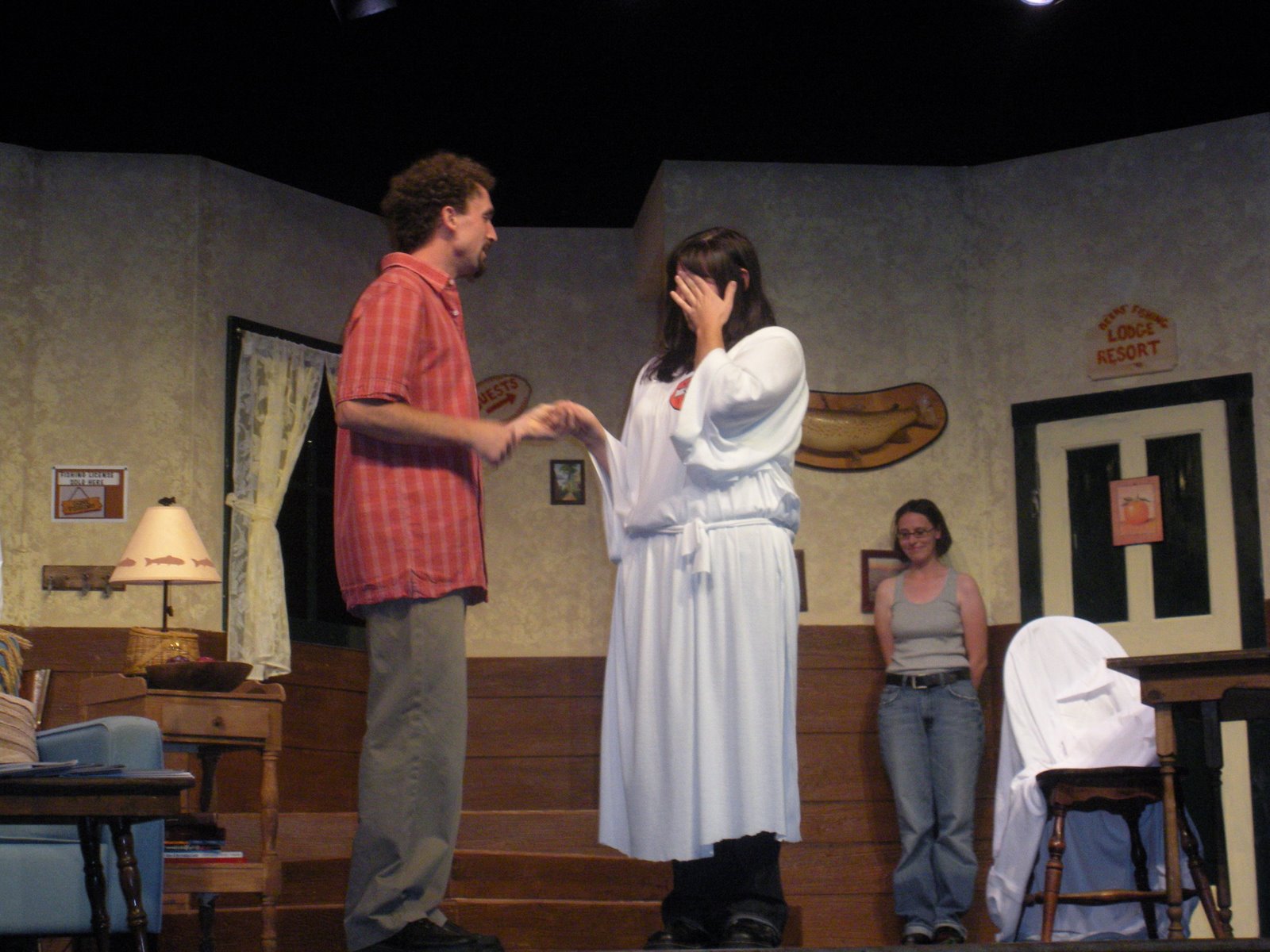
Two weekends ago, after a 3-person, 4-phone, 2-state, text-message, voicemail, super game of Telephone with Ms. Darling and her family, to ensure that she would return in time to the green mountains from her Beantown night with Madonna, Ms. Darling and I found ourselves at the Vergennes Opera House for a Friday night performance of The Foreigner, by Larry Shue, starring my friend Jay Peak, and with a brief cameo by his girlfriend Gee Wiz.

The Foreigner is a 2-act play that takes place at a fishing lodge in Georgia and centers around a pathologically shy and insecure British man named Charlie (played by Jay Peak who, jokingly [I hope] said he found some inspiration in the personality traits of yours truly) who, in an attempt to avoid any awkward social interaction with the other guests, pretends to be a non-English-speaking, non-speaking foreigner. When certain events force Charlie to communicate with the other guests in his pretend non-English language, hilarity ensues. And though the ultimate message of this play might be that even the unspoken word can communicate a human’s inherent goodness, one lesson I drew from the play was the power of language.


As the banner on my blog confidently tells my reader(s), and as most of my English-major friends will attest to, the pen is often mightier than the sword. Words matter and are often more powerful than ever intended by the person communicating them. Exhibit A for this argument can be found no further than the fact that I still remember the five most negatively influential comments made in my direction, even though all occurred at least 12 years ago, and some, a quarter of a century ago:

“You’re the worst sorry-assed student I’ve ever seen,” said Gary Perry, 11th-grade chemistry teacher after discovering me looking at a college basketball tournament bracket in class; “God is ashamed of you!” shouted Chris Ortloff, a church member after I dumped a bucket of water on his son at a church youth group meeting (I asked Papa Benchly if God was ashamed of me. His paraphrased response was, “you shouldn’t have done what you did, and that’s not something God would condone. With that said, he probably had it coming.”); “You’re Benchly. You’re asexual to us,” said Ms. Scharf, describing why I was “just friends” with 8 women in college; “Ew, Benchly touched my arm! Now I have cooties!” screamed nameless female elementary school classmate when a bump in the road knocked me into her seat on the bus; and “That’s not a real Dukes of Hazzard matchbox car, Benchly. You can’t play with us,” said nameless 1st grade classmate when I attempted to pretend that my orange matchbox sports car was The General Lee.

Though ranging from comical to typical to stereotypical to tragic, all affected me, and The Trash Heap would opine that all continue to affect me to this day. Words are powerful and have a shelf life that rivals that of even the most nonperishable foods. Whoever first claimed that names couldn’t hurt you like a stick or stone was lying or kidding him/herself, just like anyone who claims to be rubber, not glue. For instance, the names with which you’ll inevitably tease me after I quote You’ve Got Mail in the next two paragraphs will most likely sting for a long time.

This past year, I’ve been proud of the blog entries I’ve been able to craft with the words that I’ve sewn together. After two depressingly barren years of blogging, I’ve doubled the number of entries from those two years and still have two months left in the year with which to write the stories of my life. In perfect contrast, however, I feel as though I’ve slowly lost the ability to verbally communicate effectively. Anyone who has suffered through my bumbling retellings of a story or a joke lately will surely agree. Like Kathleen in You’ve Got Mail, I always “get tongue tied and my mind goes blank. Then I spend the rest of the night tossing and turning over what I should have said.” I may have a way with the written word, but the spoken one feels increasingly foreign to me.

When I do “have the pleasure of saying the thing [I] want to say at the moment [I’m] wanting to say it,” as Joe Fox warns in You’ve Got Mail, “remorse eventually follows.” For proof of that, I need to look no further than the difficulty I’ve had as of late in my attempts to communicate my feelings to Ms. Darling or my frustrations with certain family members. In each instance, no matter how carefully-crafted each thought was, I exited the conversation either feeling as if I had failed to accurately express what I was thinking, or that I had said too much. Considering how important words are, I’ve started contemplating communicating only in writing. And if this wasn’t the first step to a J.D. Salinger-like reclusive lifestyle, I’d probably go for it.

After all I’ve said, if you’re still left doubting the power of words, consider how they affected the life of Gee Wiz two weekends ago. After The Foreigner‘s curtain fell and the performers took their well-earned bows, Jay Peak stood in his rightful place at center stage, took Gee Wiz by the hand, and spoke the first nonfictional, but nevertheless well-rehearsed and deeply personal words of the night: a proposal. And in response, in between nervous snorts and tears of happiness, Gee Wiz uttered perhaps the most meaningful word of her life: “yes.” And in response, we say, “Mazel tov!”