
Migrate Love Story

This morning, I heard the honkings of the first geese of the season returning to their northern homes after a winter spent vacationing in the southern sun. Their appearance is one rung in the ladder that leads my community from the desolate depths of winter up and out to our long-awaited Vermont summer reward. After brunch with my friend, Gina, I ventured downtown to Uncommon Migrate Love StoryGrounds, navigating through a flock of college kids who had migrated down the hill after a winter spent in their dorms. I even saw the obligatory fraternity brother wearing his shorts approximately two weeks too early, which is yet another rung in that ladder.

I’m now sitting in the back of the coffee shop at a table at which, 6 years earlier, I awkwardly made conversation with a blind date. The blind date didn’t lead to anything (as was often the case back then in that infamous 2003) except a string of more blind dates at other Burlington establishments. In fact, if hard-pressed, I’m sure I could think of a date for 90% of the restaurants, bars, theatres, parks, and barns in the area. Let’s face it: the longer you live somewhere, the easier it is for you to find the remains of past heartaches splattered like graffiti love poems on the walls of businesses. If you add in the heartaches of all of your friends, you’ll find every inch of town covered with the tags of exes.

Migrate Love StoryLast summer, while she and I were experiencing our respective relationship heartaches, Sarah the L and I noticed what seemed to be a trend in our generation: all around us (i.e., friends, relatives, coworkers, friends of friends, new roommates, etc.), couples were breaking up. Even Ms. Darling and I bonded over our respective break-ups. There was no overlooking it; the Summer of 2008 was the Summer of Lovesickness. I asked Sarah the L recently if she had any theories as to why this happened. Jokingly (I think), she blamed Barack Obama. She said in a “year riddled with messages of ‘change’ and ‘hope,’” … people couldn’t help but wonder if they should upgrade their Bush for an Obama. She also thought the Summer of Lovesickness could be explained by a person’s reasonable tendency to respond to a friend’s “personal growth through trial” by reflecting on needed growth in his/her own life. Humans are impressionable creatures and for the same reasons a floor of college girls ends up on the same menstrual cycle by the end of a semester, a group of close friends most likely travels similar emotional-growth routes.

I posed this question to Sarah after a quick glimpse at an ex’s Facebook page (you do it, too) confirmed what I had long-before assumed: Hypothetical was now married (thus making her boyfriend’s Hypothetical now her husband’s Factual) and consequently, had become yet another in a long line of exes who had married the first serious boyfriend she dated after me (an ever-expanding sorority of women that also includes Widget, The Redhead, Stalker Girl, and The PT [it’s also worth noting that San Fran Girl and I never officially dated, but after our falling-out, she started dating the man to whom she’s now engaged]). This confirmed my long-standing belief that at some point in my life I had become Penultimate Man, the noble super-hero doomed to a life of boosting various women’s self esteems just enough for them to spread their wings and fly off to their future husbands. Considering I boosted Ms. Darling’s self esteem before sending her back to her stripper-loving ex, I wouldn’t be surprised if she got engaged to him within the year.

After spending a day contemplating my curse (aka, my exgirlfriends’ blessing), I asked Sarah what she thought it would take to become Ultimate Man. She wasn’t entirely sure because she has been dealing with similar demons, but she hoped one day soon she could rip open her shirt to show the world the blaze of UW (Ultimate Woman) across her chest, thus confirming my long-standing belief that she’s an exhibitionist.

Because I’m convinced that it is the perfect metaphor for every situation in life (including concerns about one’s penultimate tendencies), I’m yet again reminded of rock climbing. I haven’t talked about my adventures with rock climbing recently because after steadily improving for two months, my climbing skills have frustratingly hit a plateau. I should have known my progress would eventually decelerate: I have a history of excelling at a learned skill (e.g., guitar playing; mathematics; chess) only to reach my natural limit beyond which I can’t improve without prolonged resolute training, something my Benchly-of-Many-Skills, Master-of-None will-power has prohibited me from ever accomplishing. I’m determined to excel at this sport, though, and so I’m doing the only things in my control to ensure that that happens: consistent practice, and learning from other climbers. And as I direct my climbing questions to more experienced climbers, because I’m terrified of being Penultimate Man forever, I pose my relationship questions to my friends.

In addition to Sarah, I solicited love advice from CP and she responded with disbelief that I had asked her; she doesn’t consider herself an expert on relationships, though, she noted, her relationship had thus far survived 10 years. But truthfully, as much time as Sarah and I spend pondering how to keep love afloat, and as painfully educational as our break-ups have been, and as much success as CP has had at cultivating her love, and as much unsolicited Migrate Love Storyadvice as I’ve received in the last year, I honestly don’t think any of us have any idea of how to succeed at love with or without really trying. If you think I’m wrong, just look at our society’s divorce rates.

Uncommon Grounds is closing soon and I’m afraid, my dear readers (read: reader), that I don’t have an answer for you. I wonder if I ever will. And as I prepare to venture home against a gorgeous sunset backdrop (with views like this, can you blame the geese for coming back each spring?) while being serenaded with the sounds of college kids and geese, a bird that spends the majority of its life devoted to its “mate for life,” I can’t help but wonder if maybe I’m just looking for the answers in the wrong place.
The rain’s turned into snow…

Four years ago, Mia Wallace and I joined Sarah the L, Smoochie Poo, Peace Corp Girl, and Head in Hinesburg to mourn the end of yet another year while simultaneously celebrating the beginning of the next one. After Mia Wallace shared with me her belief that how you celebrate New Year’s Eve impacts how you spend the rest of the year, I made sure to do my part in helping to plan a great evening. I even went so far as to create the first of what has now been five straight Mr. Benchly’s New Year’s Rockin’ Eve Super Mixes. I made a copy for each partygoer. And though I did my best to make the CD a soundtrack for the evening, what I was actually doing was attempting to create a soundtrack for my life.

I know I’m not alone when I say that I’m intrigued at the thought of having a movie soundtrack play in the background of my everyday life. Whether it’s an inspirational Explosions in the Sky song for the walk to the Election Day voting booths; or a heartbreaking Bright Eyes song playing on the drive home from a break-up; or the upbeat Belle & Sebastian song that makes the stroll down Church Street that much more entertaining; or the hopeful Beatles song seemingly inspired by that first kiss; I’ve often dreamed of my life being set to music. As Caden Cotard said, every person in the world is a lead in his or her story. If that’s true, don’t we all deserve a musical accompaniment?

One song that has never made its way onto one of my Super Mixes despite its rightful claim to be there is the late great Dan Fogelberg’s “Same Auld Lang Syne.” The song tells the tale of two old lovers running into each other in their hometown and then spending the snowy evening drinking and reminiscing of days gone by. They toast their past and their present, and they attempt a conversation riddled with “emptiness.” In one of my favorite lines, Fogelberg says that the two were “living in our eloquence.”

I can’t think of a better way to describe a conversation between two old flames than how Fogelberg paints the picture in his song. Anyone who has ever experienced such an encounter firsthand knows that interacting with an ex is a complicated dance: there’s the obvious connection that drew you to each other in the first place, but it’s been marred by whatever drama that inspired your break-up; depending on how much time has passed, feelings are either confused or gone altogether and with them has gone the love-is-blindness that helped you overlook your ex’s flaws. What remains and the only thing capable of sustaining the conversation is the eloquence of your words. But your relationship has already ended for good reason and it’s inevitable that you’ll “run out of things to say.” Such is your fate as exes.

Despite “Same Auld Lang Syne”’s especially relevant subject matter this past holiday season (considering my break-up with Ms. Darling in the rainy autumn), it failed once more to make the final cut for my most recent Super Mix. Instead, I tried yet again to create a soundtrack for my life and, as embarrassing as this is to admit, like a documentarian trying to rewrite history, my song choices reflected my hope at reconciliation with Ms. Darling. A few of you received copies of the Super Mix before, predictably, I realized how unhealthy such a compilation was; I suppose that these copies will now be considered collector’s items. The lesson learned here is that though we each are leads in our own stories, we can’t act out our lives; we can only live them. Since that day, I’ve done my best to live my life to the fullest.

What’s so sad about Fogelberg’s song is that it’s autobiographical; it’s a genuine soundtrack to his life because these are words he actually lived. And it’s a song that will never be mistaken for a hopeful one. At the end of the night, the old flames kiss and go their separate ways back to their separate lives. Fogelberg sings, “Just for a moment, I was back at school and felt that old familiar pain. As I turned to make my way back home, the snow turned into rain.” Ms. Parker and I have debated the meaning of these lines and I’m not sure that we ever settled on an ultimate interpretation, but I don’t think that it’s much of a stretch to say that Fogelberg was going for symbolism with his words. My belief is that the snow represented joy or hope, and the rain, sadness or realism.

This song and my interpretation of its symbolic lyrics were on my mind late last year on an unseasonably warm and rainy December day when, on my walk to work, I heard a woman say to her friend, “well, at least it’s better than snow.” As timing would have it (and you know how this blog and its author love timing), this depressing, global-warming-loving comment happened two days after I met Cherry on Top, and inspired me to write her an email to tell her about it. I told her that though I may not ski, and though I’ll most likely feel differently in April, even I will admit that in the winter, I prefer snow to rain. And later that day, as I typed another email to her, adding yet another page to this new chapter in my life, the rain outside turned into snow.

Benchly’sleeve

As Papa Benchly’s and my checkbook will confirm, nine years ago, I purchased four years of education at the University Whose Name Shall Never Be Said. And though I was paying for the classes, I found most of my education outside the classroom. While a student there, I wrote a newspaper column that often critiqued the university, its people, its departments, and its policies. And though I admit that the column was borne out of contempt for the university, I gradually found myself writing words that I hoped would help positively change the university (while maintaining my often sarcastic tone, of course). In a sense, I was seeking change I could believe in. But as President-Elect Obama and his supporters know far too well, when you criticize something, even if it’s something you love, often times the response is essentially, “if you don’t like it here, leave,” and criticism is most certainly what I received, even in the form of threats (unless, of course, those five fraternity brothers who showed up at my apartment were telling the truth when they claimed they only wanted to talk).

It was in dealing with negative responses to my newspaper column that I learned a valuable lesson in journalism: a journalist should respond to criticism only when there’s a gross misstatement of fact, when questions have been asked of the publication, or when the criticism needs some sort of clarification, lest the journalist risk alienating his/her readers with a most-likely never-ending argument/contest of who can have the last word. Most importantly, the very same freedom of speech that allows journalists and bloggers the opportunity to speak their mind must provide the same blanket of protection and opportunity for those who raise their voice in disagreement. And so, nine years later, these are the thoughts that are on my mind as I sit here and contemplate what, if anything, to do about the recent feedback hand I’ve been dealt on this very blog.

As my reader(s) most likely know, my last blog entry had the honor of receiving not one, but three comments from my fans (just about doubling my fan base), two of which from “Anonymous” could be classified as “Constructive Feedback.” (The other, authored by Ms. Darling, I’ve filed under “Obligatory Adoration.”) For the technologically savvy (read: those who can operate a mouse), I’ve included a link to these comments so that Anonymous’s words can speak for themselves.

For the technologically challenged, I’ll briefly summarize them here: Anonymous was concerned that my written words might be harmful; that good communication required listening, which became difficult when communicating in writing; that if I wasn’t open to stepping out of my comfort zone to listen to what others had to say, it would be because I was afraid to hear criticism or I was simply self-centered; and that if I stopped hiding behind my words, I’d be better off for it. A few days later, Ms. Darling’s sweet (pun intended) blog entry about me received another Anonymous posting, which seemed to be related (pun not quite unintended): “Be kind, and remember that while a second or third life can be lived online, you are still left with the first.”

I have no way of knowing if the comments from Anonymous #1 and Anonymous #2 are related, but for the purpose of this blog, I’m going to pretend that they are. And though I have a hunch that Anonymous #1 wasn’t responding to my blog but rather to my actions and/or inactions in my “first life,” since she claimed to be “offering a response to some of [my] musings,” I’ll treat her comments as such. With that in mind, it seems to me that the argument being made here is that there is a time and a place for a blog, and that maybe Ms. Darling and I have crossed that fine line by speaking openly about our recent dating adventure/challenge, which has occurred fairly close (some would consider too close) in time to our previous relationships. I’m going to resist the temptation to debate who is right and who is wrong; with such an ever-changing technological world, I think even Emily Post would have trouble finding her social etiquette footing. What I will do instead is offer up for your consideration and clarification my brief (read: non-Benchly-like) philosophy on blogging:

When I first started blogging back at the obviously-trademark-infringed,-though-cleverly-named-nonetheless The Continuing Story of Bungalow Benchly, I had a discussion with Ms. Parker about how personal one’s blog entries should be. I don’t remember her opinion on the matter (I think she said if it was meant for your journal under your bed, it shouldn’t be in your blog), but I remember mine as it’s one I’ve tried to maintain to this day: I want to write only about what I would feel comfortable discussing face-to-face with anyone tomorrow. My aim has been to express the same respectful honesty in my happy-ever-after blogs as can be found in my heart-broken-again ones. And though, admittedly, a few of my blog tirades crossed a line (the snoring banishment episode comes to mind), I think for the most part I’ve done a great job. I may be a screenname as I post this, but as Anonymous #2 pointed out, I’m human first and foremost, and so it’s no surprise that I’ve made some blogging mistakes. At the very least, I can say that they’ve been genuine ones with honest intentions.

So to Anonymous #1 and Anonymous #2, thank you for your feedback. I appreciate that you’ve taken the time to read my blog and to consider all that I have to say. And I hope that you continue to do so. If you do, I promise you that what you will find is what you’ve always found: an honest, sensitive, and respectful portrayal of my feelings about my life and the world and people around me. Like my wet sleeves in my “first life,” I wear my emotions in my second life here on my blog. If I’m happy, if I’m sad, if I’m heartbroken, or if I’ve met an amazing woman and am hopeful that things will work out for us in the end, you can rest asssured that you’ll read it here, either boldly stated, or somewhere between the lines.

Away With Words?

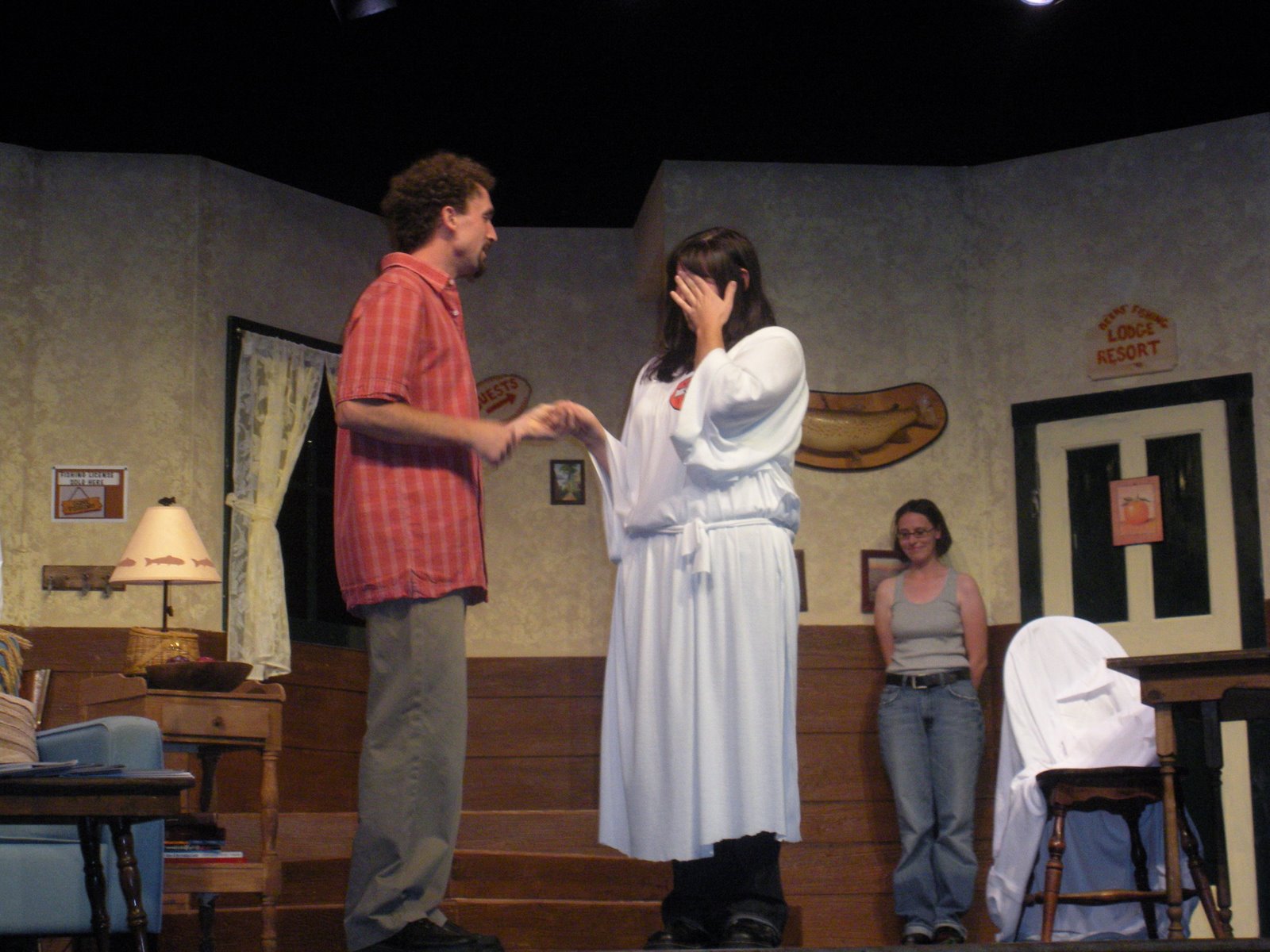
Two weekends ago, after a 3-person, 4-phone, 2-state, text-message, voicemail, super game of Telephone with Ms. Darling and her family, to ensure that she would return in time to the green mountains from her Beantown night with Madonna, Ms. Darling and I found ourselves at the Vergennes Opera House for a Friday night performance of The Foreigner, by Larry Shue, starring my friend Jay Peak, and with a brief cameo by his girlfriend Gee Wiz.

The Foreigner is a 2-act play that takes place at a fishing lodge in Georgia and centers around a pathologically shy and insecure British man named Charlie (played by Jay Peak who, jokingly [I hope] said he found some inspiration in the personality traits of yours truly) who, in an attempt to avoid any awkward social interaction with the other guests, pretends to be a non-English-speaking, non-speaking foreigner. When certain events force Charlie to communicate with the other guests in his pretend non-English language, hilarity ensues. And though the ultimate message of this play might be that even the unspoken word can communicate a human’s inherent goodness, one lesson I drew from the play was the power of language.


As the banner on my blog confidently tells my reader(s), and as most of my English-major friends will attest to, the pen is often mightier than the sword. Words matter and are often more powerful than ever intended by the person communicating them. Exhibit A for this argument can be found no further than the fact that I still remember the five most negatively influential comments made in my direction, even though all occurred at least 12 years ago, and some, a quarter of a century ago:

“You’re the worst sorry-assed student I’ve ever seen,” said Gary Perry, 11th-grade chemistry teacher after discovering me looking at a college basketball tournament bracket in class; “God is ashamed of you!” shouted Chris Ortloff, a church member after I dumped a bucket of water on his son at a church youth group meeting (I asked Papa Benchly if God was ashamed of me. His paraphrased response was, “you shouldn’t have done what you did, and that’s not something God would condone. With that said, he probably had it coming.”); “You’re Benchly. You’re asexual to us,” said Ms. Scharf, describing why I was “just friends” with 8 women in college; “Ew, Benchly touched my arm! Now I have cooties!” screamed nameless female elementary school classmate when a bump in the road knocked me into her seat on the bus; and “That’s not a real Dukes of Hazzard matchbox car, Benchly. You can’t play with us,” said nameless 1st grade classmate when I attempted to pretend that my orange matchbox sports car was The General Lee.

Though ranging from comical to typical to stereotypical to tragic, all affected me, and The Trash Heap would opine that all continue to affect me to this day. Words are powerful and have a shelf life that rivals that of even the most nonperishable foods. Whoever first claimed that names couldn’t hurt you like a stick or stone was lying or kidding him/herself, just like anyone who claims to be rubber, not glue. For instance, the names with which you’ll inevitably tease me after I quote You’ve Got Mail in the next two paragraphs will most likely sting for a long time.

This past year, I’ve been proud of the blog entries I’ve been able to craft with the words that I’ve sewn together. After two depressingly barren years of blogging, I’ve doubled the number of entries from those two years and still have two months left in the year with which to write the stories of my life. In perfect contrast, however, I feel as though I’ve slowly lost the ability to verbally communicate effectively. Anyone who has suffered through my bumbling retellings of a story or a joke lately will surely agree. Like Kathleen in You’ve Got Mail, I always “get tongue tied and my mind goes blank. Then I spend the rest of the night tossing and turning over what I should have said.” I may have a way with the written word, but the spoken one feels increasingly foreign to me.

When I do “have the pleasure of saying the thing [I] want to say at the moment [I’m] wanting to say it,” as Joe Fox warns in You’ve Got Mail, “remorse eventually follows.” For proof of that, I need to look no further than the difficulty I’ve had as of late in my attempts to communicate my feelings to Ms. Darling or my frustrations with certain family members. In each instance, no matter how carefully-crafted each thought was, I exited the conversation either feeling as if I had failed to accurately express what I was thinking, or that I had said too much. Considering how important words are, I’ve started contemplating communicating only in writing. And if this wasn’t the first step to a J.D. Salinger-like reclusive lifestyle, I’d probably go for it.

After all I’ve said, if you’re still left doubting the power of words, consider how they affected the life of Gee Wiz two weekends ago. After The Foreigner‘s curtain fell and the performers took their well-earned bows, Jay Peak stood in his rightful place at center stage, took Gee Wiz by the hand, and spoke the first nonfictional, but nevertheless well-rehearsed and deeply personal words of the night: a proposal. And in response, in between nervous snorts and tears of happiness, Gee Wiz uttered perhaps the most meaningful word of her life: “yes.” And in response, we say, “Mazel tov!”


"With every mistake, we must surely be learning…"

Thanks to the Photo Album Project of 2003–2008, the majority of my photographs since 1992 are now filed chronologically in no less than 10 albums, each with its own decorative cover carefully selected to suggest a maturity void of any effeminate qualities (see also my dark red, manly-patterned Martha Stewart comforter). Buried deep within one of these albums is a photograph taken at the Holocaust Museum in Washington, DC in 1994; a picture whose purpose is actually expressed in the biblical quote contained within its frame: “Only guard yourself and guard your soul carefully lest you forget the things your eyes saw, and lest these things depart your heart all the days of your life. And you shall make them known to your children, and to your children’s children” (Deuteronomy 4:9). In simpler (read: more John-McCain/Sarah-Palin-friendly) terms, the heart of this message is clear: honor history by learning from it and ensuring it isn’t repeated.

In an unintended bit of poignancy, this photograph is surrounded in these 10 albums by photographs of the various serious, semi-serious, and not-so-serious girlfriends/dates/girl-space-friends in my life, each of whom has been responsible for at least one valuable lesson about life, love, my flaws, my strengths, what I’m capable of in relationships, what I need to improve, what I want out of a relationship, what I shouldn’t put up with, etc. Whether it’s the woman who first called to attention my caretaker personality trait, or the ones who made me realize my susceptibility to dependency, or the ones who forced me to take responsibility for my role in our relationships, or the ones who helped me understand that disagreements can be healthy, I’ve learned a lot in the 15 years that I’ve been dating. And although I feel a tad shameful applying the lesson from a Holocaust-related-quote to a 30-something’s love life (I find my solace and justification in another lesson learned from the Holocaust: that each life is valuable and worth discussing), I think it goes without saying (though when has that ever stopped me from saying it anyway?) that if I ever want to find myself in a healthy relationship capable of sustaining the Long Haul, I need to protect these lessons learned from being erased in my memory like out-of-focus digital photos taken one-too-many-glasses-of-wine into a Friday night.


Now that I’ve started seeing a therapist, my past relationships have taken center stage in my memory’s playhouse. Although quite a bit of our 50-minute hours have been spent discussing the Benchlys who, in the last two and a half months, have started to resemble an overly dramatic and meddling family straight out of a bad 80s nighttime serial drama, we have also taken the time to figure out why my past relationships have failed, in hopes that my next one won’t. And though I finally caved at Mama Benchly’s twentieth suggestion that I seek therapy simply because I wanted to vent about my family, I’ll be the first one to admit how nice it has been to discuss my ideas/fears/questions about relationships with an educated, soft-spoken professional, affectionately nicknamed The Trash Heap (I can’t take credit for this one; this was Sarah the L’s idea). For although I pay her and so we’re naturally at risk for the “customer is right” mentality creeping in, her brutal honesty thus far has assured me that I can consider her opinion to be unbiased and caring.

The Trash Heap has been invaluable lately for a reason I’m sure my reader(s) won’t be surprised to hear simply because today I’m about as transparent as a political ad or election running-mate choice: I’ve started dating someone new. Her name is Ms. Darling (Ms. Parker: I have faith that you’ll figure this one out) and a darling she is. In the grand scheme of things, “what it is we’re doing” is fairly fresh and still carries with it that new car smell called Confidence that excitedly says, “This is the greatest car to ever be driven off the lot. I can’t believe it only has 2 miles on it! And look at the cup holders!” In other words, we’re still in that stage when you’re blown away by the refreshing and exciting new addition to your life, and you spend your time together discovering that second glove compartment or whether or not two bikes can fit in the back. But we’re not kidding ourselves. We’re hopeful that this is going in the direction of the Long Haul (and there are certainly days when I’m convinced that it is), but we expect road bumps. We expect headlights and taillights to go out, and maintenance required lights to go on. We expect them because that’s what our respective pasts have taught us, among many other lessons, and to remember and learn from these pasts is to honor them.

(I must admit, this time around I feel an overwhelming sense of comfortable calmness. Ms. Darling excites me and makes me feel relaxed at the same time. This is new for me and most definitely worthy of The Trash Heap’s input.)

I realized recently that the time has come to purchase an 11th photo album. I’m starting to feel overloaded with developed pictures awaiting their appropriate place in my chronologically documented history. Included in those pictures are new ones of Ms. Darling from the hikes we’ve been on, one of our marathon dates, the night we got lost under the stars, and a recent bike ride. These are moments I already know I don’t want to forget, lest these things depart my heart all the days of my life.