A Love/Hate Relationship

As most of you have heard by now, after a woman compared President Obama to Adolf Hitler in a town hall meeting, U.S. Representative Barney Frank responded, “It is a tribute to the First Amendment that this kind of vile, contemptible nonsense is so freely propagated.” I agree. She had a right to make the comparison, and Frank had a right to call the comparison vile.

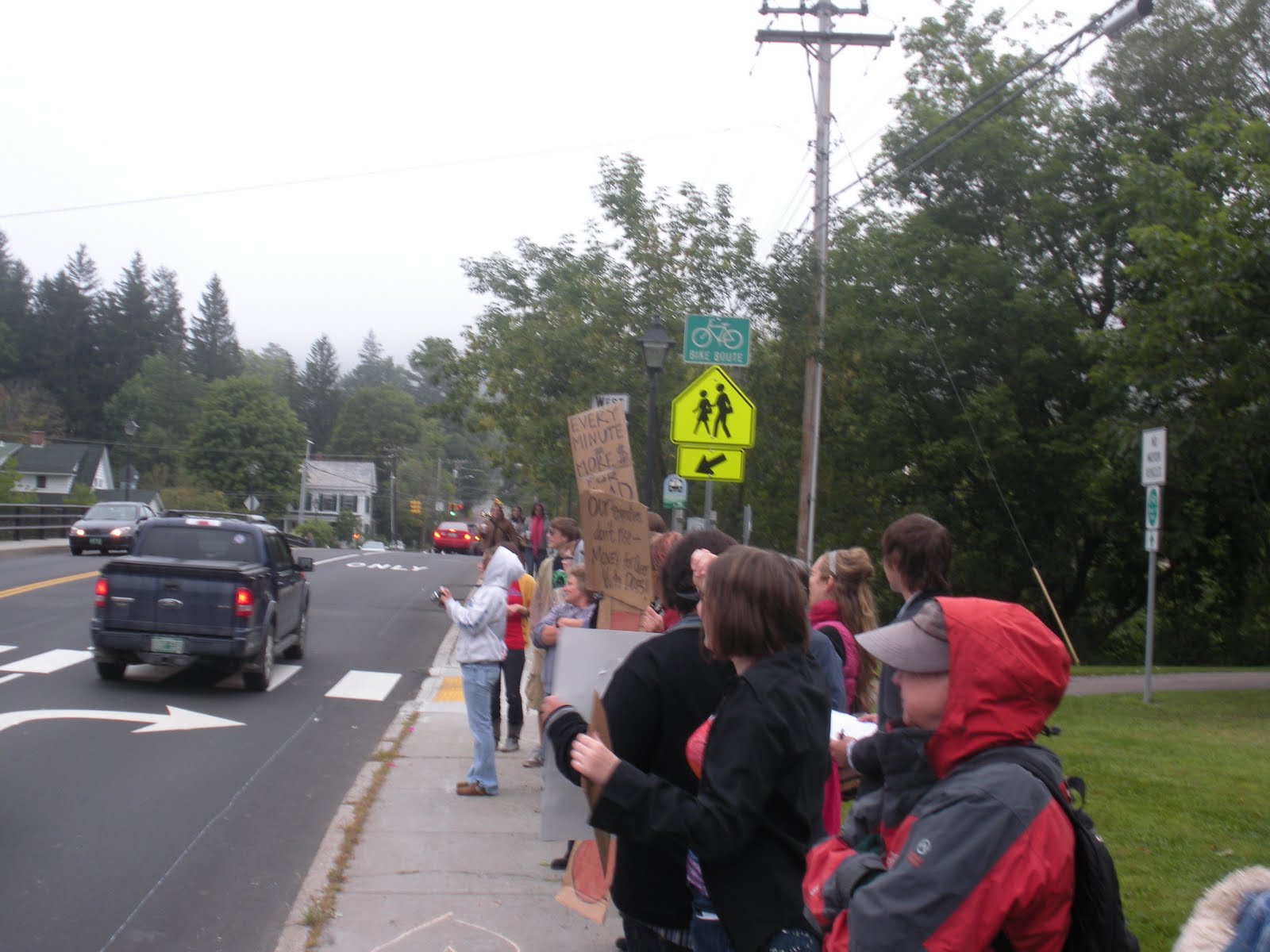
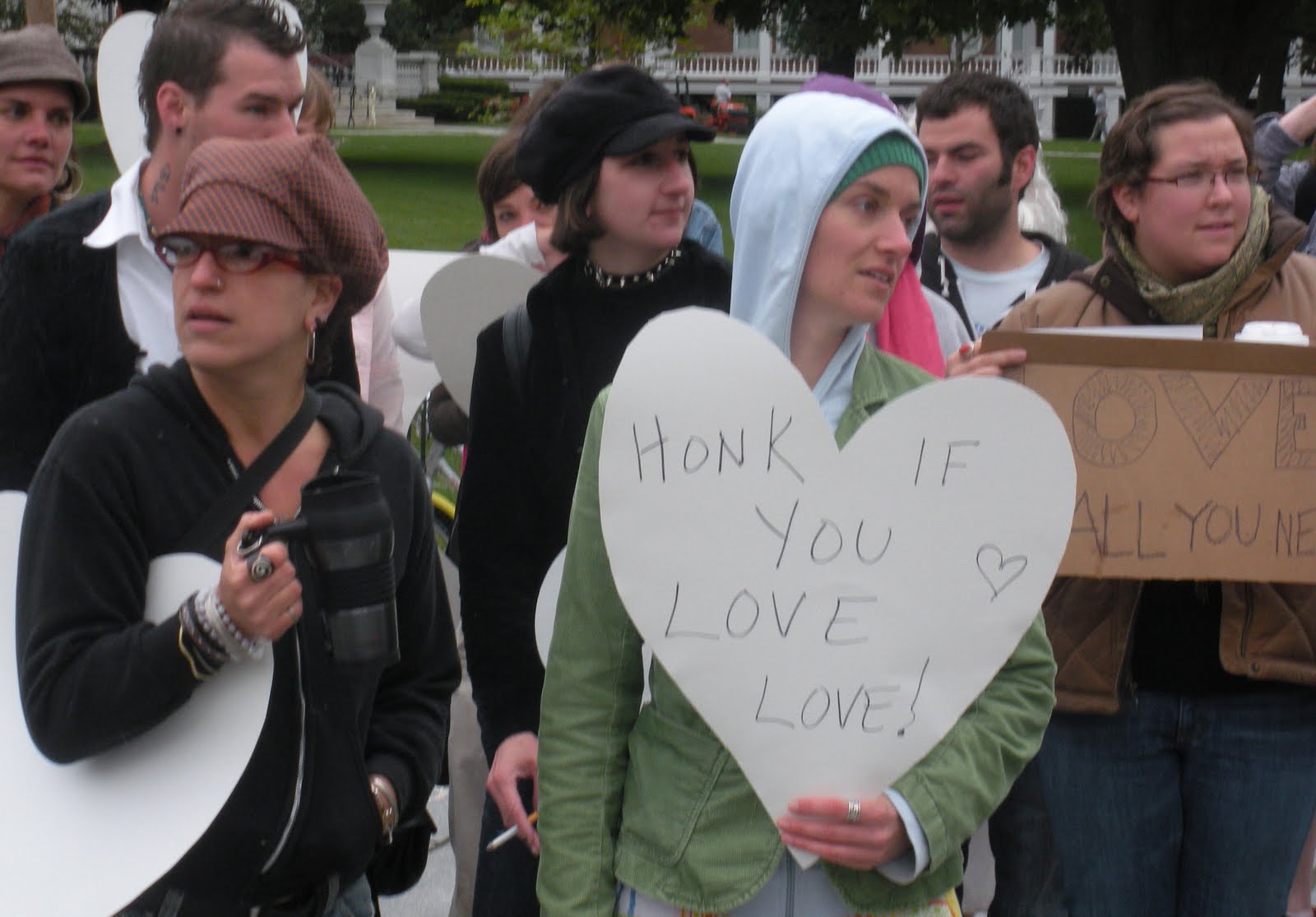
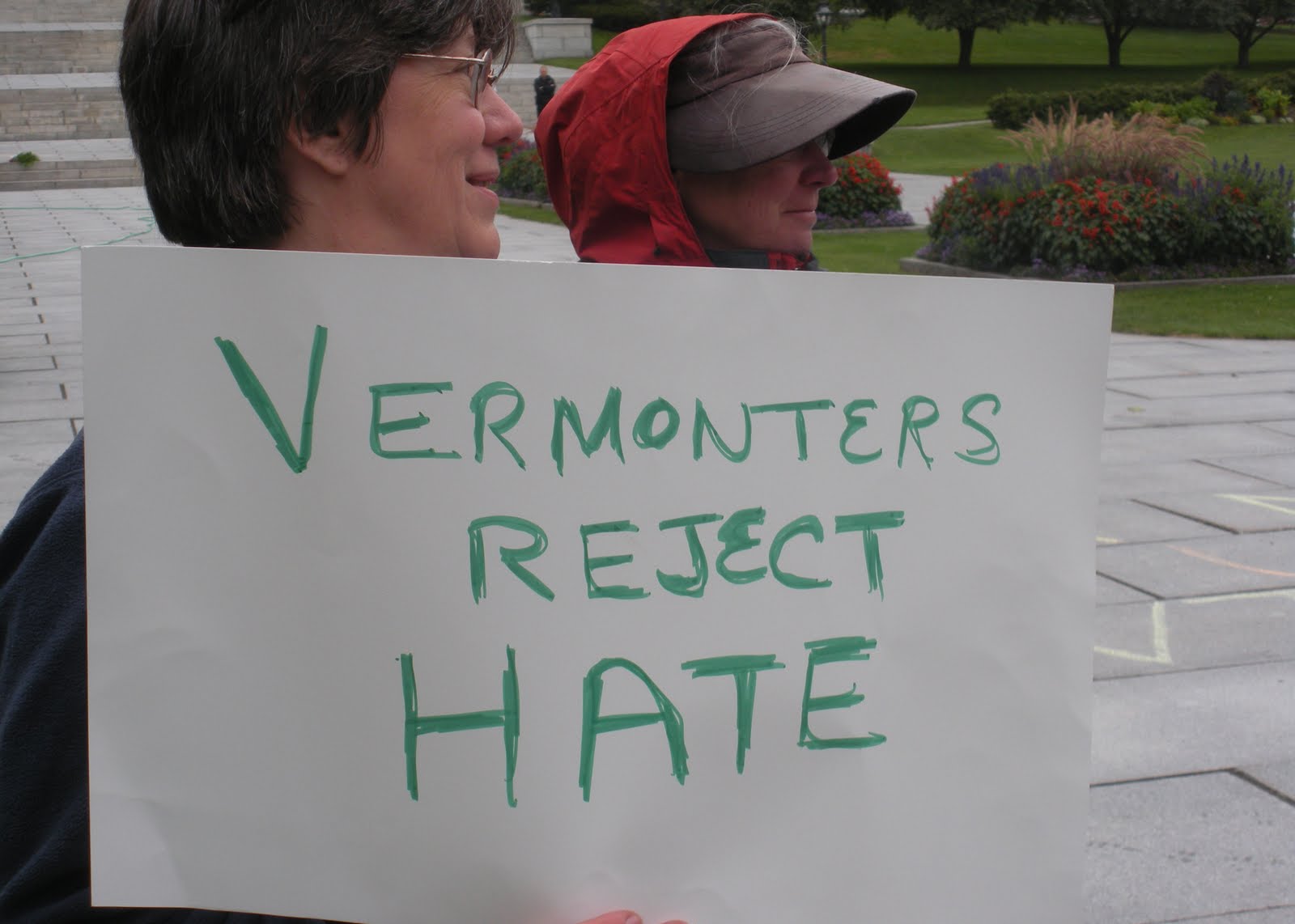
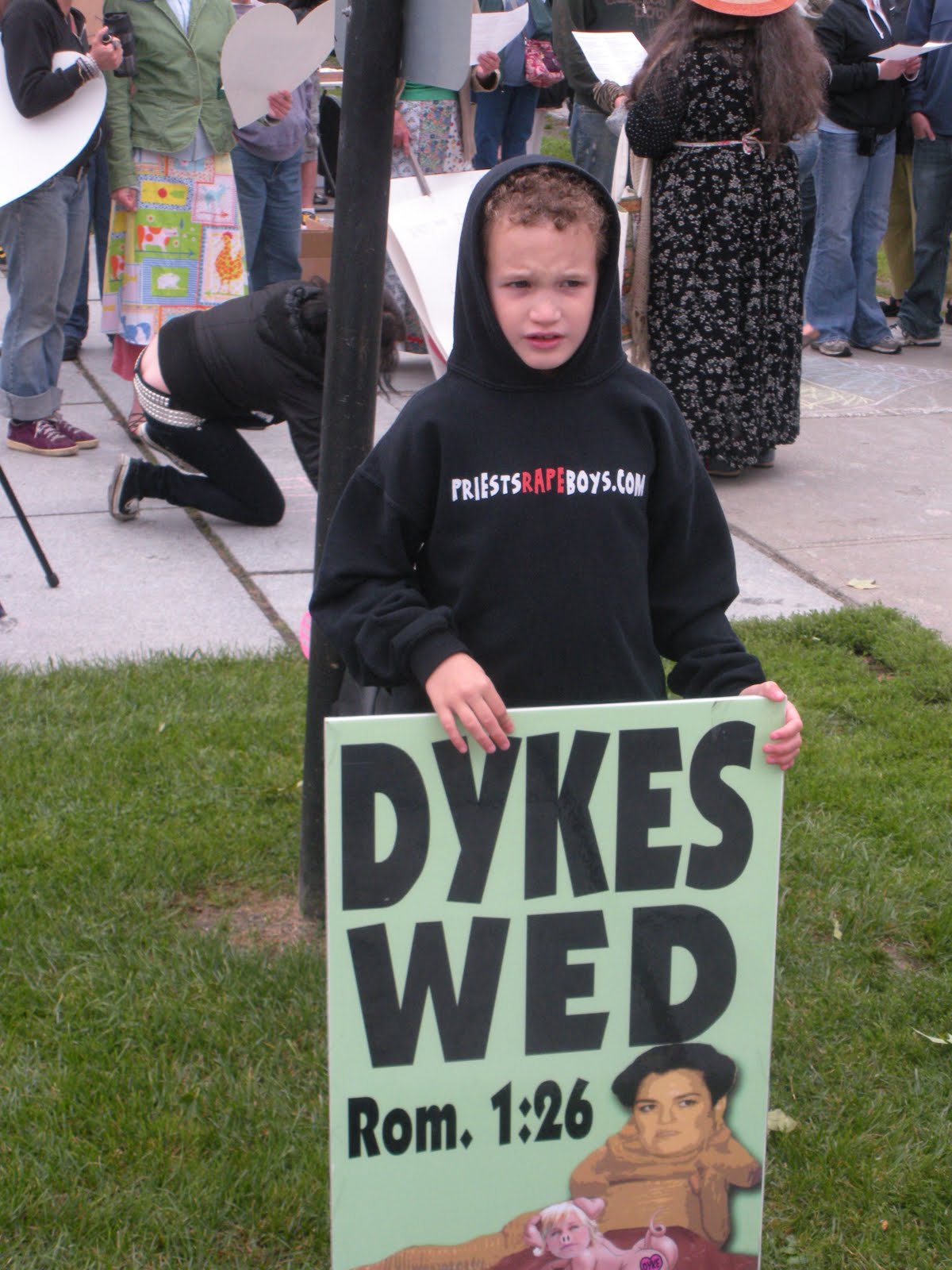
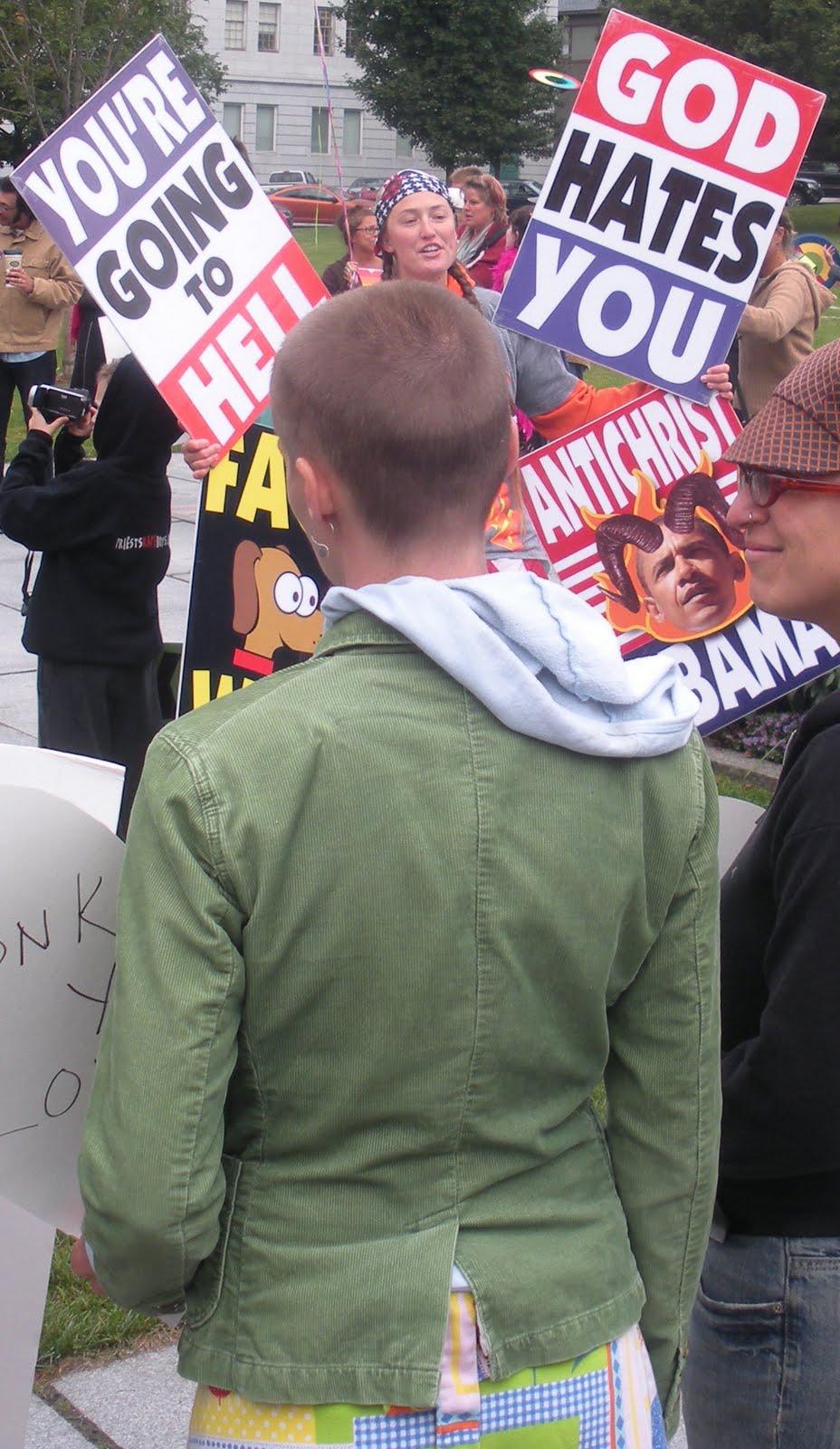
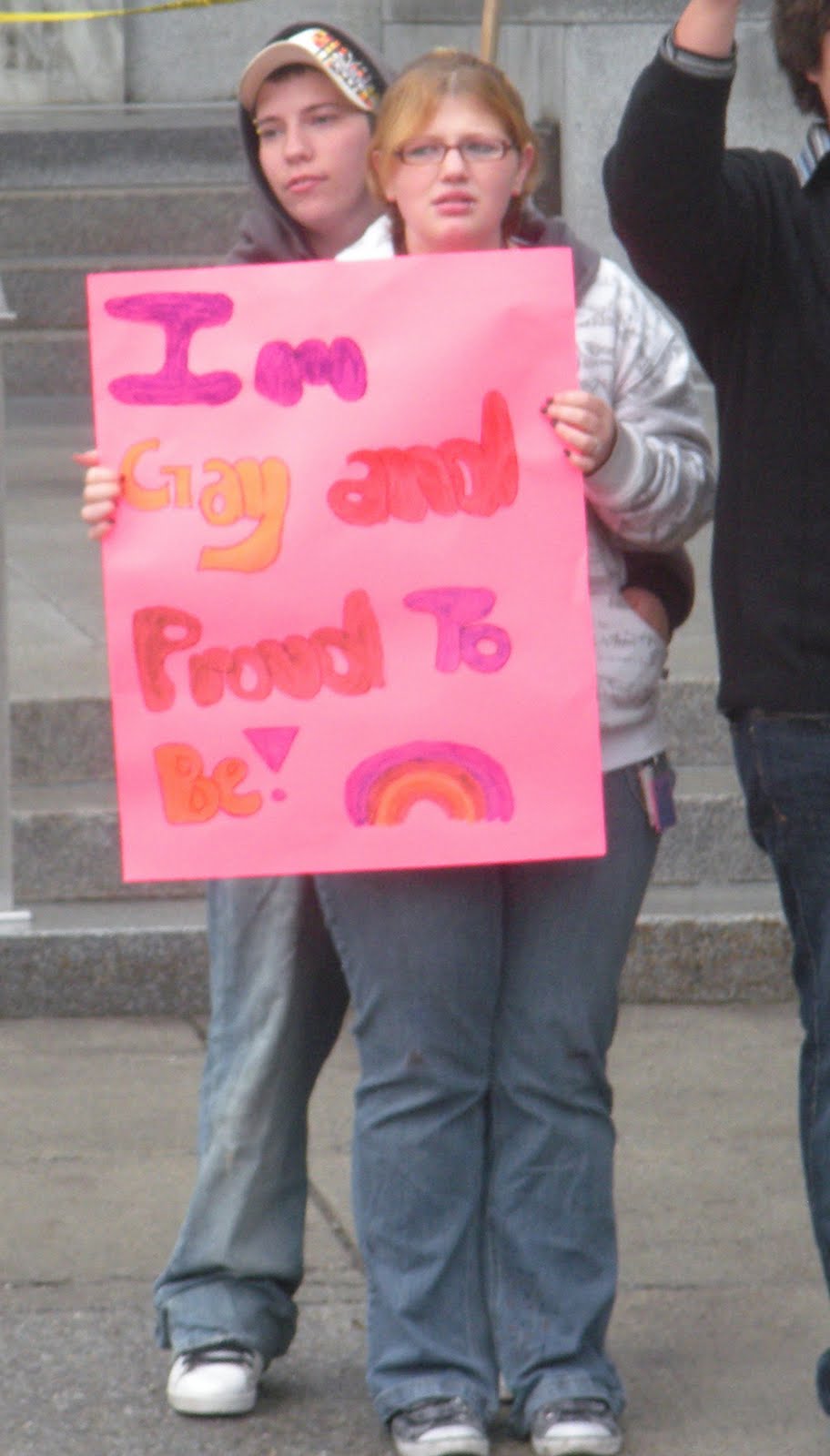
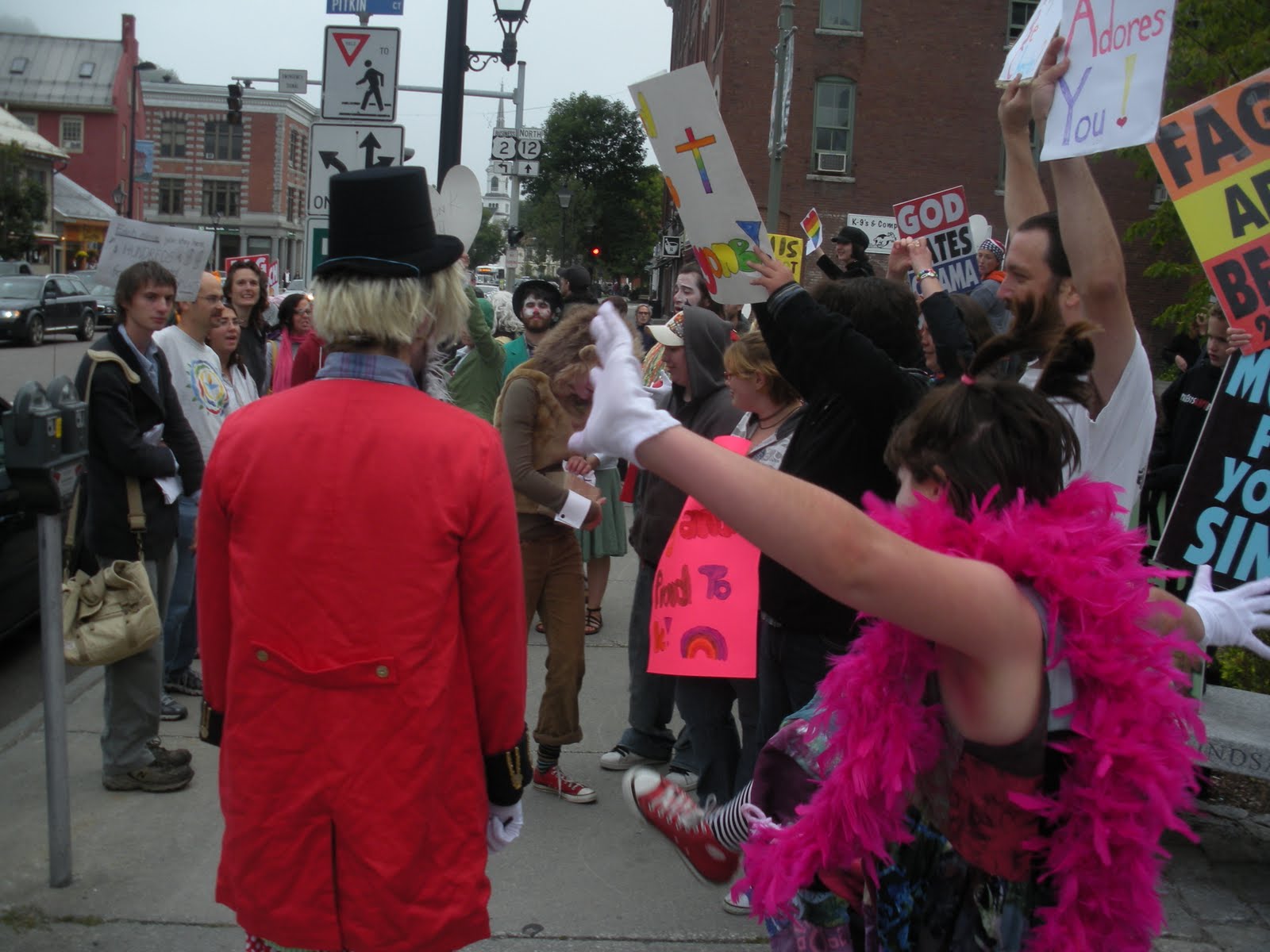
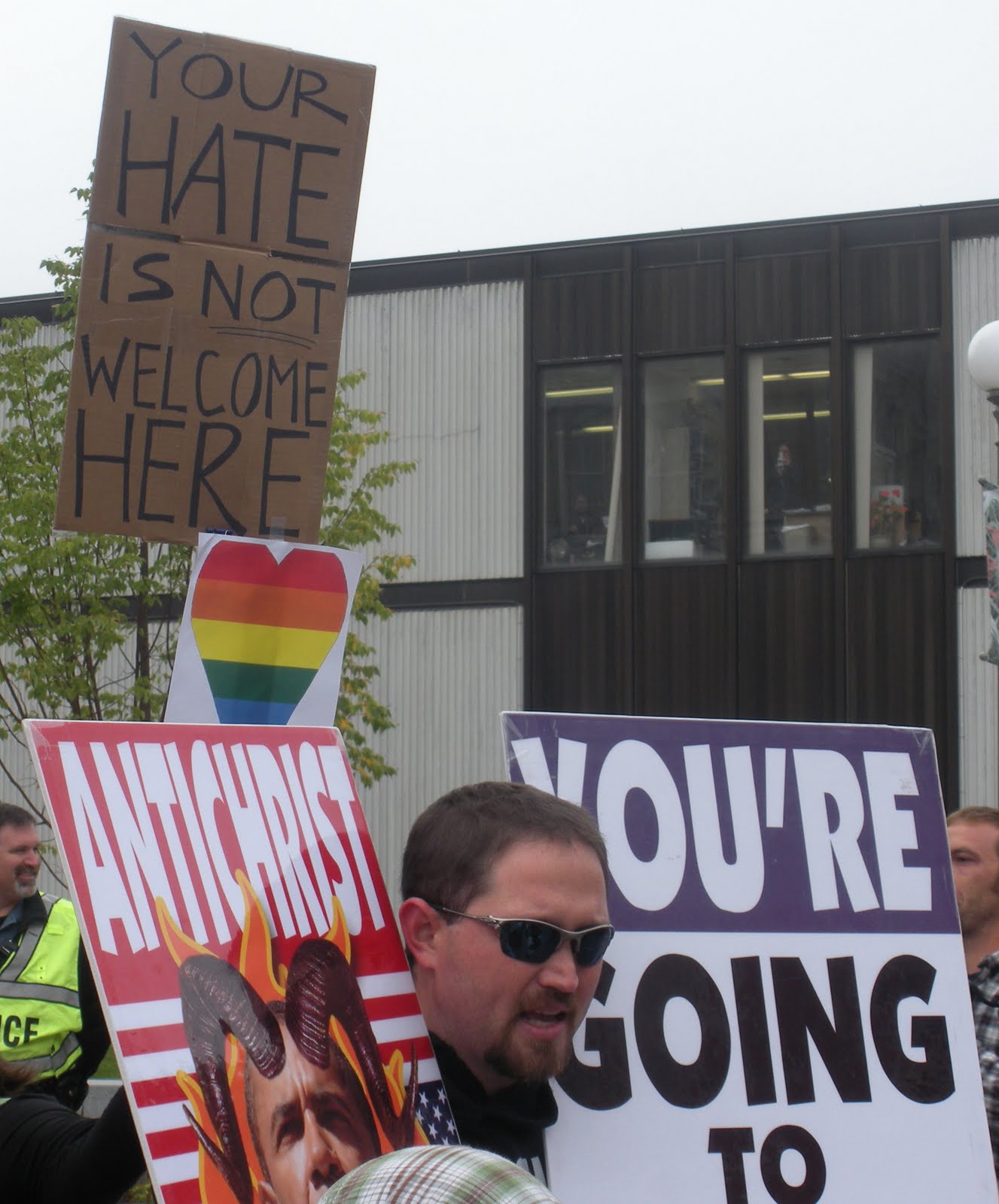
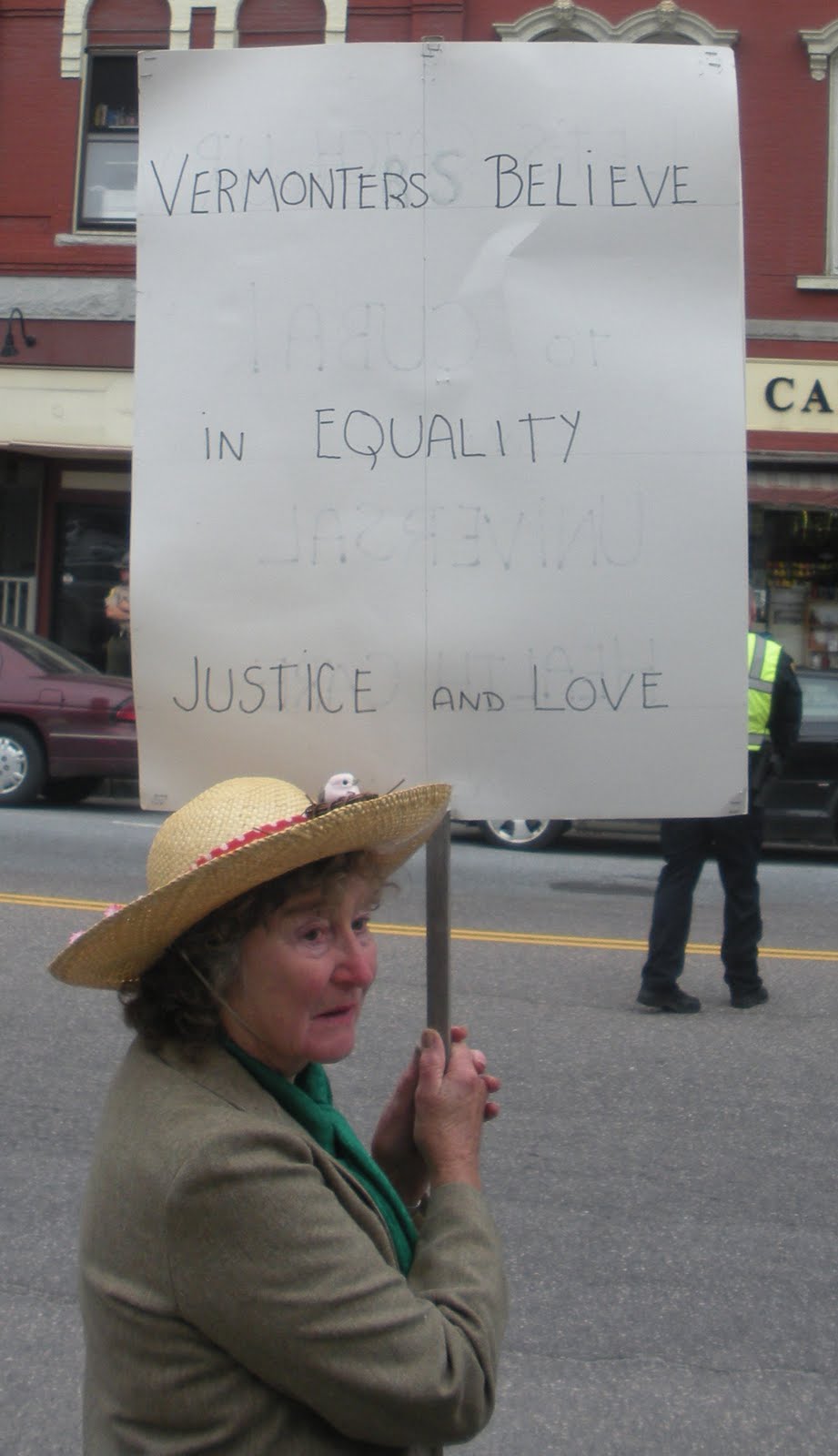
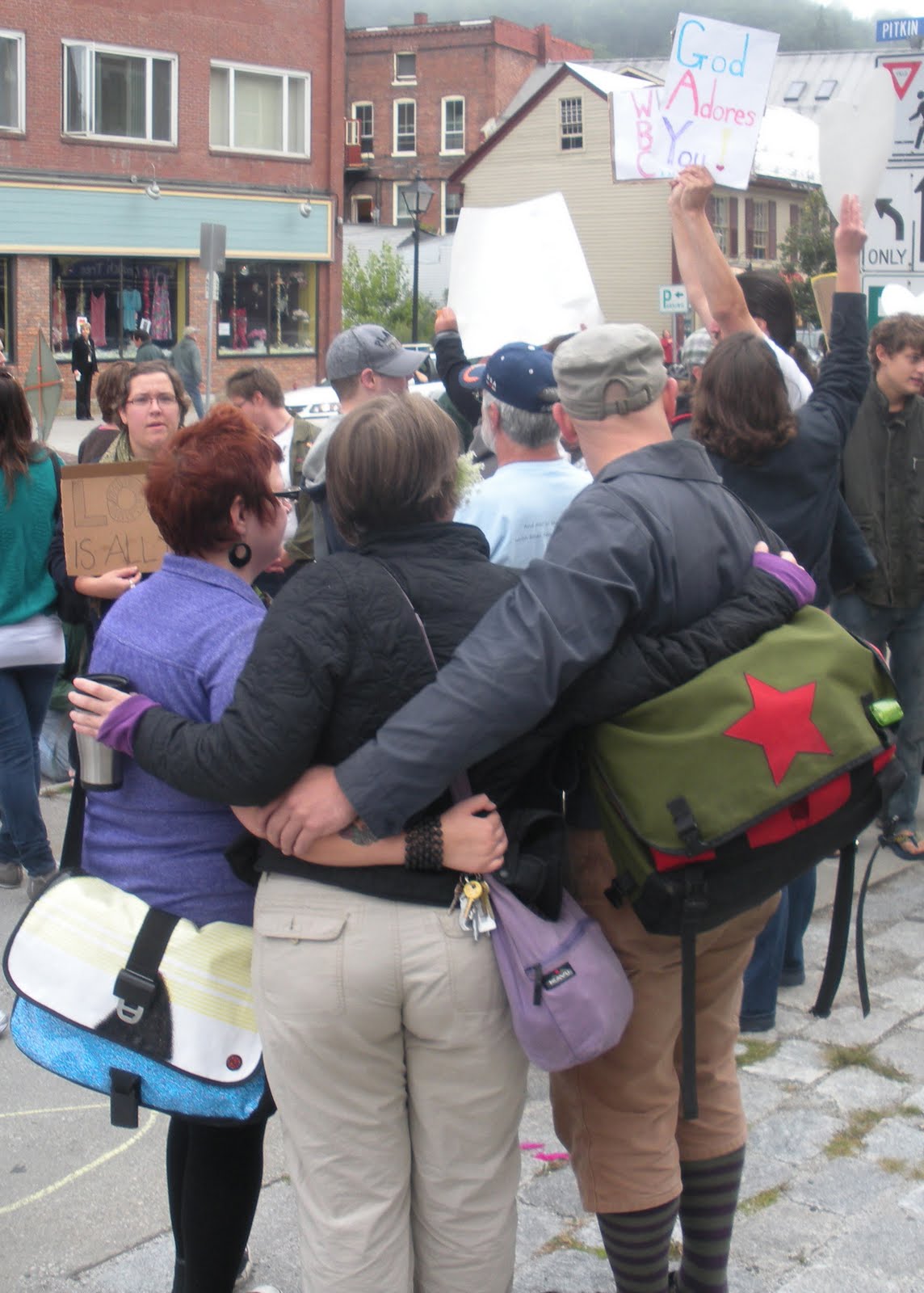
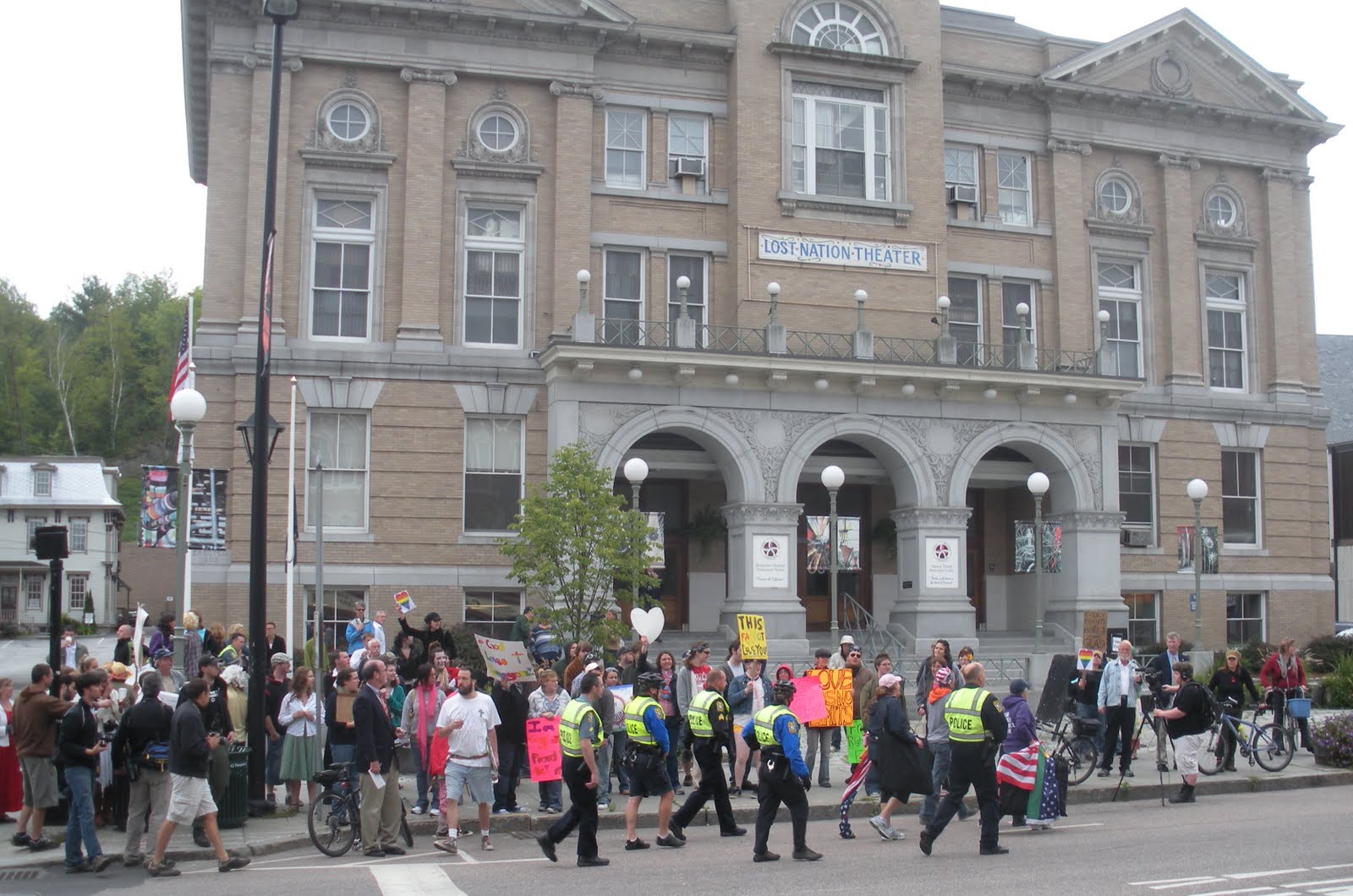
For obvious reasons, this encounter was on my mind yesterday morning when a small group of extreme protesters (or, to be fair, “protesters who some have deemed to be extreme”) visited Vermont to protest gay marriage as well as, it seemed to this biased observer, everything else. They were doing so on behalf of God. I’m not making that up. One of the women in the group said, “you’re darn tootin’ we’re a hate group. We’re preaching the hatred of God.” I can’t begin to imagine what makes these people tick; how one goes about justifying such a message. What I can state with full confidence, though, is that the majority of Vermonters disagree. And disagree they did.

As a writer, my predilection is to use visual aids only when they can complement the written word. After witnessing yesterday’s events, though, I understand that the only proper way to document this story is to complement the photographs with captions.

This story is one of love and hate. While love is appropriate for all ages, the photo essay that follows might not be.

We love Viva Espresso for opening at 6 a.m. …

… so that Sarah and I could get our coffee.

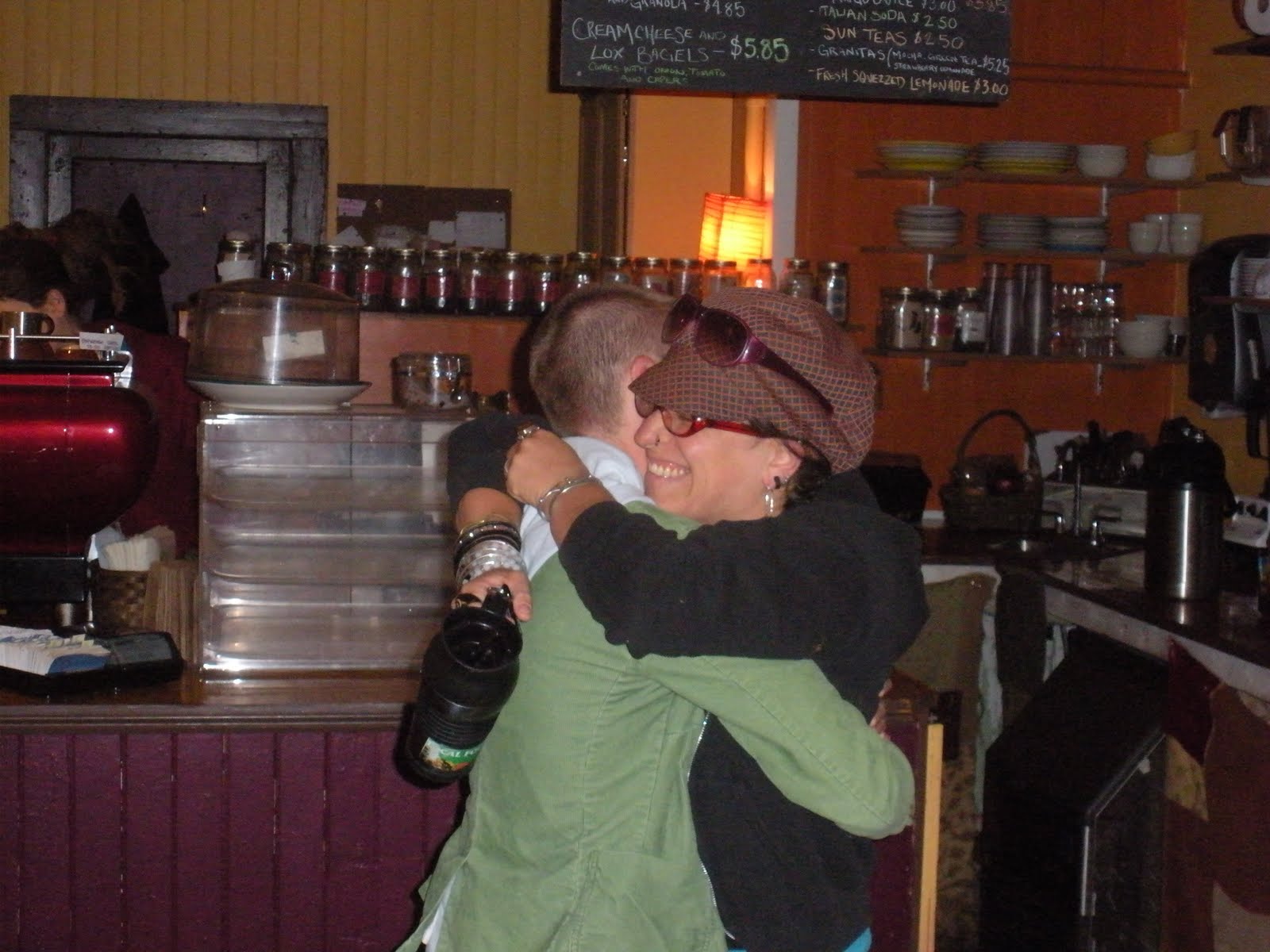
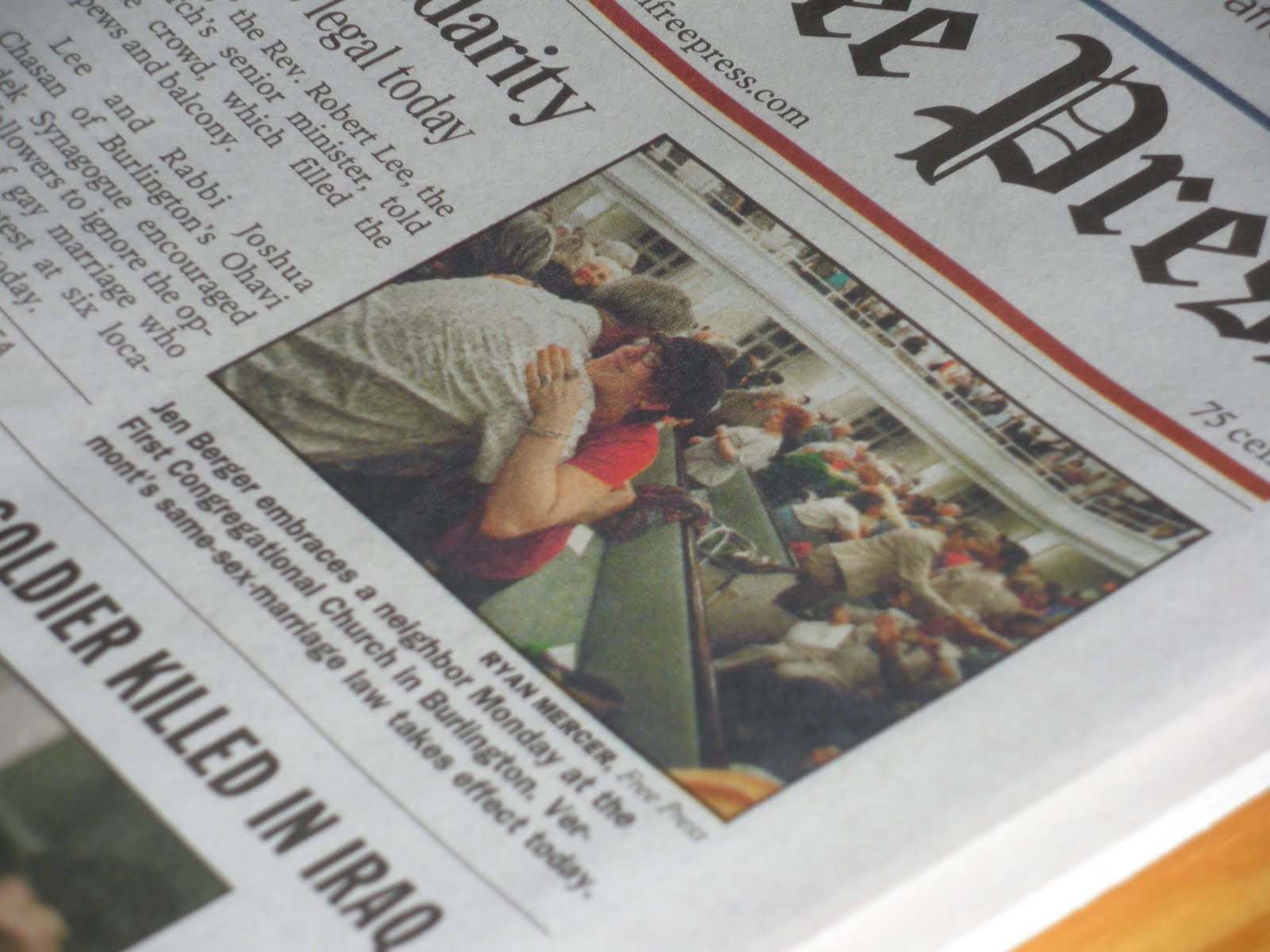
And then Jen showed up and was loved …

… and reenacted the morning’s news.

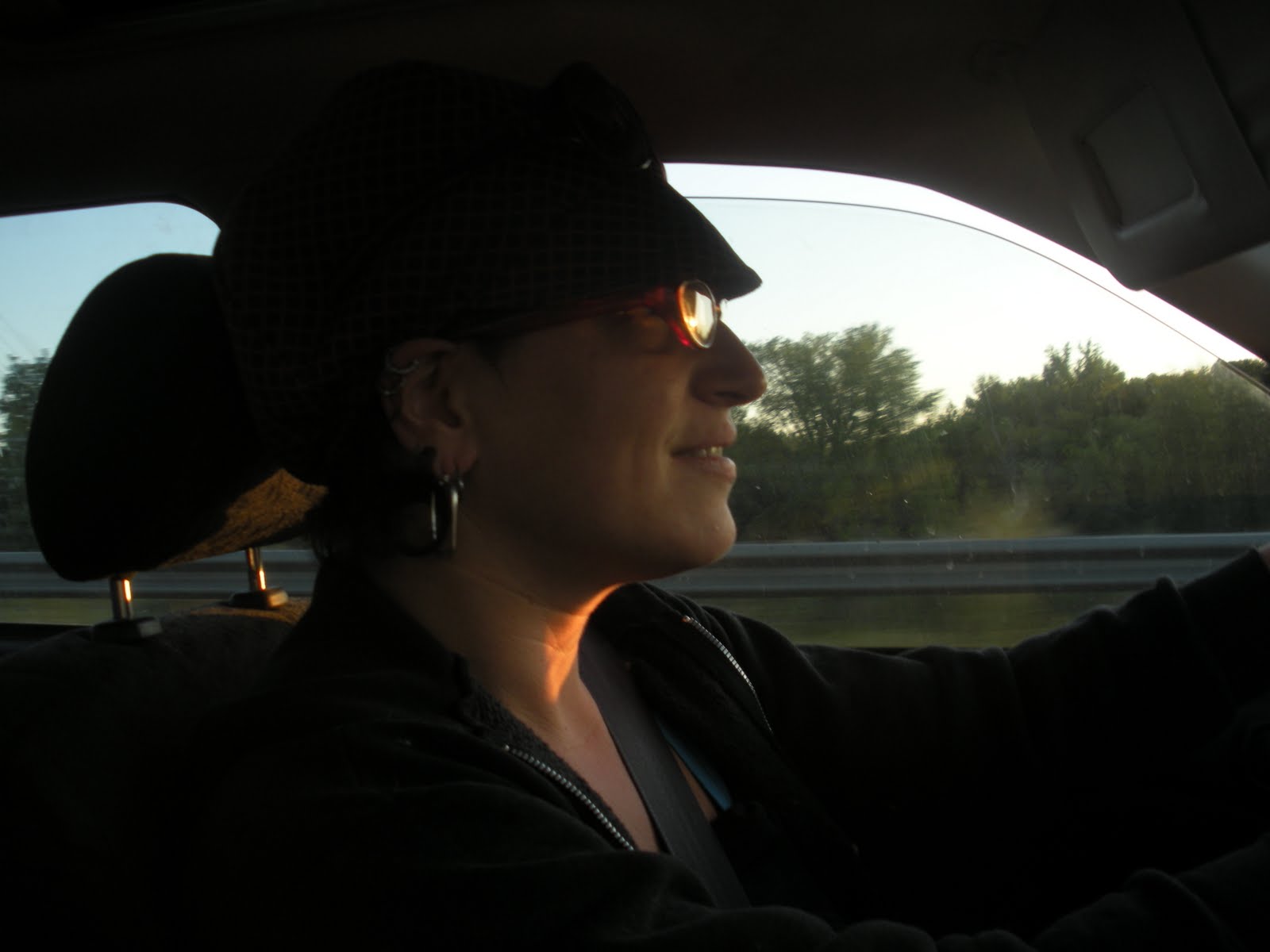
And then the sun showed up.

And we love the sun.

When we saw this, we knew Montpelier loved us.

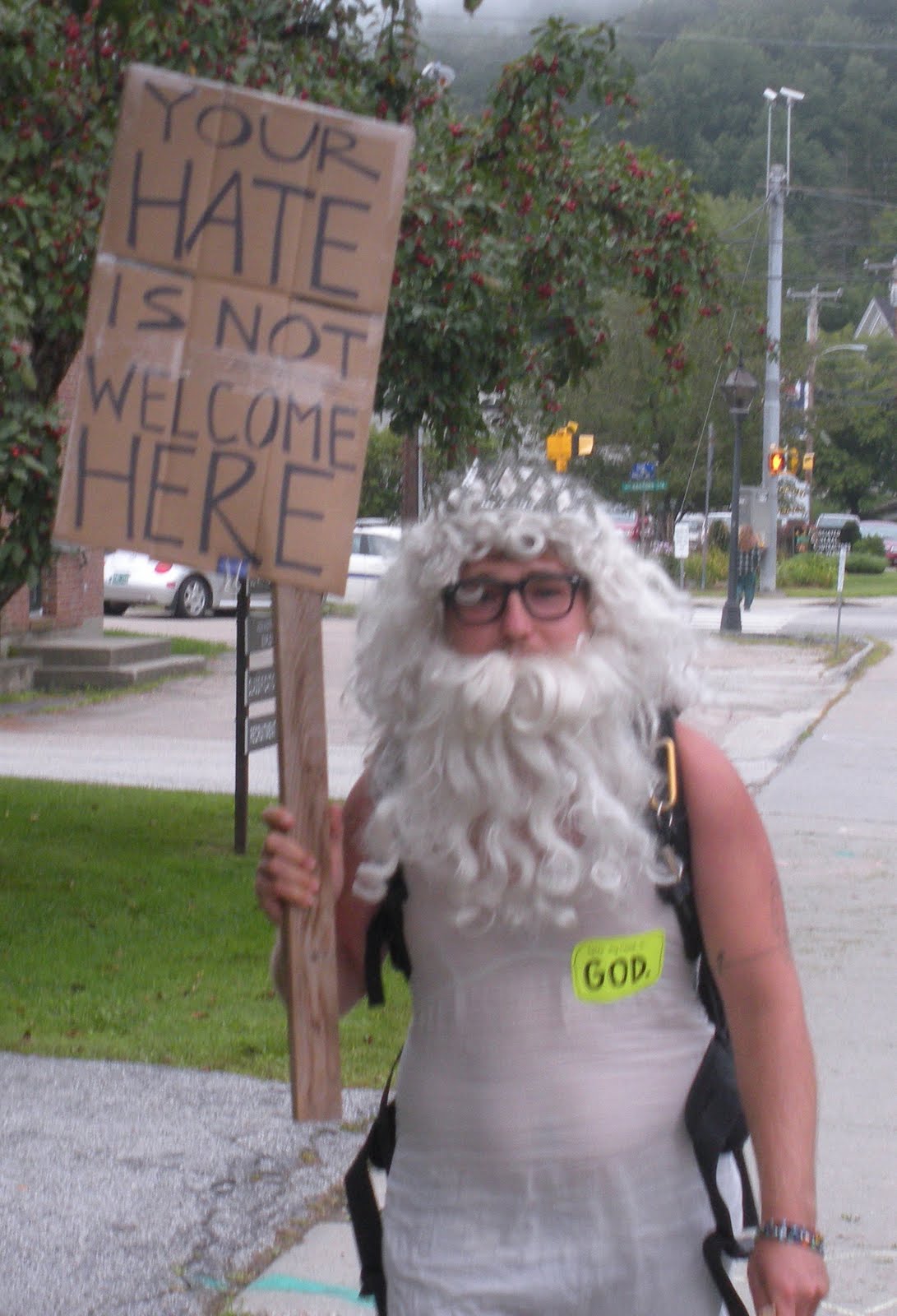
And God loves Anne.

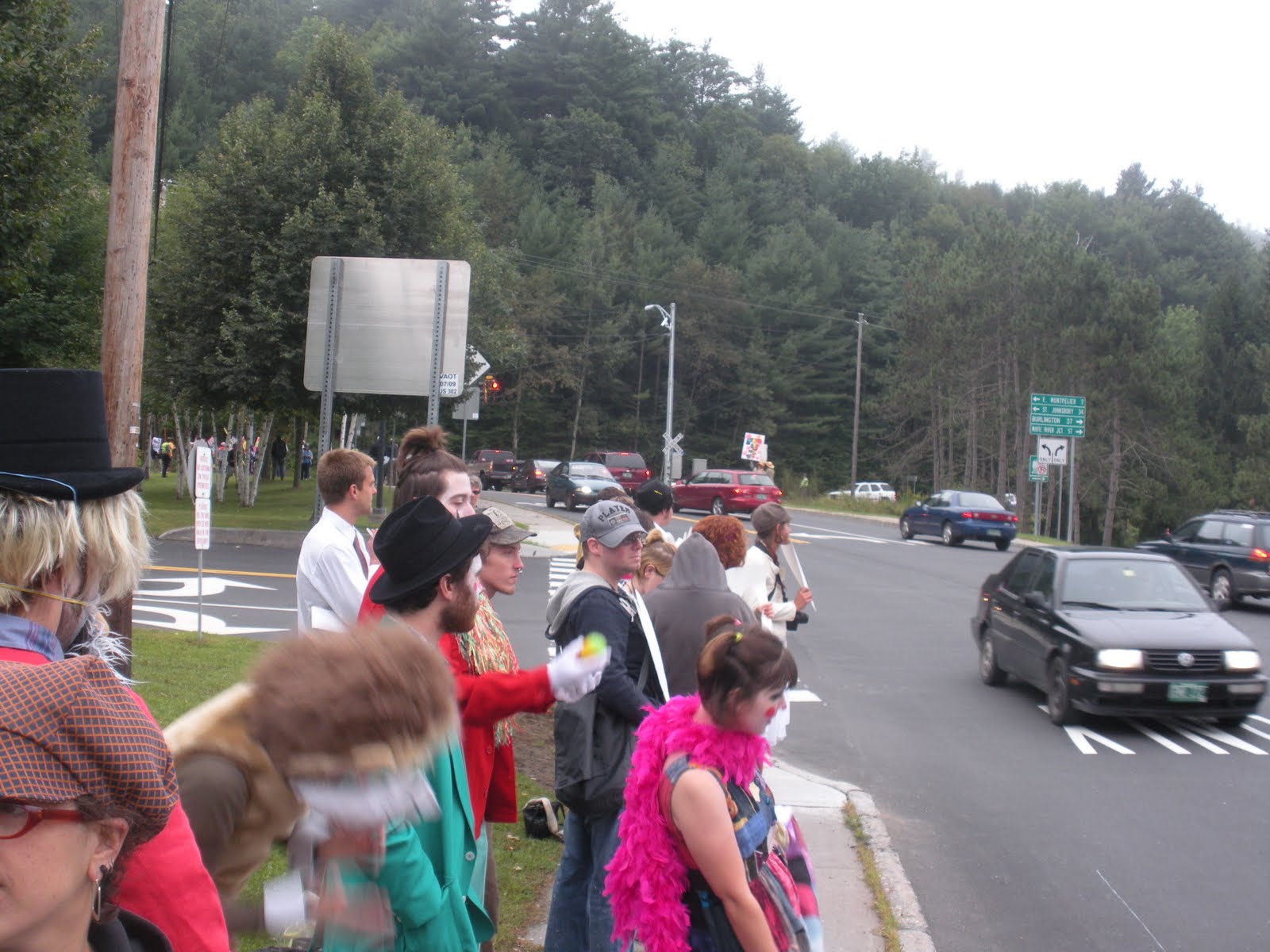
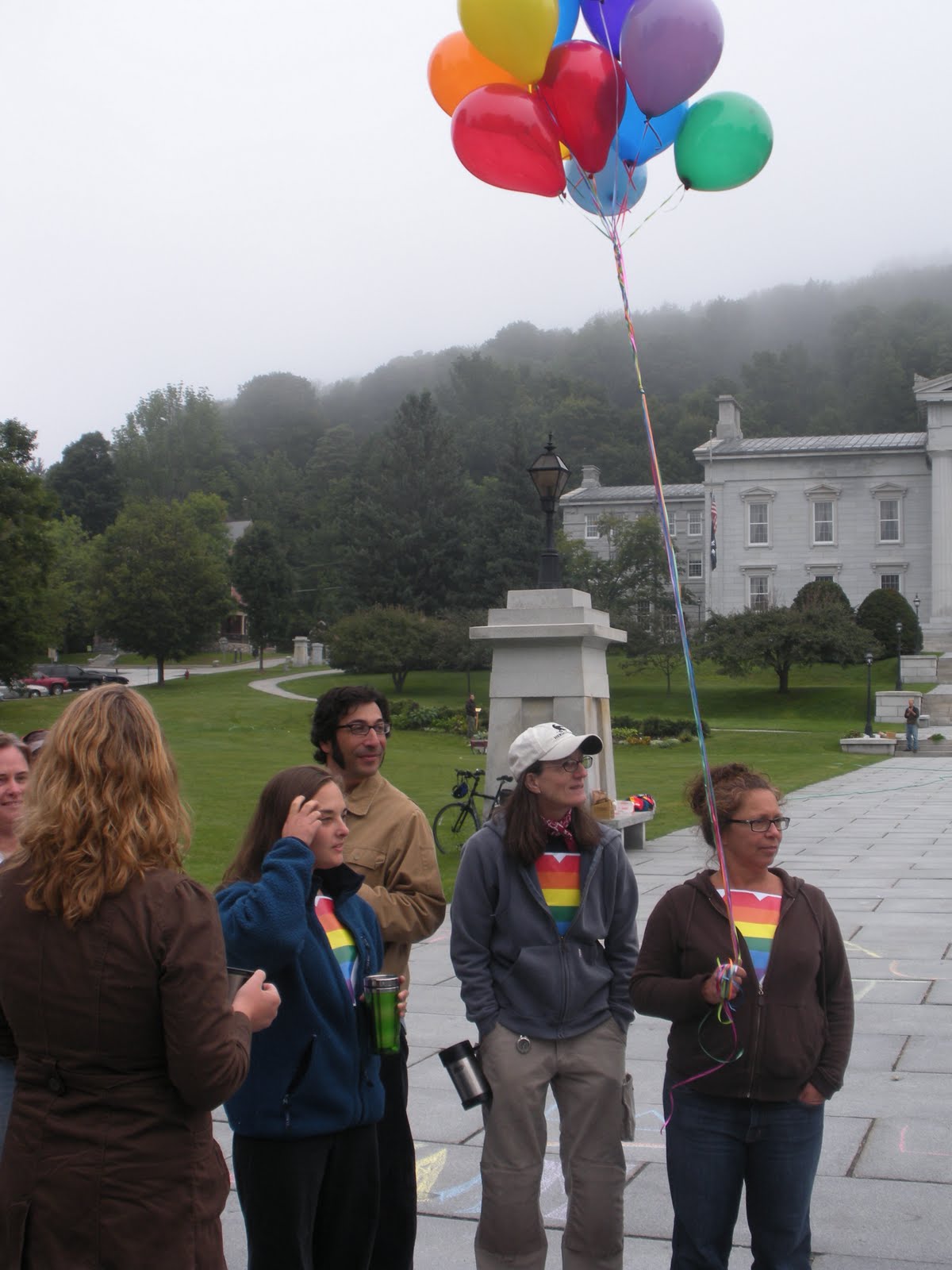
And other people showed up …

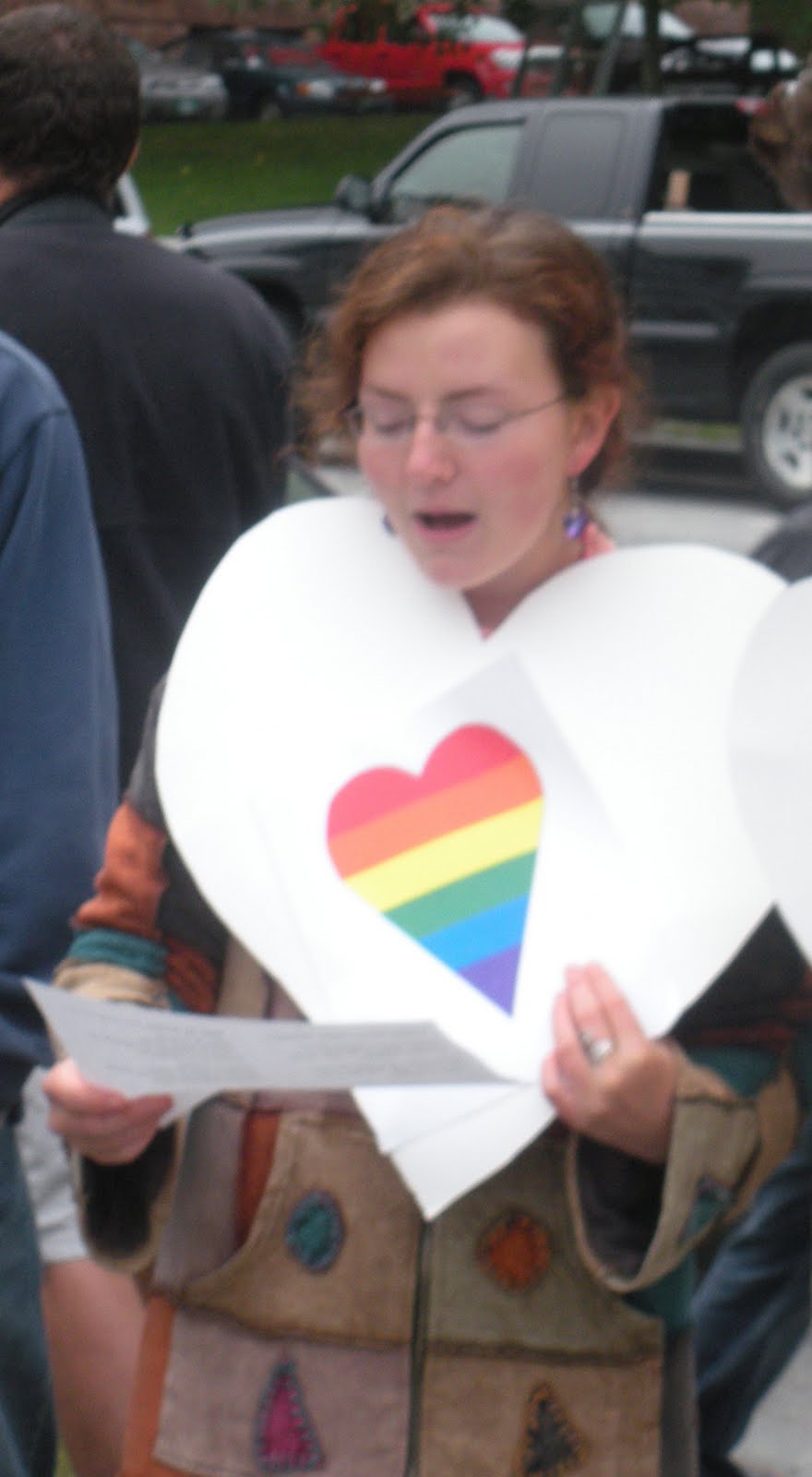
… to show their love.

And this guy loved the shirt right off of his back.

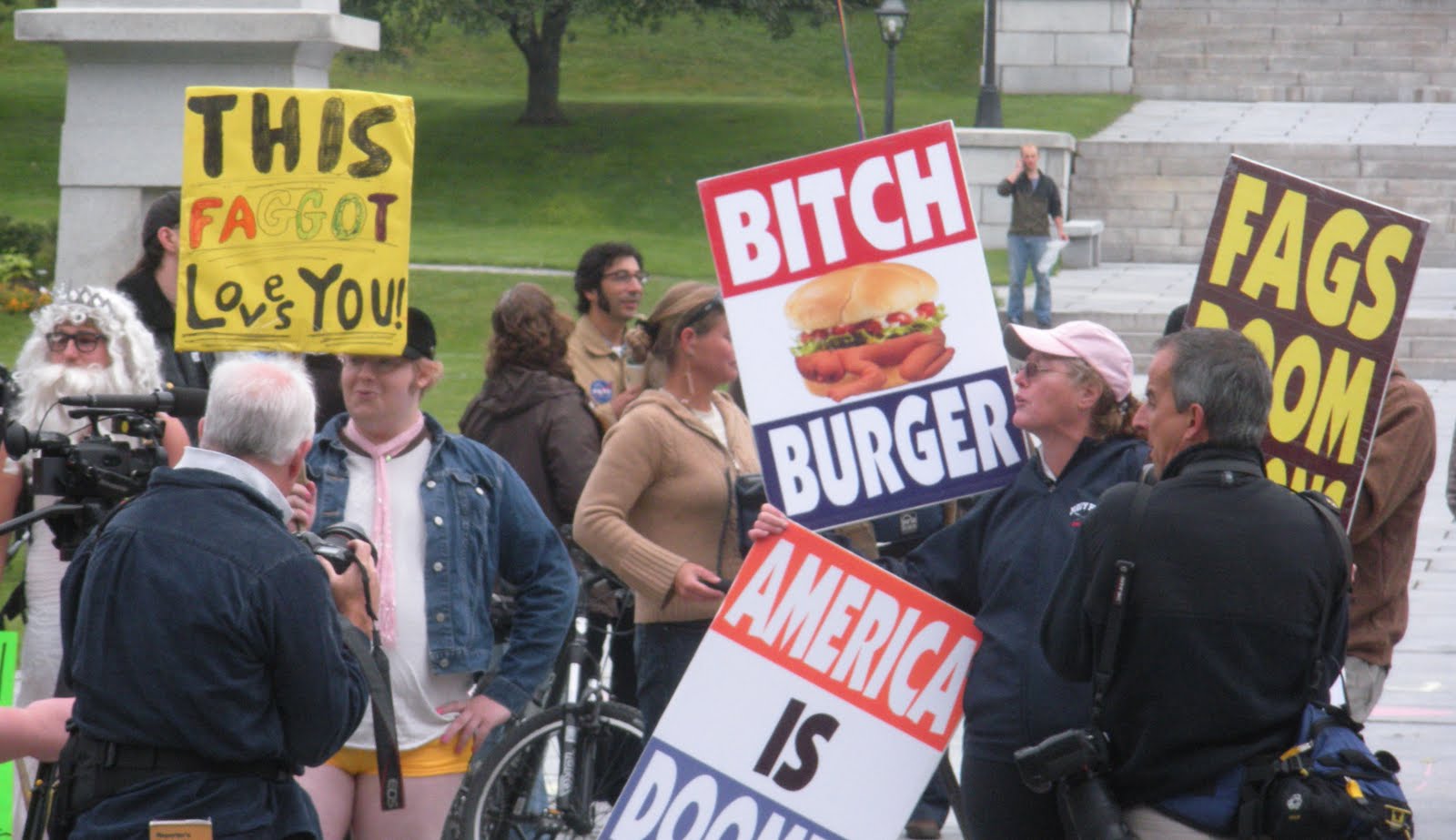
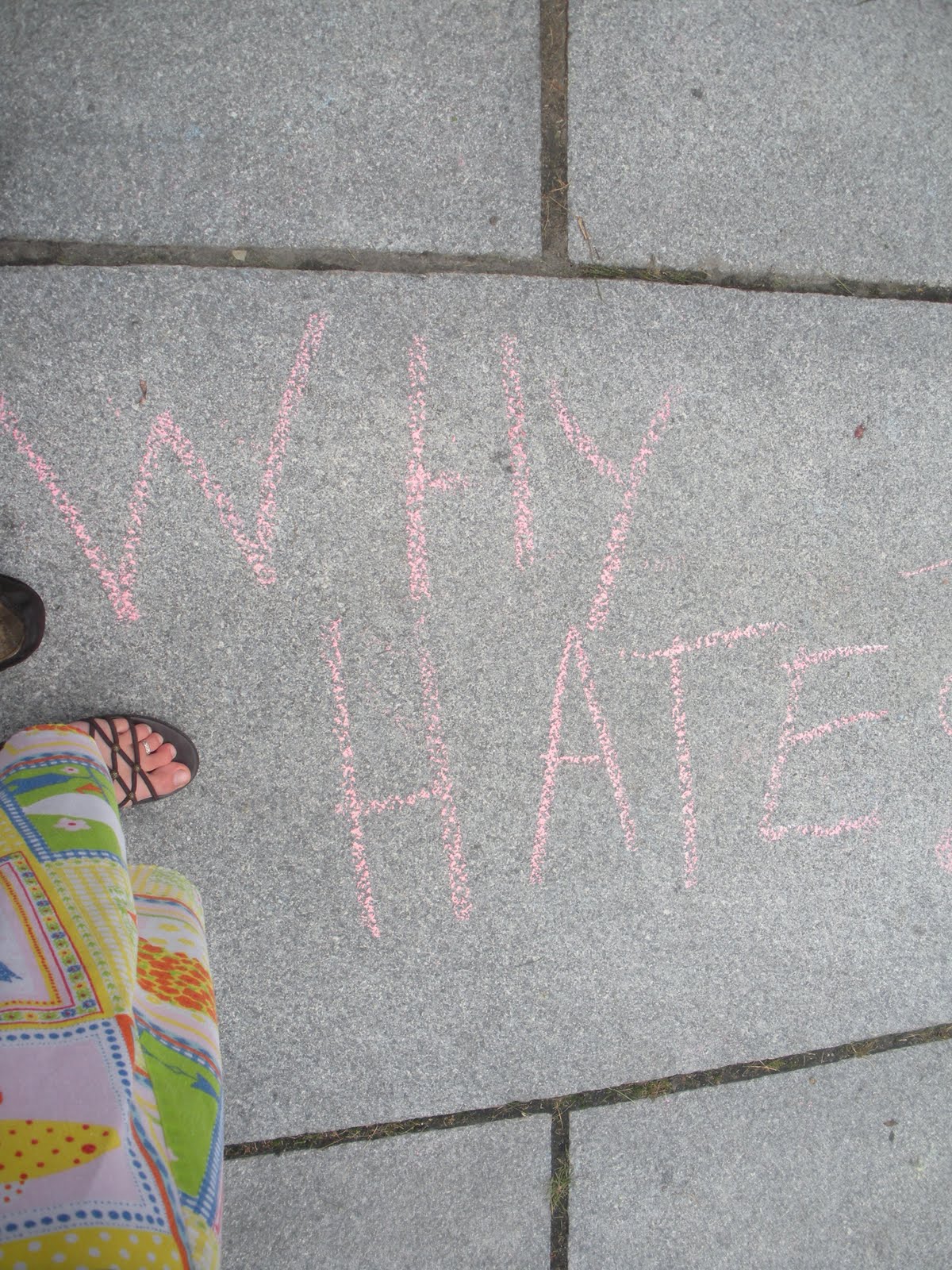
And then the hate came.

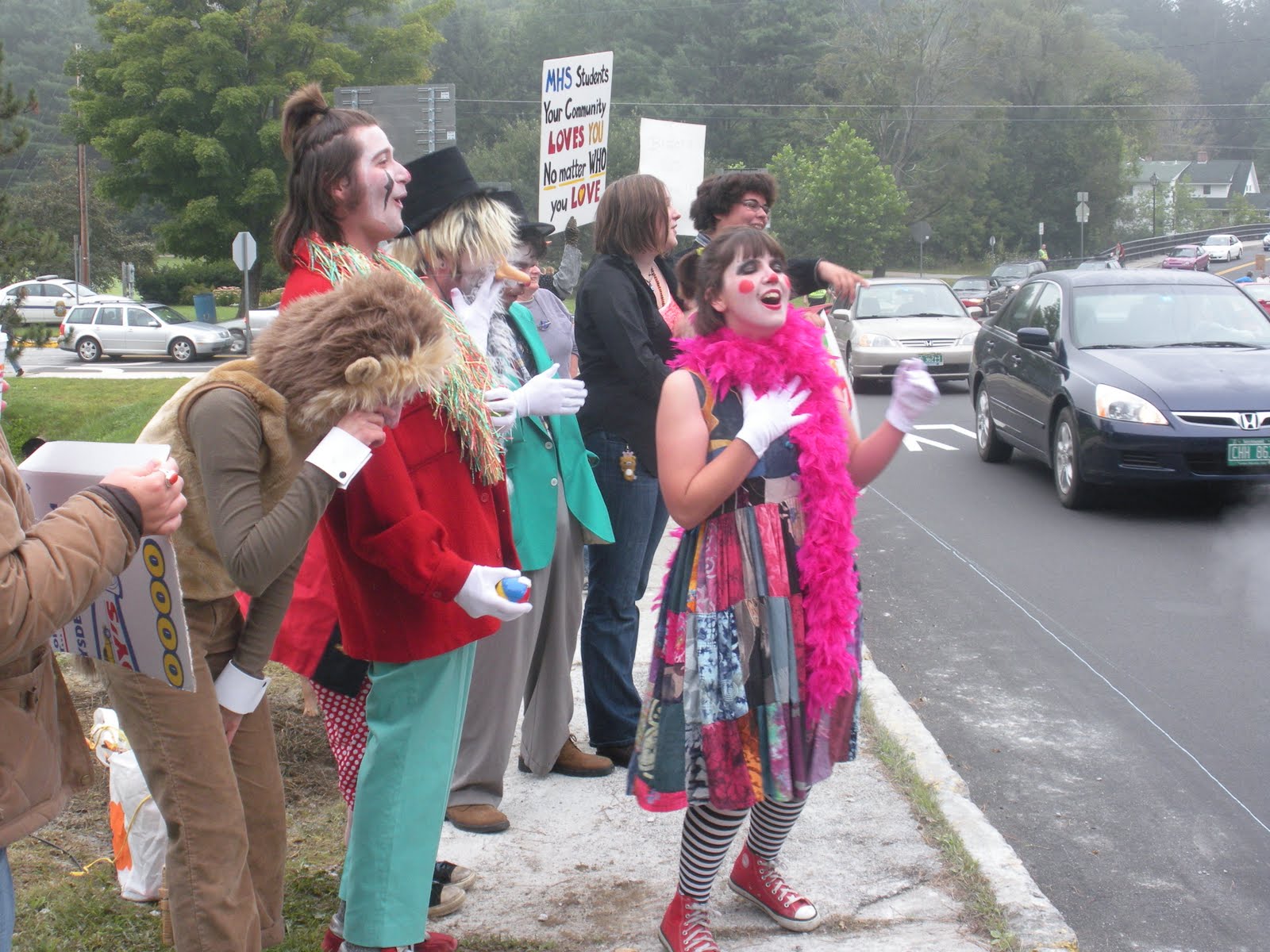
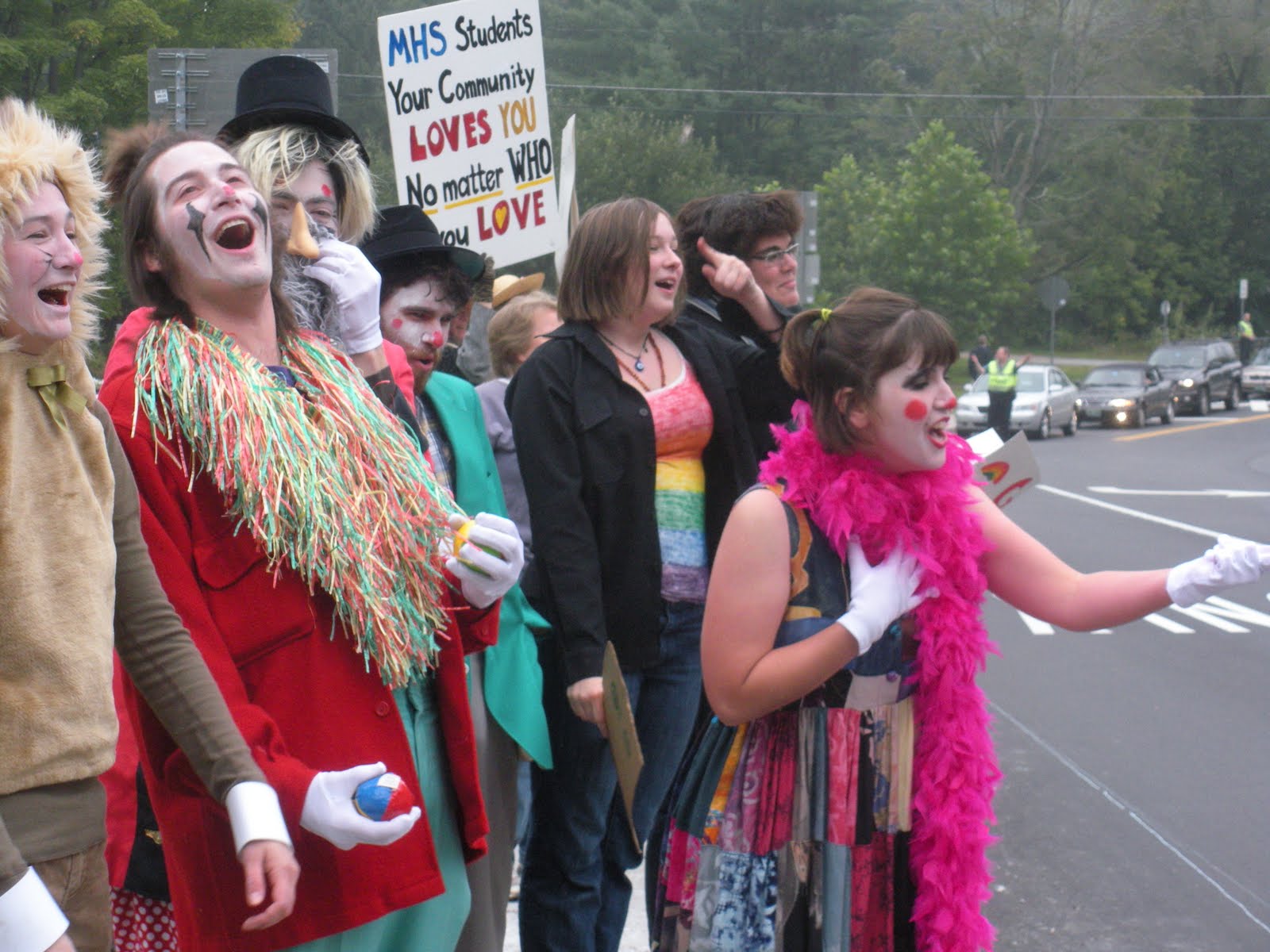
But that didn’t stop the love.

And love laughed …

… and laughed …

… because hate is no match for love …

… and because the joke was on hate.

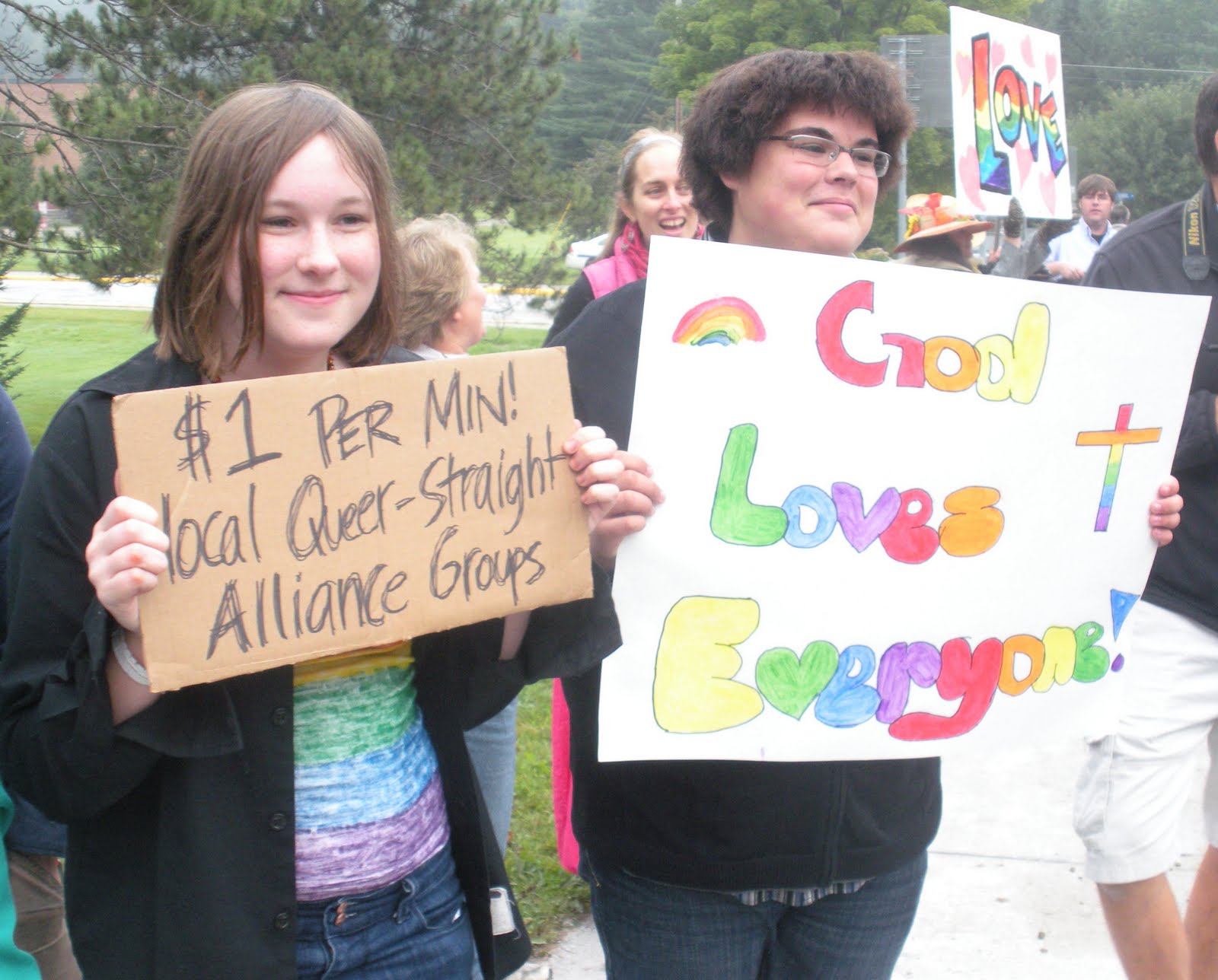
You see, every minute they hated, love raised money. (For more information, see the Facebook group Westboro Baptist Church Hates, Montpelier High School Donates.)

And raise money they did!

Even God helped.

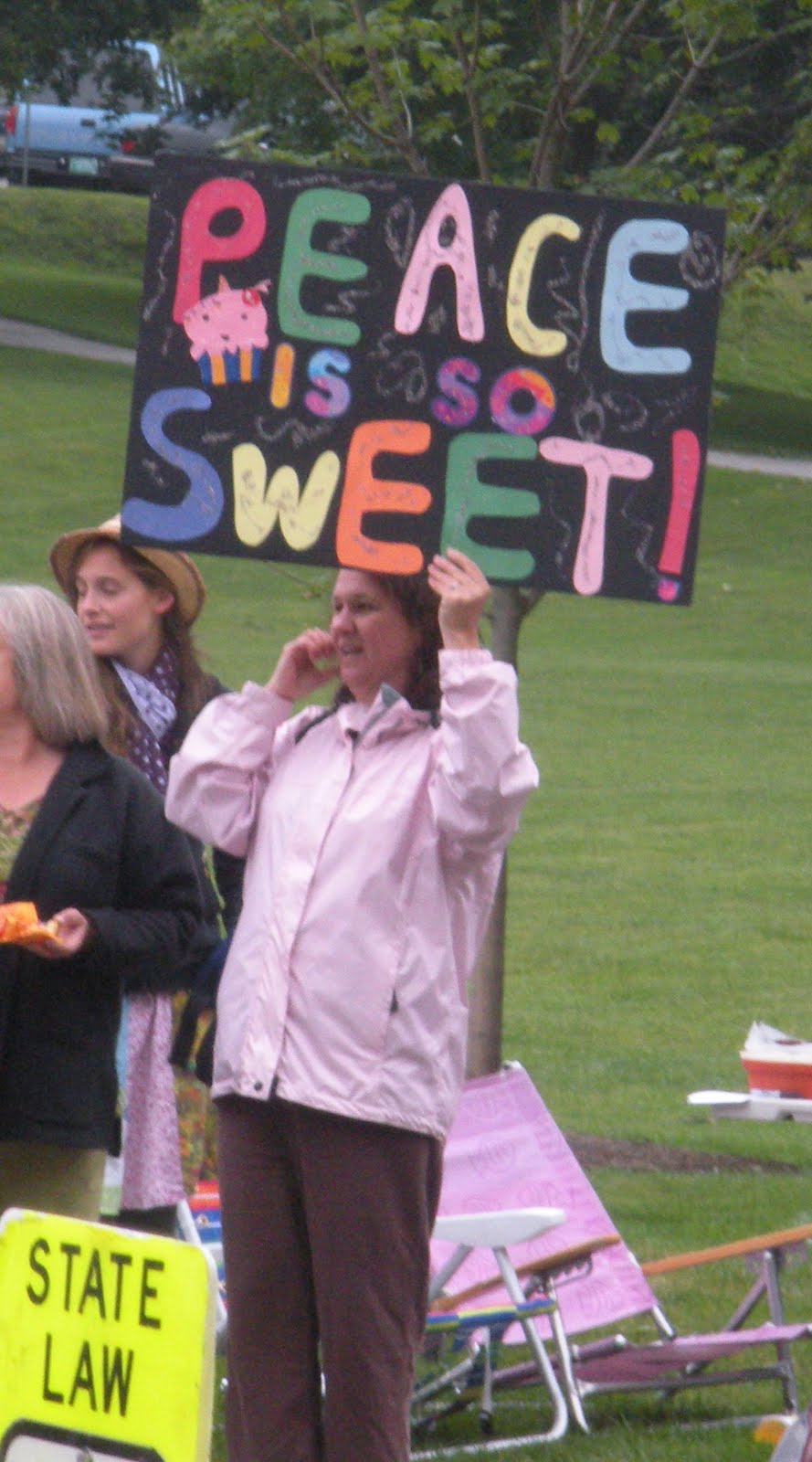
And so did Peace.

And hate kept hating.

And we kept loving …

… even when it would have been easy not to.

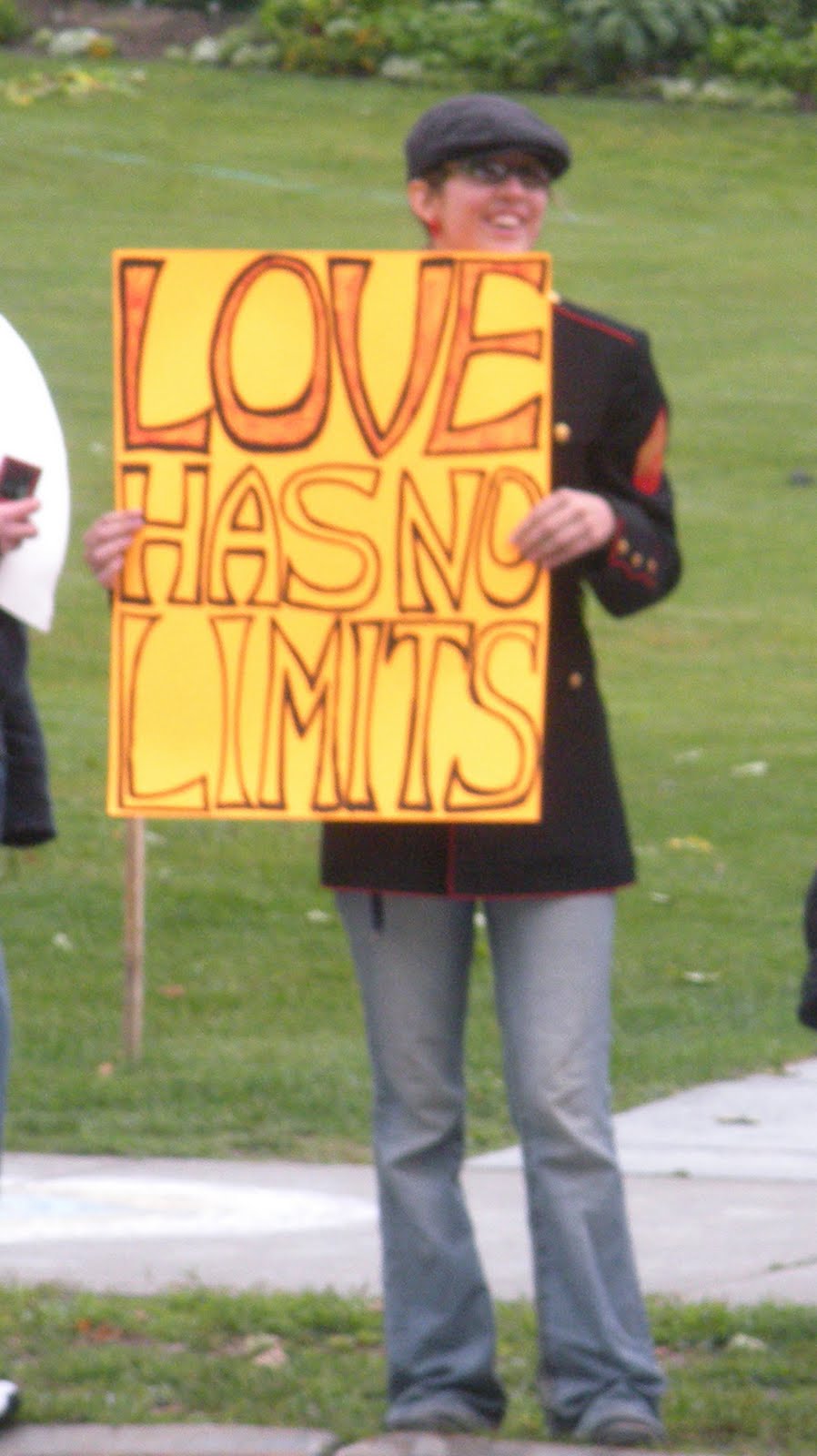
Because love has no limits.

Not even in the eyes of the law.

So we honked for love.

And we sang for love.

And we flew balloons for love.

And they kept on hating.

And we saw their hate …

… and raised them peace.

And because of this …

… we prayed for them …

… and kept on loving.

Because why hate …

… when you can smile?

Our love is divine …

… no matter what they say.

And we walked proudly …

… around town.

Wherever hate went …

… love followed

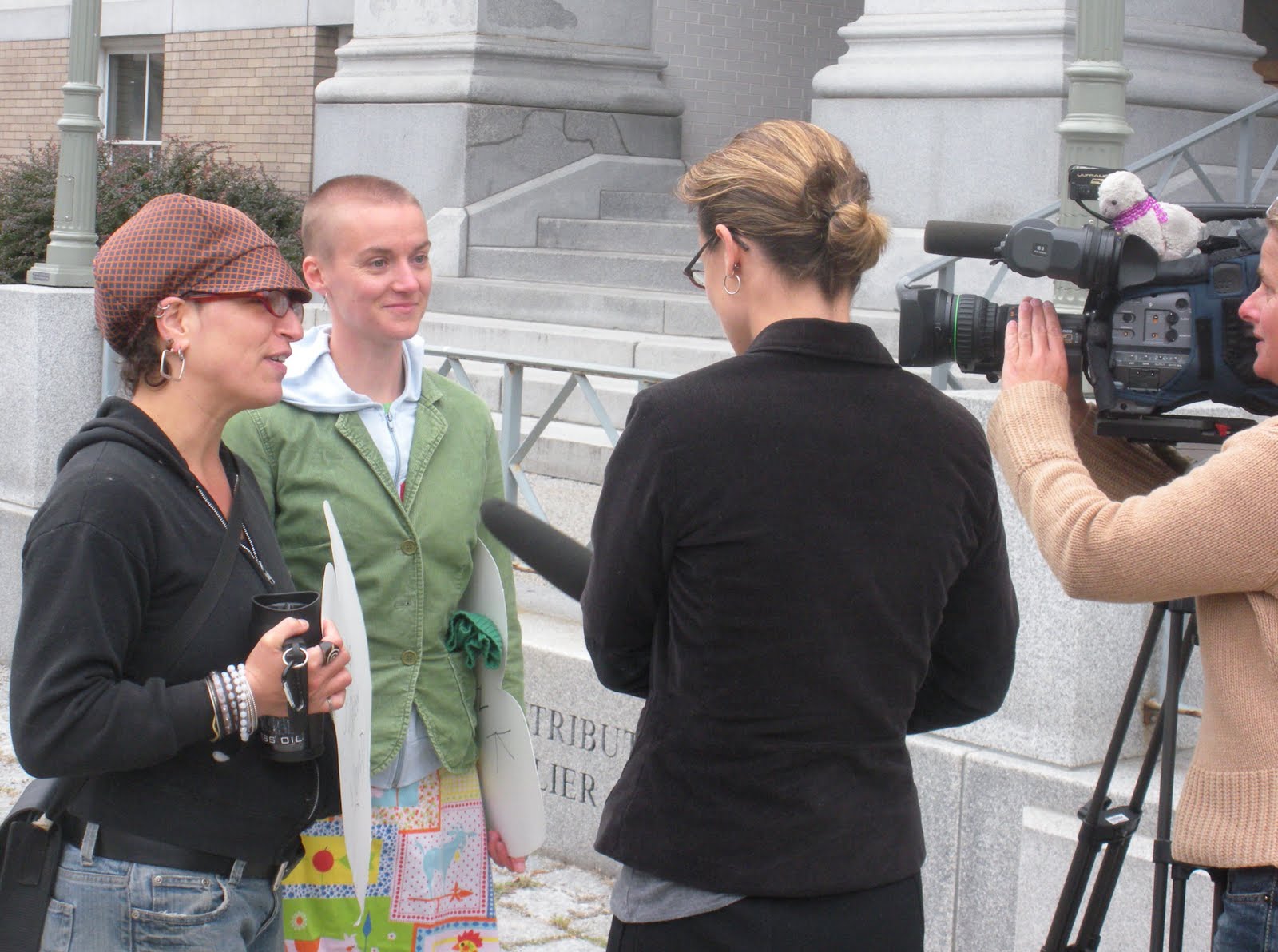
(and the media).

And as much as hate tried …

… love was right …

… and strong.

And while hate disappeared …

… love burned brightly …

… on and on and on and on …

Migrate Love Story

This morning, I heard the honkings of the first geese of the season returning to their northern homes after a winter spent vacationing in the southern sun. Their appearance is one rung in the ladder that leads my community from the desolate depths of winter up and out to our long-awaited Vermont summer reward. After brunch with my friend, Gina, I ventured downtown to Uncommon Migrate Love StoryGrounds, navigating through a flock of college kids who had migrated down the hill after a winter spent in their dorms. I even saw the obligatory fraternity brother wearing his shorts approximately two weeks too early, which is yet another rung in that ladder.

I’m now sitting in the back of the coffee shop at a table at which, 6 years earlier, I awkwardly made conversation with a blind date. The blind date didn’t lead to anything (as was often the case back then in that infamous 2003) except a string of more blind dates at other Burlington establishments. In fact, if hard-pressed, I’m sure I could think of a date for 90% of the restaurants, bars, theatres, parks, and barns in the area. Let’s face it: the longer you live somewhere, the easier it is for you to find the remains of past heartaches splattered like graffiti love poems on the walls of businesses. If you add in the heartaches of all of your friends, you’ll find every inch of town covered with the tags of exes.

Migrate Love StoryLast summer, while she and I were experiencing our respective relationship heartaches, Sarah the L and I noticed what seemed to be a trend in our generation: all around us (i.e., friends, relatives, coworkers, friends of friends, new roommates, etc.), couples were breaking up. Even Ms. Darling and I bonded over our respective break-ups. There was no overlooking it; the Summer of 2008 was the Summer of Lovesickness. I asked Sarah the L recently if she had any theories as to why this happened. Jokingly (I think), she blamed Barack Obama. She said in a “year riddled with messages of ‘change’ and ‘hope,’” … people couldn’t help but wonder if they should upgrade their Bush for an Obama. She also thought the Summer of Lovesickness could be explained by a person’s reasonable tendency to respond to a friend’s “personal growth through trial” by reflecting on needed growth in his/her own life. Humans are impressionable creatures and for the same reasons a floor of college girls ends up on the same menstrual cycle by the end of a semester, a group of close friends most likely travels similar emotional-growth routes.

I posed this question to Sarah after a quick glimpse at an ex’s Facebook page (you do it, too) confirmed what I had long-before assumed: Hypothetical was now married (thus making her boyfriend’s Hypothetical now her husband’s Factual) and consequently, had become yet another in a long line of exes who had married the first serious boyfriend she dated after me (an ever-expanding sorority of women that also includes Widget, The Redhead, Stalker Girl, and The PT [it’s also worth noting that San Fran Girl and I never officially dated, but after our falling-out, she started dating the man to whom she’s now engaged]). This confirmed my long-standing belief that at some point in my life I had become Penultimate Man, the noble super-hero doomed to a life of boosting various women’s self esteems just enough for them to spread their wings and fly off to their future husbands. Considering I boosted Ms. Darling’s self esteem before sending her back to her stripper-loving ex, I wouldn’t be surprised if she got engaged to him within the year.

After spending a day contemplating my curse (aka, my exgirlfriends’ blessing), I asked Sarah what she thought it would take to become Ultimate Man. She wasn’t entirely sure because she has been dealing with similar demons, but she hoped one day soon she could rip open her shirt to show the world the blaze of UW (Ultimate Woman) across her chest, thus confirming my long-standing belief that she’s an exhibitionist.

Because I’m convinced that it is the perfect metaphor for every situation in life (including concerns about one’s penultimate tendencies), I’m yet again reminded of rock climbing. I haven’t talked about my adventures with rock climbing recently because after steadily improving for two months, my climbing skills have frustratingly hit a plateau. I should have known my progress would eventually decelerate: I have a history of excelling at a learned skill (e.g., guitar playing; mathematics; chess) only to reach my natural limit beyond which I can’t improve without prolonged resolute training, something my Benchly-of-Many-Skills, Master-of-None will-power has prohibited me from ever accomplishing. I’m determined to excel at this sport, though, and so I’m doing the only things in my control to ensure that that happens: consistent practice, and learning from other climbers. And as I direct my climbing questions to more experienced climbers, because I’m terrified of being Penultimate Man forever, I pose my relationship questions to my friends.

In addition to Sarah, I solicited love advice from CP and she responded with disbelief that I had asked her; she doesn’t consider herself an expert on relationships, though, she noted, her relationship had thus far survived 10 years. But truthfully, as much time as Sarah and I spend pondering how to keep love afloat, and as painfully educational as our break-ups have been, and as much success as CP has had at cultivating her love, and as much unsolicited Migrate Love Storyadvice as I’ve received in the last year, I honestly don’t think any of us have any idea of how to succeed at love with or without really trying. If you think I’m wrong, just look at our society’s divorce rates.

Uncommon Grounds is closing soon and I’m afraid, my dear readers (read: reader), that I don’t have an answer for you. I wonder if I ever will. And as I prepare to venture home against a gorgeous sunset backdrop (with views like this, can you blame the geese for coming back each spring?) while being serenaded with the sounds of college kids and geese, a bird that spends the majority of its life devoted to its “mate for life,” I can’t help but wonder if maybe I’m just looking for the answers in the wrong place.


What do we do now?

A week after Election Day, the BBGE gathered at The Dean’s house to discuss Cormac McCarthy’s The Road, the fictional tale of a father and son trying to survive in a post-apocalyptic world. Some sort of event happened an unspecified amount of time prior to the events described in the book, and resulted in the father and son wandering along a road in a desolate world, desperately searching for their next meal. The story takes place over a few months, and through the book’s format, which is essentially one long chapter broken down into short, mostly-chronological anecdotes, the reader can’t help but feel as if he/she is walking on the road alongside the protagonists, living each day as if it might be the last. Through McCarthy’s borderline-monotonous-and-consequently-effective descriptions, it becomes extremely easy to empathize with the characters and the dire situation in which they find themselves. This book affected me by making me believe such a reality was possible, and by forcing me to wonder how I would handle such a dramatic life change. (We all know how much I love change.)

Considering that the recent presidential election was on the liberal minds of all BBGE members, it was surprising when no one wondered aloud who was running the country when this fictional apocalypse occurred. What was not surprising, however, was how quickly any of our conversations that night quickly transitioned into discussions on said election. As you probably imagined, like the majority of my fellow Vermonters, I celebrated Barack Obama’s victory on Election Night, and like quite a few of those same Vermonters, I stayed up late to hear his speech; a speech and a moment that nearly led me to tears. I discovered that among my fellow BBGE members, I was not alone. Obama was an historic candidate on so many different levels and his campaign slogan “Change we can believe in,” though awkwardly phrased, had inspired all of us nonetheless. And with 53% of the national vote, it could be argued that this country mandated that January 20, 2009 be a day of change. Whatever that vague change may be is still undecided.

While President-Elect Obama prepares to transition into the Oval Office of Change, we the voters return to our everyday lives with our everyday problems. The Professor remarked that, like so many others, she felt the symptoms of election withdrawal: the emptiness that can suffocate you when, after an 18-month election season, the need to check election polls and view SNL videos and discuss political gaffes has quickly vanished and been replaced by the realization that as historic as this moment was, none of your problems have disappeared. And it’s in this moment that I’m reminded of the underrated 1972 film The Candidate, starring Robert Redford as Bill McKay, a 30-something son of a California governor hand-picked to lose a Senate election against the popular Republican incumbent. After surviving and thriving in a primary, a debate, and a tiring election campaign, McKay surprisingly wins a close election and responds by asking his advisors, “what do we do now?” In one of my favorite movie endings, the film ends without McKay ever receiving an answer. And I imagine that that’s kind of how this country is feeling right now.

A NY Times critic said it felt as if The Candidate “had been put together by people who had given up hope.” I think it could be argued that Obama’s campaign was so successful because it was aimed at inspiring the very same kinds of people capable of making such a film. After living so many years desperate to believe in a candidate, voters were ecstatic when they finally found someone about whom they didn’t have to make excuses. Gone were the days of “he’s great, but,” and “I like what he says, but,” and “sure, he has the same values, but,” and in their place stood the realization that for the first time in their adult lives, they were face to face with someone in whom they could finally believe. Their Mr. Right, if you will. “He’s great,” without adding a “but.”

But “what do we do now?” When people get what they want, they often wind up wanting more. Who knows why really? Faced with an uphill struggle against two wars, a faltering economy, a record deficit, and hardly any national pride, my guess is no president could achieve instant results, no matter how Mr. Right he/she was, and so I’m curious to see how long the country gives Obama before they start giving up on him. And equally important is how Obama will respond if they do.

But I think that despite this country’s recent history of picking the wrong guy, she finally nabbed the right one this time. And I have hope that he will pass her tests with flying colors. I have to have hope. Because as great as Cormac McCarthy’s story was, no one wants to walk down a road alone.


Benchly’sleeve

As Papa Benchly’s and my checkbook will confirm, nine years ago, I purchased four years of education at the University Whose Name Shall Never Be Said. And though I was paying for the classes, I found most of my education outside the classroom. While a student there, I wrote a newspaper column that often critiqued the university, its people, its departments, and its policies. And though I admit that the column was borne out of contempt for the university, I gradually found myself writing words that I hoped would help positively change the university (while maintaining my often sarcastic tone, of course). In a sense, I was seeking change I could believe in. But as President-Elect Obama and his supporters know far too well, when you criticize something, even if it’s something you love, often times the response is essentially, “if you don’t like it here, leave,” and criticism is most certainly what I received, even in the form of threats (unless, of course, those five fraternity brothers who showed up at my apartment were telling the truth when they claimed they only wanted to talk).

It was in dealing with negative responses to my newspaper column that I learned a valuable lesson in journalism: a journalist should respond to criticism only when there’s a gross misstatement of fact, when questions have been asked of the publication, or when the criticism needs some sort of clarification, lest the journalist risk alienating his/her readers with a most-likely never-ending argument/contest of who can have the last word. Most importantly, the very same freedom of speech that allows journalists and bloggers the opportunity to speak their mind must provide the same blanket of protection and opportunity for those who raise their voice in disagreement. And so, nine years later, these are the thoughts that are on my mind as I sit here and contemplate what, if anything, to do about the recent feedback hand I’ve been dealt on this very blog.

As my reader(s) most likely know, my last blog entry had the honor of receiving not one, but three comments from my fans (just about doubling my fan base), two of which from “Anonymous” could be classified as “Constructive Feedback.” (The other, authored by Ms. Darling, I’ve filed under “Obligatory Adoration.”) For the technologically savvy (read: those who can operate a mouse), I’ve included a link to these comments so that Anonymous’s words can speak for themselves.

For the technologically challenged, I’ll briefly summarize them here: Anonymous was concerned that my written words might be harmful; that good communication required listening, which became difficult when communicating in writing; that if I wasn’t open to stepping out of my comfort zone to listen to what others had to say, it would be because I was afraid to hear criticism or I was simply self-centered; and that if I stopped hiding behind my words, I’d be better off for it. A few days later, Ms. Darling’s sweet (pun intended) blog entry about me received another Anonymous posting, which seemed to be related (pun not quite unintended): “Be kind, and remember that while a second or third life can be lived online, you are still left with the first.”

I have no way of knowing if the comments from Anonymous #1 and Anonymous #2 are related, but for the purpose of this blog, I’m going to pretend that they are. And though I have a hunch that Anonymous #1 wasn’t responding to my blog but rather to my actions and/or inactions in my “first life,” since she claimed to be “offering a response to some of [my] musings,” I’ll treat her comments as such. With that in mind, it seems to me that the argument being made here is that there is a time and a place for a blog, and that maybe Ms. Darling and I have crossed that fine line by speaking openly about our recent dating adventure/challenge, which has occurred fairly close (some would consider too close) in time to our previous relationships. I’m going to resist the temptation to debate who is right and who is wrong; with such an ever-changing technological world, I think even Emily Post would have trouble finding her social etiquette footing. What I will do instead is offer up for your consideration and clarification my brief (read: non-Benchly-like) philosophy on blogging:

When I first started blogging back at the obviously-trademark-infringed,-though-cleverly-named-nonetheless The Continuing Story of Bungalow Benchly, I had a discussion with Ms. Parker about how personal one’s blog entries should be. I don’t remember her opinion on the matter (I think she said if it was meant for your journal under your bed, it shouldn’t be in your blog), but I remember mine as it’s one I’ve tried to maintain to this day: I want to write only about what I would feel comfortable discussing face-to-face with anyone tomorrow. My aim has been to express the same respectful honesty in my happy-ever-after blogs as can be found in my heart-broken-again ones. And though, admittedly, a few of my blog tirades crossed a line (the snoring banishment episode comes to mind), I think for the most part I’ve done a great job. I may be a screenname as I post this, but as Anonymous #2 pointed out, I’m human first and foremost, and so it’s no surprise that I’ve made some blogging mistakes. At the very least, I can say that they’ve been genuine ones with honest intentions.

So to Anonymous #1 and Anonymous #2, thank you for your feedback. I appreciate that you’ve taken the time to read my blog and to consider all that I have to say. And I hope that you continue to do so. If you do, I promise you that what you will find is what you’ve always found: an honest, sensitive, and respectful portrayal of my feelings about my life and the world and people around me. Like my wet sleeves in my “first life,” I wear my emotions in my second life here on my blog. If I’m happy, if I’m sad, if I’m heartbroken, or if I’ve met an amazing woman and am hopeful that things will work out for us in the end, you can rest asssured that you’ll read it here, either boldly stated, or somewhere between the lines.